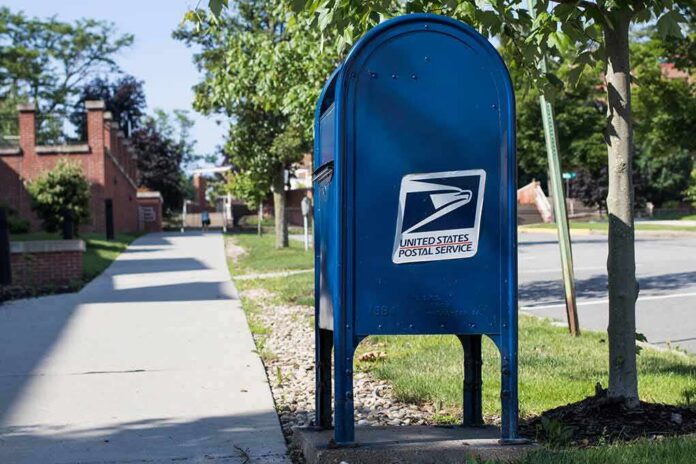
At the heart of the current fight over President Trump’s mail‑ballot executive order is a simple but far‑reaching question: can the federal executive branch, working through the U.S. Postal Service, effectively condition the delivery of mail ballots on states turning over voter rolls for federal citizenship checks, or does that move collide with the Constitution’s allocation of election authority to Congress and the states.
At a Glance
- The D.C. Circuit has allowed USPS to move forward with a proposed rule tied to Trump’s 2026 executive order, but only on a temporary, procedural basis.
- Multiple district courts have already blocked core parts of the order and related USPS directives as unconstitutional overreach and in conflict with prior USPS settlement obligations.
- The proposal depends heavily on federal databases such as SAVE, which courts and analysts have criticized as incomplete, error‑prone, and legally problematic for bulk voter screening.
- For the 2026 midterms, the real battlefield is whether these rules ever become final, survive the ongoing constitutional challenges, and can be reconciled with state control over election administration.
The Architecture of Trump’s Mail‑Ballot Executive Order
Executive Order 14399, signed on March 31, 2026, is best understood as an attempt to reorganize the machinery of mail voting around federal citizenship verification. The order directs the Department of Homeland Security, the Social Security Administration, and the U.S. Postal Service to collaborate in building state‑specific “citizenship lists” and to use those lists to govern who may receive a mail‑in or absentee ballot in federal elections. At the operational level, the order requires states to submit detailed manifests—names, addresses, and unique barcode identifiers for each voter who will receive a mail ballot—at least 60 days before a federal election. Those manifests become the backbone of a system in which USPS verifies ballot eligibility against federal‑state data, tracks individual ballots via “intelligent mail” barcodes, and, crucially, declines to transmit ballots for voters who are not properly enrolled on the relevant list.
In that sense, the Postal Service is no longer merely a neutral carrier of election mail; if the order is fully implemented, it becomes a gatekeeper, refusing to deliver ballots in states that do not share voter data or adopt the specified ballot design and tracking standards. The order also pushes enforcement beyond logistics. It instructs the Department of Justice to prioritize prosecutions of election officials and even mail carriers who deliver ballots to “ineligible” voters, and contemplates conditioning federal election funds on the adoption of documentary citizenship proof requirements. The ambition is clear: centralize eligibility verification for mail voting in federal hands, and build legal pressure on states and local officials to comply.
What the Proposed USPS Rule Actually Does—and Does Not Yet Do
USPS has responded with a proposed rule that closely tracks the executive order’s requirements. The draft regulation would require states that want USPS to deliver mail‑in and absentee ballots for federal elections to provide lists of all voters scheduled to receive such ballots, and would instruct postal employees to verify each ballot against those lists before delivery. For non‑compliant states—those that refuse to submit the data or to adopt the prescribed ballot standards—the agency has been explicit: Postmaster General David Steiner told Congress that USPS “will not deliver” mail‑in and absentee ballots in any state that refuses to comply.
Two legal features of this rule matter enormously. First, it is still in proposed form. Time’s reporting and USPS’s own rulemaking notice make clear that the rule must run the full Administrative Procedure Act gauntlet—public comment, possible revision, and formal adoption—before it becomes operative. Public comments on the proposal are open into early July 2026, and until USPS issues a final rule with an effective date, the legal obligations it describes remain contingent and subject to change. Second, the rule expressly leaves states responsible for determining who belongs on the lists they submit; USPS’s internal documents say postal staff “would not verify whether individuals should or should not be included” on a state’s mail‑ballot participation list, only whether a given ballot matches a listed voter. That structure is designed to answer a common objection—that the federal government is dictating who may vote—but it still gives USPS an unprecedented role in deciding which ballots get delivered at all.
The D.C. Circuit’s Stay: A Procedural Win, Not Substantive Vindication
The D.C. Circuit’s recent order, which has been framed in some outlets as a sweeping “victory” for Trump’s election integrity agenda, is significantly narrower once one reads the underlying reasoning. In that case, a district court had enjoined USPS from implementing the proposed rule on the ground that it violated a 2021 settlement agreement with the NAACP that obligated the Postal Service to prioritize the timely delivery of election mail through 2028. The appellate panel granted USPS’s request to stay that injunction. In doing so, the court emphasized two points: the challenge appeared premature because it targeted a proposed, not final, rule; and even if the rule were adopted in its current form, it was “likely” not to conflict with the NAACP settlement’s terms.
This distinction between procedural posture and substantive legality is critical. A stay means the injunction is paused while the appeal proceeds; it does not mean the rule has been upheld on the merits, nor that the executive order underpinning it has been deemed constitutional. The panel’s likelihood‑of‑success assessment was narrowly focused on whether the NAACP agreement itself barred USPS from considering ballot eligibility in its mail handling, and the court took pains to note that broader constitutional challenges remained live in other litigation. Judge Carl Nichols, in a separate district court case brought by several states, similarly declined to issue a preliminary injunction—not because he endorsed the order’s constitutionality, but because the plaintiffs had not yet demonstrated the kind of immediate, irreparable harm that preliminary relief requires. Both rulings buy time for USPS and the administration; they do not settle the core structural disputes.
Constitutional Pushback: Elections Clause and Separation of Powers
On the other side of the ledger, district courts have been much more skeptical of the executive order’s legality. Judge Indira Talwani’s June 25, 2026 memorandum order, in a multistate challenge brought by 23 states, is especially blunt. Talwani concluded that EO 14399 was ultra vires—beyond the President’s lawful authority—because the Constitution “does not grant the President any specific powers over elections,” and because USPS, as an independent agency created by statute, has “no legal authority to control mail‑in voting.” That ruling blocked enforcement of key sections of the order in 24 jurisdictions, effectively carving out a substantial portion of the country from the order’s reach.
The Campaign Legal Center’s complaint in a separate D.C. case crystallizes the doctrinal argument. CLC contends that Section 3(b)(iii) of the order, which conditions ballot delivery on enrollment in a state‑specific list maintained with USPS, violates the Elections Clause by imposing a new voting requirement that neither Congress nor the state legislatures have enacted. The Clause allocates the power to regulate the “Times, Places and Manner” of federal elections to those legislatures, with Congress holding override authority; the President, by design, is absent from that allocation. Legal analysts at the Brennan Center and Brookings go further, arguing that delegating election‑critical functions to USPS—an independent agency whose leadership is insulated from direct presidential control—short‑circuits the constitutional design by using administrative levers to “usurp” what should be legislative decisions.
A separate front involves USPS’s own obligations. Judge Emmet Sullivan, presiding over a case in Washington, D.C., issued a nationwide injunction against USPS directives implementing the order, finding that they conflicted with a previous NAACP settlement that required USPS to maintain certain service levels and practices around election mail. While the D.C. Circuit has now questioned whether the new rule truly violates that settlement, Sullivan’s order underscores how the Postal Service’s unique legal status—part political creature, part regulated utility—complicates any attempt to repurpose it as an election arbiter.
The SAVE Database and the Risk of Wrongful Disenfranchisement
Technically, the citizenship verification system envisioned by the executive order depends on federal data sources that are ill‑suited to the mass voter screening role they are being asked to play. Central among them is DHS’s Systematic Alien Verification for Entitlements (SAVE) database. SAVE tracks non‑citizens who have interacted with the federal government for immigration or benefit purposes; it is not designed as a comprehensive roll of who is, and is not, a U.S. citizen.
Judge Sparkle L. Sooknanan, in litigation over the administration’s plan to run statewide voter rolls against SAVE, ruled that the program violated the Privacy Act of 1974 by aggregating sensitive personal data without the required notice to affected individuals. Election‑law analysts have also emphasized the database’s technical limitations: records for naturalized citizens are often not promptly updated, and states that have tried to use SAVE for voter eligibility checks have found substantial error rates. In Texas, for example, bulk SAVE queries flagged thousands of supposed non‑citizens on voter rolls, but local investigations showed that only a small fraction of those individuals were, in fact, ineligible; the rest were citizens whose records had not caught up.
The order’s enforcement section exacerbates the civil‑liberties concerns. The Brennan Center has highlighted language directing the attorney general to pursue criminal prosecutions of election officials and mail carriers who facilitate voting by ineligible individuals “without regard for criminal intent or whether those ineligible individuals actually cast the ballots.” That formulation risks punishing officials based on database errors and bureaucratic misclassifications rather than willful misconduct. When combined with bulk screening tools that are known to be incomplete and underinclusive, it creates a system in which eligible voters—particularly naturalized citizens and those who move or register close to the 60‑day cutoff—face a heightened risk of being silently excluded from mail voting.
USPS as Election Gatekeeper: Institutional and Structural Tensions
Beyond the doctrinal citations, the controversy reflects deeper structural discomfort with turning USPS into an election gatekeeper. Historically, the Postal Service’s role in elections has been straightforward: carry ballots and election materials with specified service standards, and stay out of the business of deciding who may vote. That arrangement is backed by settlements like the NAACP agreement, which set performance benchmarks for election mail during the 2020 cycle and extended certain obligations through 2028. The new rule would overlay a distinct function—verifying ballot eligibility against voter lists—that goes well beyond routing and timing.
Legal commentators have linked this shift to a broader pattern of executive attempts, beginning in Trump’s first term, to use unilateral directives to reshape election administration. Judge Colleen Kollar‑Kotelly’s January 2026 ruling in a related case captured the baseline: the President “cannot impose unilateral changes to federal election procedures” absent congressional authorization. From that perspective, EO 14399 is less an isolated measure than a continuation of a strategy to relocate election‑rule decisions from legislatures to the White House and the administrative state, under the banner of “integrity” and “citizenship verification.” For USPS, an independent agency accountable to Congress and overseen by the Postal Regulatory Commission, the order creates internal tension as well: the Postal Service has not yet sought a PRC advisory opinion on the rule, and its leadership has been notably quiet in publicly defending the proposal’s legal grounding.
What It Means for the 2026 Midterms
For voters and election officials looking ahead to the 2026 midterms, the practical landscape is unsettled. On paper, the executive order and proposed USPS rule describe a system in which states must turn over mail‑voter lists for citizenship checks, and in which USPS will not deliver ballots for states that refuse. In practice, three constraints stand in the way. First, the Postal Service’s rule is still proposed, and until it is finalized through notice‑and‑comment rulemaking, its enforceability is limited. Courts, including the D.C. Circuit, have explicitly treated challenges to the rule as premature, precisely because it has not yet taken final regulatory form.
Second, injunctions like Judge Talwani’s and Judge Sullivan’s carve out large parts of the country and key USPS practices from the order’s reach, at least for now. Those rulings are subject to appeal, and emergency applications to the Supreme Court are possible, but until higher courts act, they stand as concrete limits. Third, the Supreme Court’s own recent decisions sketch boundary conditions that may cut against broad executive authority in the election space: the Court has upheld birthright citizenship against Trump’s effort to narrow it by executive order, and it has confirmed that states retain latitude to define mail‑ballot timing rules—as in the Mississippi case upholding ballots received up to five days after Election Day, postmarked by that date.[CBS42 video summary] Those decisions underscore the judiciary’s willingness to defend longstanding constitutional understandings and state election autonomy against unilateral presidential revision.
The net effect is that the D.C. Circuit’s stay is best seen as a temporary opening for USPS to continue developing its rule, not as a settled green light for a system in which non‑compliant states automatically lose access to mail‑ballot delivery. Whether that system ever emerges in practice will depend on how quickly USPS moves from proposal to final rule, how appellate courts resolve the Elections Clause and separation‑of‑powers challenges, and whether Congress chooses to legislate in this domain rather than leaving the battlefield to executive orders and injunctions.
Sources:
thegatewaypundit.com, facebook.com, about.usps.com, wmar2news.com, democracydocket.com, brookings.edu, campaignlegal.org, npr.org, brennancenter.org, scrippsnews.com, cato.org, aclu.org, apwu.org, responsivegov.org