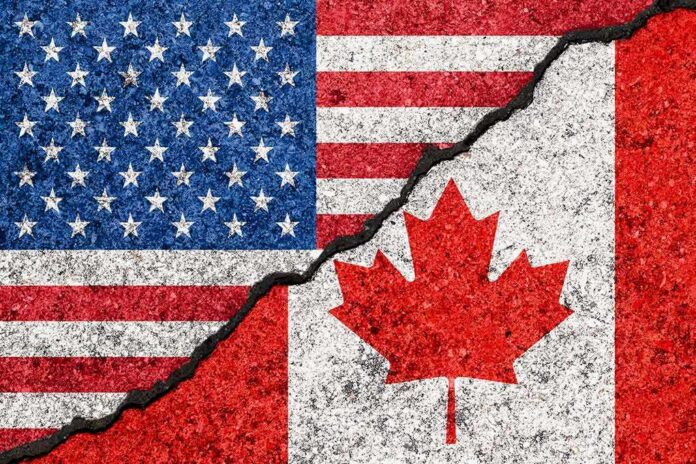
President Donald Trump’s new 50% tariffs on Canadian goods mark a sharp escalation in a trade fight that is already hammering workers, shoppers, and small businesses on both sides of the border.
Story Snapshot
- The United States is slapping an additional 50% tariff on a wide range of Canadian imports, using a rarely tested law from 1930.
- The White House says the move responds to Canada’s “discriminatory” treatment of American cars, alcohol, and dairy products.
- Key everyday items — from cheese and wine to clothing, furniture, and hockey gear — will get more expensive for American buyers.
- The decision deepens an 18‑month trade war that many Americans already blame for higher prices and growing distrust of government.
What Trump’s New 50% Tariffs Actually Do
On Monday, the Trump administration announced that it will add a new 50% tariff on certain Canadian goods imported into the United States. A senior administration official said the list is broad, covering products such as dairy, alcohol and alcohol-related goods, food items, construction materials, clothing, furniture, technology, and car parts. The tariffs will start in 30 days and apply even to goods protected under the United States–Mexico–Canada Agreement free trade deal. Everyday items like wine and hockey sticks are specifically mentioned on the tariff list.
The administration is using Section 338 of the Tariff Act of 1930, a little-known law that allows the president to slap tariffs of up to 50% if another country is found to discriminate against American products. This legal path is different from earlier moves that used “national security” arguments about drugs and border control to justify tariffs on Canada under the International Emergency Economic Powers Act and Section 232 of the Trade Expansion Act. Because Section 338 has rarely been used this way, trade lawyers say it adds a layer of uncertainty for businesses trying to plan ahead.
Why the White House Says Canada Is at Fault
The White House claims Canada has treated American autos, alcohol, and dairy in a “discriminatory” way, and that the new tariffs are meant to “hold” Canada “accountable” for its retaliation to earlier Trump tariffs. The senior official briefing reporters argued that Canada’s response to U.S. trade actions aimed at “reindustrializing” and “reshoring” manufacturing crossed a line, and that these 50% duties will “level the playing field” for key American exports in those sectors. Canadian rules for dairy and alcohol were already flashpoints, with Washington long complaining that they block U.S. products from fairly reaching Canadian shelves.
The move also fits into a pattern of Trump portraying Canada as an unfair trader, even as independent fact-checkers have noted that Canada’s overall tariff levels are relatively low by global standards. His trade office has highlighted Canadian barriers on steel, aluminum, and autos as evidence of discrimination. Ottawa, for its part, has kept significant tariffs on some U.S. steel, aluminum, and vehicles in response to Trump’s earlier actions, while dropping others to try to ease pressure on its own consumers and firms. That back-and-forth cycle of “you hit us, we hit you” is exactly what many Americans see as proof that the system serves politicians and lobbyists more than families trying to pay their bills.
Deepening a Trade War That Was Already Hurting
This latest step is not the start of the fight, but the third major escalation in an 18‑month trade war between the United States and Canada. In early 2025, Trump imposed sweeping 25% tariffs on most Canadian goods and a 10% tariff on Canadian energy, claiming a national security emergency tied to illegal drugs and immigration. Later that year, he raised many of those tariffs to 35%, again singling out Canada even as some other countries received delays or lighter treatment. Analysts say the average U.S. tariff rate jumped from barely above 2% to some of the highest levels seen in more than a century.
Canada answered with its own counter-tariffs on tens of billions of dollars in American goods, hitting items like liquor, clothing, appliances, and sports equipment — the very things ordinary households buy. These tit-for-tat measures pushed prices higher and rattled small manufacturers and farmers who depend on cross‑border trade. Canadian and U.S. central bank researchers have warned that such shocks can slow growth and squeeze workers even more when inflation and housing costs are already high. Many citizens, conservative and liberal alike, have responded by losing trust in promises from both governments that “temporary” trade pain will somehow lead to long‑term gain.
Exemptions, Everyday Impact, and Growing Public Frustration
The new 50% tariffs will not hit everything Canada sells to the United States. The administration says energy, potash products already covered by national security tariffs, and certain other goods such as fish and critical minerals will be exempt. Those carve‑outs underline a key frustration for many Americans: powerful industries that supply oil, minerals, and other strategic materials are shielded, while sectors tied to regular consumers and small businesses absorb the shock. Shoppers and small shop owners will feel the higher costs on things like food, booze, clothing, furniture, and sports gear long before big corporations do.
🚨 Trump turns up the heat on Canada. 🇺🇸🇨🇦
After confronting PM Mark Carney over wildfire smoke, Trump says Canada could face tariffs or even damages if toxic smoke keeps crossing the border. From diplomacy to dollars—America's patience is wearing thin. pic.twitter.com/WL7hjQBlBc
— Xi Znping (@XiZnping) July 21, 2026
Politically, the tariffs play into long‑running anger on both sides of the aisle. Many conservatives see them as overdue pushback against global rules and foreign governments that they believe have taken advantage of U.S. workers. Many liberals see them as another example of “America First” politics that punishes ordinary people and deepens inequality while the well‑connected escape the worst damage. What unites both groups is a shared sense that the federal government has turned trade policy into a high‑stakes game that benefits elites, lobbyists, and career politicians more than families trying to reach the American Dream.
Trump Slaps 50% Tariffs on Canada https://t.co/eMuCqOB9Q7
— Angelo Guarino (@AngeloG_016259) July 21, 2026
Sources:
youtube.com, reuters.com, nbcnews.com, axios.com, bbc.com, cbc.ca, thefulcrum.us, nydailynews.com, ctvnews.ca, blakes.com, aljazeera.com, rbc.com