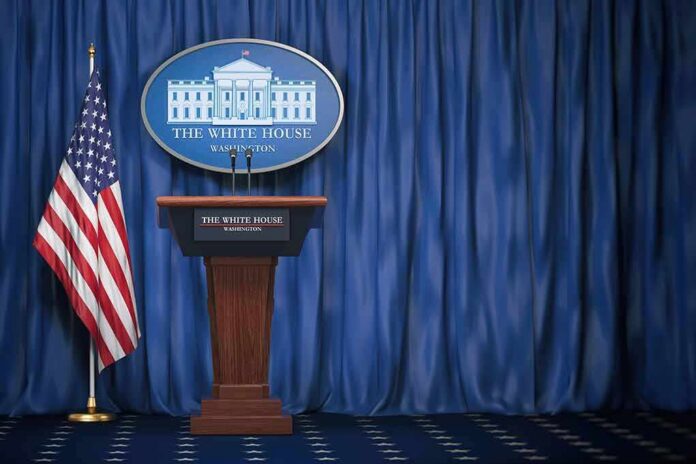
President Trump said three national outlets are “banned” from the White House effective immediately, thrusting press freedom and government power into open conflict.
Story Highlights
- Trump announced an immediate ban on CNN, MS NOW, and Politico from the White House.
- CNN called the move an “illegal assault” on constitutional press rights.
- Experts warned viewpoint-based exclusions likely violate the First Amendment.
- Reports said on day one there was no clear enforcement and CNN staff stayed on site.
What The White House Announced
On September 18, President Trump wrote that he was banning CNN, MS NOW, and Politico from the White House “effective immediately.” He framed the step as a response to what he called constant “fake news” reporting by those outlets. The message did not include a signed order or a legal memo. It also did not spell out whether the ban covered briefings, the press pool, or all grounds access.
Trump also claimed Politico received an “illegal” eight million dollar government subscription under President Biden. The reports that quoted him did not include documents to prove the claim or show a legal ruling on it. Without records, the status and legality of any contract remain unclear in the public reporting used here. That gap matters, since alleged funding ties were cited as a reason to bar access.
How Newsrooms And Advocates Responded
CNN said it has a right under the United States Constitution to report on the White House without government interference and warned that any ban would be an illegal assault on that right. The Reporters Committee for Freedom of the Press told CNN the move would be “flatly unconstitutional” viewpoint discrimination. A Reuters-quoted First Amendment expert said expelling outlets from the press pool would be “doubly unconstitutional” because the pool functions as a public forum.
Some onlookers asked what the ban actually means in practice. Bloomberg’s Jeff Mason noted that the scope remained unclear, including whether it covered the Oval Office or the entire campus. A syndicated report said CNN staff remained in their White House work area hours after the announcement, suggesting no immediate enforcement. HNGN also reported no formal action had followed at the time of its story. These details point to discretion still sitting with White House and security staff.
The Legal Lines At Stake
Courts have long said the White House can manage access, but not based on viewpoint once it opens spaces to the press in general. A federal judge restored CNN correspondent Jim Acosta’s pass in 2018 on due process grounds, and the case highlighted that viewpoint limits were still in play. More recent disputes over the Associated Press also turned on whether officials may exclude specific reporters for how they report.
This record shows risk for any attempt to punish coverage by limiting access. The stronger the tie between a ban and an outlet’s viewpoint, the weaker it looks under the First Amendment, especially in spaces open to the credentialed press. If the White House issues formal credential actions, those documents will likely land in court fast. That is where a clear legal theory will be tested against past rulings and the facts on how access is controlled.
Why This Matters Beyond The Beltway
Americans who think national media often get key stories wrong will see this as overdue accountability. Americans who fear government overreach will see this as a step toward silencing critics. Both concerns grow from a shared worry: powerful institutions protect themselves first. When a president threatens press access over coverage, and when large outlets dismiss public distrust, people on both sides feel the system serves the few, not the many.
#Trump says CNN, MS NOW and Politico are barred from the White House effective immediately, opening a new confrontation over presidential press access. pic.twitter.com/7Xx3l7syqs
— XionistaNews ✡︎ (@XionistasNews) September 19, 2026
Press access rules are not a niche fight. They shape how the public learns about wars, budgets, immigration, and energy policy. If access becomes a reward for friendly coverage, the public loses tough questions. If newsrooms never correct errors or own bias, the public loses trust. The narrow path forward is clear rules, posted in writing, applied evenly, and strong reporting that shows its work. Anything less deepens the belief that elites, not citizens, run the show.
Sources:
twitchy.com, english.news.cn, cnbc.com, wrtv.com, fox29.com, yahoo.com