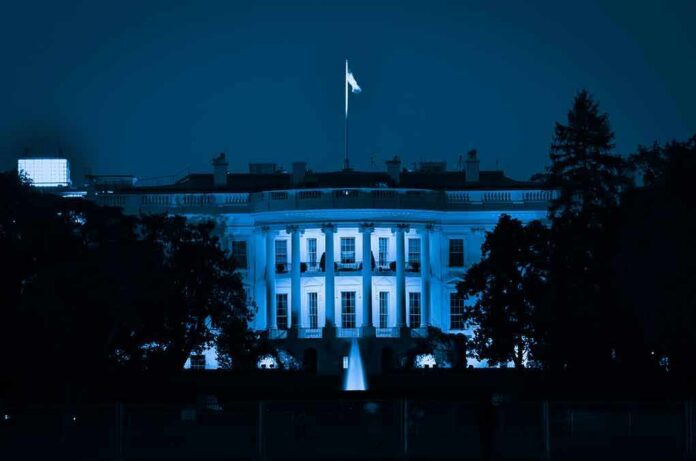
President Trump has released new artist renderings showing his White House ballroom sitting atop a six-story underground complex built with bomb shelters, a hospital and a rooftop drone base.
Story Snapshot
- New renderings show the ballroom built above bomb shelters, a hospital, sniper nests and a drone platform on the roof.
- The Supreme Court let construction continue in a 5-4 ruling, with Chief Justice John Roberts dissenting.
- The administration moved about $350 million from the Secret Service to pay for the security upgrades.
- A judge ruled Trump cannot treat the whole ballroom as a national security necessity without congressional approval.
New Renderings Show a Bunker-Like Design
Trump released new artist renderings of the White House ballroom project this month, filed as part of the ongoing legal fight over the construction. The drawings depict a complex built around heavy security, including bomb shelters, a hospital, sniper nests and a drone platform on the roof, according to filings tied to the case.
Trump described the underground portion as six stories deep, with a military hospital, research facilities and meeting rooms built beneath the ballroom floor. He said the windows will use glass about four inches thick and steel he called “impenetrable,” while the roof will carry “massive” drone defenses, according to remarks he made while touring the site.
Legal Fight Reaches the Supreme Court
The Supreme Court ruled 5-4 in late August to let construction continue while Trump challenges a lower court order that would have paused much of the work. Chief Justice John Roberts dissented from the majority, siding with judges who wanted tighter limits on the project until Congress weighs in.
A federal judge had earlier ruled that Trump cannot treat the entire ballroom as a national security necessity. Above-ground construction must stop without congressional approval, though work to build and cover the underground security facilities can continue, the judge found.
Money Shifted From the Secret Service
The administration transferred about $350 million from the Secret Service to pay for White House security upgrades tied to the ballroom project. Two transfers, worth $340.8 million and $10.75 million, happened within the same week in June, according to federal records reviewed by reporters.
Three former officials said the White House already has an underground bunker built for the president and staff during emergencies. That existing shelter, built decades ago, raises questions about how urgent the new underground work truly is, though the new project reportedly goes far beyond the old bunker’s size.
Presidents Have Long Reshaped the White House
The White House complex has changed many times before. Theodore Roosevelt built the West Wing in 1902, and Franklin Roosevelt added the current East Wing in 1942, partly to hide construction of an earlier bunker known as the Presidential Emergency Operations Center.
What sets this project apart, historians say, is how openly officials have tied a ceremonial ballroom to specific military features while courts still sort out the rules. The White House itself calls the ballroom “a proud presidential legacy,” pointing to past expansions as precedent for the work.
The ballroom, roughly 90,000 square feet with room for 650 guests, replaced the demolished East Wing, which had housed the first lady’s offices for decades. Construction began without review from the National Capital Planning Commission, which normally oversees federal building projects, though the White House and Capitol are exempt from that requirement under a decades-old law.
Sources:
npr.org, thehill.com, abcnews.com, nytimes.com, reuters.com, inquirer.com, whitehouse.gov