The smell of decaying bodies hanging over La Guaira after Venezuela’s twin earthquakes is a brutal sign of how fast a modern city can collapse when weak buildings and weak institutions meet a massive natural shock.
Story Snapshot
- Two huge quakes on June 24 shattered Venezuela’s coastal state of La Guaira, pancaking tower blocks and killing thousands.
- Caraballeda, a seaside community once filled with high-rise housing, is now a landscape of rubble, twisted steel, and mass graves.
- Ordinary citizens dubbed “the moles” are tunneling through collapsed buildings by hand to rescue survivors and recover bodies while the state response struggles.
- The disaster exposes long‑running problems familiar to many Americans: unsafe construction, corrupt or overwhelmed officials, and a system that fails badly when people need it most.
Twin earthquakes turn La Guaira into a disaster zone
On June 24, 2026, two powerful earthquakes measuring magnitudes 7.2 and 7.5 struck northern Venezuela just 39 seconds apart, hitting near the capital Caracas but causing their worst damage in the coastal state of La Guaira. Authorities say more than 5,100 people are confirmed dead and over 16,700 injured, with tens of thousands still missing under collapsed buildings. International and United Nations estimates suggest between 40,000 and 50,000 people may remain buried, most of them in La Guaira’s dense coastal strip.
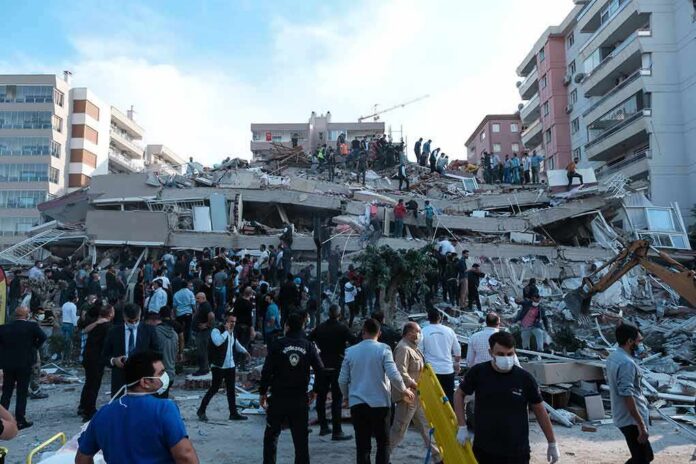
Emergency officials quickly declared La Guaira a disaster zone, with the biggest impacts in communities such as Caraballeda and Catia La Mar. Satellite and aerial images show entire blocks wiped out, streets filled with crushed concrete, and high-rise apartment towers reduced to piles of debris only a few stories tall. Verisk, a global risk firm, estimates around 1,400 buildings were destroyed in La Guaira alone, with total economic losses likely above 10 billion dollars for the country. These numbers are still climbing as damage counts catch up with reality.
Caraballeda’s collapsed towers and the struggle to find the missing
Caraballeda, once known for its cluster of modern housing towers along the Caribbean coast, has emerged as one of the hardest-hit neighborhoods. Reporting based on satellite imagery and field visits describes seven high-rise blocks heavily damaged, with four or five of them completely collapsed into dense rubble. Survivors compare the scene to war, with cars crushed in parking garages, stairwells sheared away, and whole families missing after buildings fell in seconds.
Officials and aid groups say thousands of people from Caraballeda and nearby areas were at home when the quakes hit at 6:04 p.m., leaving many trapped inside as floors “pancaked” on top of each other. A crowdsourced missing-persons database, Venezuela Reporta, lists more than 41,000 people missing, nearly all in La Guaira’s coastal strip. Independent disaster analysts warn that, given the level of building collapse and the slow pace of formal rescues, the final death toll could move far beyond 10,000. Families now camp near ruins, waiting for news or digging themselves.
“The moles”: civilians dig through rubble as the smell of decay spreads
As in many disasters, the first and most determined rescuers in Venezuela have been ordinary citizens, not formal emergency services. Residents, rural workers, and volunteers from other states rushed into La Guaira within hours, forming teams to tunnel into collapsed apartments with shovels, pickaxes, and bare hands. One widely reported crew of rural laborers, traveling about five hours to reach Caraballeda, became known as “the moles” because they burrow into debris piles, carving narrow tunnels to reach trapped survivors and bodies.
Reporters on the ground describe people working in flip-flops, without helmets or breathing gear, moving one “grain of sand” at a time to clear corridors into pancaked floors. In Catia La Mar and Caraballeda, families say they saw almost no government civil defense crews for days and instead relied on neighbors and volunteers to recover loved ones. Eight days after the quakes, Associated Press journalists wrote of black smoke rising from fires in flattened buildings and the strong smell of decomposing bodies hanging over the ruins as teams kept digging, hoping for rare rescues but often finding only remains.
Weak buildings, weak institutions, and a warning for other countries
Experts now say the human toll in La Guaira was driven not only by the size of the earthquakes but also by deep, long‑running structural problems. Many of the worst collapses came in high-rise housing built in recent decades, including projects under former President Hugo Chávez’s Great Housing Mission, which some reports say “fell like sandcastles” when the shaking began. Disaster engineers point to poor rebar, thin columns, and lax enforcement of building codes in a known hazard zone, echoing past tragedies in the same region.
At the same time, years of economic crisis and political conflict have hollowed out basic state capacity. Venezuelan and foreign reporters note stalled cranes, idle heavy machinery, and uniformed personnel standing by while civilians dig with hand tools. Citizen-led aid networks, churches, business owners, and diaspora groups have stepped in to provide food, shelter, and medical help, building ad hoc systems where official ones failed. For many observers, the scene in La Guaira looks less like a freak accident and more like the predictable result of a government that ignored repair, maintenance, and honest oversight until nature finally tested the system.
Shared lessons for Americans who fear their own systems are cracking
For Americans watching from afar, Venezuela’s disaster hits familiar nerves. Many on the right see evidence of corrupt elites and state-run housing built cheaply while insiders got rich. Many on the left see ordinary people abandoned by power, forced to rescue themselves while inequality and neglect leave them exposed. Both views point to the same core worry: when institutions rot, the cost is paid by regular families living in fragile buildings and relying on services that may not show up.
“Magnitude of the Disaster”: @hadjalahbib Visits Venezuela’s Earthquake Epicentre in La Guaira!
European Commissioner Hadja Lahbib visited earthquake-affected zones in Caraballeda and Catia La Mar, in La Guaira State, Venezuela, following the devastating twin earthquakes that… pic.twitter.com/6I5I5kN36B— euDebates.tv (@eudebates) July 17, 2026
The smell of decomposed bodies in La Guaira today is not just a local horror story. It is a warning about what happens when known risks go unaddressed and when citizens lose trust that their leaders will protect them when it counts. In Venezuela, neighbors and “moles” are doing the slow, heartbreaking work the state should have been ready to do. For a United States already divided over infrastructure, disaster response, and who the system really serves, the lesson is stark: nature will test every weakness we leave in place.
Sources:
aljazeera.com, usatoday.com, reuters.com, reliefweb.int, cnn.com, theguardian.com, facebook.com, youtube.com, english.elpais.com, globalvoices.org, thenewhumanitarian.org, csmonitor.com, forbes.com, ca.news.yahoo.com, nytimes.com, detroitnews.com, abc7.com, rescue.org, semissourian.com