
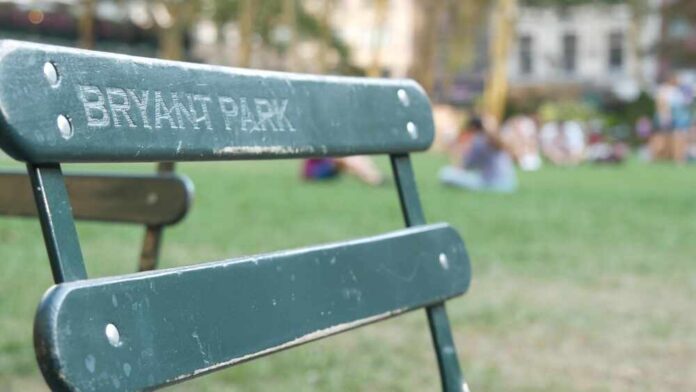
A baby in a stroller was hit by a thrown cell phone near Bryant Park, and the way this story is being handled raises hard questions about safety, justice, and who gets protected in New York City.
Story Snapshot
- Police say a homeless man threw a cell phone twice, hitting a baby and her mother near Bryant Park.
- The child’s injuries were described as minor, but no medical report or video has been released to the public.
- Media outlets are using loaded language like “crazed,” “unhinged,” and “horror attack” that shape public opinion before any trial.
- The incident fits a pattern of random park assaults that fuel fear, even as broader crime data is more mixed.
What Police Say Happened Near Bryant Park
New York Police Department officers say that on Saturday morning, July 18, 2026, 49-year-old Marc Okon threw a cell phone at a baby girl in a stroller near Sixth Avenue and West 41st Street, just by Bryant Park. Police reports say the phone struck the baby’s left arm around 9:55 a.m., leaving visible redness, and that Okon then picked up the phone and threw it again at the child’s 39-year-old mother. Officers at the scene arrested Okon right away and charged him with assault, endangering the welfare of a child, and reckless endangerment.
Police say the mother and baby did not know Okon and had no contact with him before the attack, which makes this sound like a random assault on a young child and her parent. Reports describe the baby’s injuries as minor, and the mother is said to have refused medical care for herself and her daughter. That detail matters, because it suggests the physical harm was limited, even though the emotional impact of a stranger targeting a baby in public is clearly serious.
What We Still Do Not Know About the Case
So far, almost everything the public knows comes from police statements repeated by the New York Daily News and the New York Post. No surveillance video has been released that shows the throws, and there is no public forensic report on the phone itself or the baby’s injury. There is also no detailed medical record shared with the public; we only have the phrase “minor injuries” and “visible redness” from law enforcement and reporters. No defense lawyer statement, victim statement, or named eyewitness account has appeared in the coverage yet.
Those gaps matter for anyone who cares about due process and honest reporting, no matter their politics. Without video, medical documents, or sworn testimony from the mother or bystanders, the public cannot independently check the police version. That does not mean the police are lying; it means the story is being decided in the court of public opinion mostly on one side’s account. People on both the right and the left who distrust “the system” will recognize this pattern: officials speak, media amplifies, and real evidence often stays behind closed doors.
How Media Language Shapes Public Anger
The two main tabloids covering this case frame Okon as “unhinged,” “crazed,” and a “horror attack” suspect, and they highlight that he is homeless. This language is designed to grab clicks and outrage, not to inform calmly. It turns a serious but still developing case into a simple villain story before a judge or jury hears full facts. Many conservatives see this as proof of urban decay and weak leadership; many liberals see it as proof that the safety net and mental health care have failed. Both sides can agree that sensational headlines help media companies more than they help readers understand the truth.
This latest claim also lands on top of other Bryant Park incidents that drew headlines, such as the 2025 case where David Silva was accused of randomly slapping or punching a six-year-old boy in the face at the Bryant Park Winter Village and was later found to have 17 prior arrests. Other reports describe stabbings, machete attacks, and pickpocket rings in the same area over the years. Each event feeds a larger narrative that public parks are dangerous and that ordinary families are on their own, even while city leaders often say crime is under control.
The Bigger Picture: Park Crime, Fear, and Government Trust
These high-profile park attacks hit a nerve because they target children and feel totally random, and they come at a time when many Americans already feel the government is failing at basic tasks like safety, mental health care, and homelessness. Some studies of New York City park crime from 2018 to 2021 show no clear long-term surge across all parks, suggesting the picture is more complex than the scariest headlines. At the same time, data from Central Park showed robberies up over 200 percent in early 2024 compared with the year before, and major offenses up nearly 50 percent. People do not live inside spreadsheets; they respond to the worst stories, especially when children are involved.
Man throws cell phone at baby girl and her mom near Bryant Park: cops https://t.co/2uQisRkW0g
— ♡SUN'SHIYNE♡ (@IAmSunshiyne) July 19, 2026
For many readers on both the right and the left, this case highlights a painful mix of problems. A homeless man is accused of attacking a baby in broad daylight steps from a major park, while city policy still treats parks as “sensitive locations” where ordinary citizens face strict limits on self-defense tools, even though a sign does not stop an attacker. Media outlets push emotional coverage that may tilt a future jury, but the same system is slow to release hard evidence like video, medical reports, or full case files. People see a government that talks about safety yet leaves parents wondering if their child is truly protected in public spaces.
Sources:
nypost.com, nydailynews.com, nytimes.com, yahoo.com, ahajournals.org, studentwork.prattsi.org, nysafeinc.com