
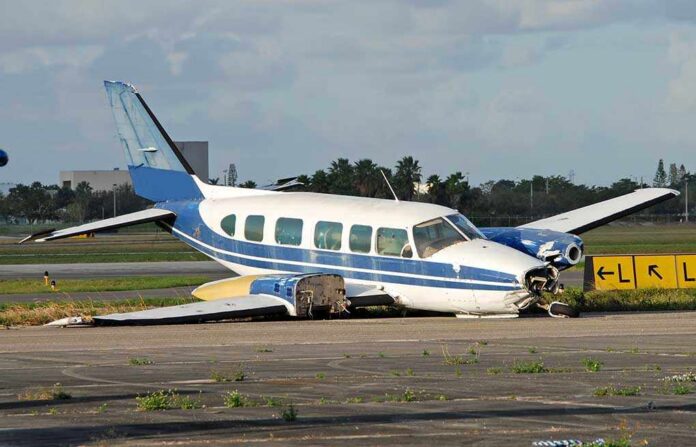
A United Airlines jet’s engine blast flipped a Cessna 172 onto its roof at John Wayne Airport, leaving two aboard shaken but unhurt.
Story Snapshot
- Federal officials said a Cessna 172 overturned while taxiing behind United Flight 2611 at John Wayne Airport.
- The instructor and student inside were not injured, according to airport and news reports.
- The instructor’s written report cited jet blast after the Boeing increased power to enter the runway.
- Jet blast hazards to light aircraft are well known in Federal Aviation Administration guidance.
What Happened on the Ramp
The Federal Aviation Administration said a Cessna 172 was blown over while taxiing behind United Airlines Flight 2611 at John Wayne Airport in Santa Ana, California. Local video and photos showed the small plane inverted on the pavement as crews responded. Airport officials and reporters identified the United flight as a Boeing 737 waiting for departure. Officials said the two people aboard the Cessna were not hurt. The agency called the information preliminary, pending further review.
Flight instructor Jason Ryu described a sudden, powerful rush of air as he turned toward parking with a student on board. He told local television that strong airflow hit the Cessna as they entered the ramp area, and in a written report he linked the loss of control to jet blast from a Boeing that increased power to enter the runway. He wrote that the blast moved the aircraft and he could not maintain control of its movement.
Conflicting Early Explanations and Known Hazards
Early reports differed on the main cause. The Federal Aviation Administration pointed to the Cessna taxiing behind the United jet, while an airport spokesperson referenced strong winds in the area that afternoon. Such events align with known ground risks. Federal Aviation Administration advisories warn that jet engine blast can upset light aircraft at close range and urge adequate separation during ground operations to prevent damage and loss of control.
Ground-control radio traffic captured after the event suggested the Cessna may have been close enough to be “blasted” by the 737’s exhaust, according to reporting on initial recordings. Location details varied across outlets, with some describing a runway, others a ramp or taxi area, which may reflect construction changes and tight space on the field. These differences do not change the core result: the aircraft overturned and the occupants walked away without injury.
Why This Matters for Travelers and Pilots
Jet blast is a predictable hazard, but preventing harm depends on spacing, clear instructions, and awareness of who is nearby. Federal Aviation Administration guidance stresses that exhaust velocity drops with distance, so spacing and positioning are key to safety on crowded ramps and taxiways. Past investigations by the National Transportation Safety Board describe similar overturns when small aircraft were too close to high-power thrust or when high-power runs happened near active movement areas without proper coordination.
Travelers may wonder how a small plane got so close to a large jet’s exhaust path. Reports mention construction and limited space near parking, which can compress normal buffers and change routes on short notice. Those conditions raise familiar worries across the political spectrum: complex systems, many contractors, and crowded schedules can strain basic safety rules. People want clear accountability when preventable risks slip through and put lives and property in danger.
What Comes Next in the Investigation
Investigators will review air traffic control recordings, ground movement data, surface wind observations, and statements from the Cessna crew, the United crew, and controllers. They will likely check how much thrust the Boeing used, how far the Cessna was from the exhaust path, and whether construction changed taxi flows that day. The Federal Aviation Administration’s final findings, when released, should explain the sequence and any safety changes needed to prevent another overturn like this one.
Sources:
washingtontimes.com, cbsnews.com, faa.gov, ocregister.com, flyingmag.com