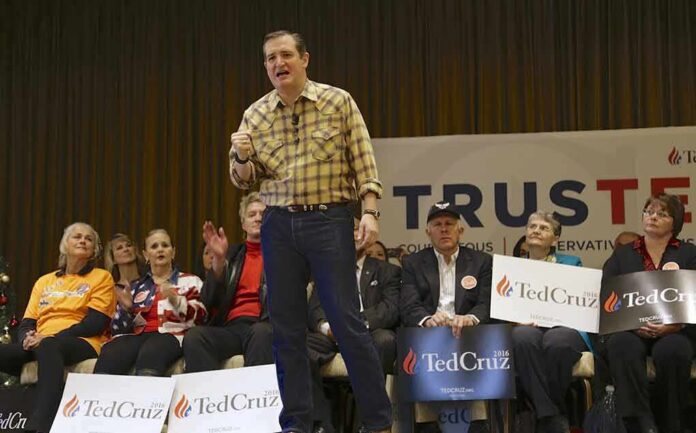
Ted Cruz says Democrats’ sweep in Texas was a “Watergate-level repudiation,” and he is vowing a rebuild focused on everyday costs and blue-collar voters.
Story Snapshot
- Democrats swept Texas statewide races, leaving Senator Ted Cruz as the lone Republican in statewide office.
- Cruz blames voter anger over high costs and says Republicans ignored working families’ struggles.
- He says the party lost blue-collar, evangelical, rural, Hispanic, and young voters and must win them back.
- Cruz pledges “we will bring Texas back,” but has not released a detailed policy plan.
Historic Texas Loss Sets the Stage
Reuters and other outlets reported that Democrats won the Texas Senate race, the governorship, and every other statewide office in November 2026. Senator Ted Cruz became the only Republican left in statewide office. Cruz called the result an “ass-kicking” and a “Watergate-level repudiation,” language that highlights the scale of the defeat and the urgency he now places on a reset. The sweep reshapes how both parties view Texas after decades of Republican dominance.
Cruz told conservative audiences that Republicans were hit by a “blue tsunami,” and he argued the path back runs through voters who feel squeezed by daily costs. He said Texans punished the party for appearing deaf to price pressures on food, fuel, housing, and insurance. He also said the party drifted from concerns of people who work with their hands and live paycheck to paycheck. He framed the loss as a wake-up call, not a permanent realignment.
Cruz’s Diagnosis: Who the GOP Lost and Why
Cruz listed the groups he believes moved away: blue-collar workers, evangelical Christians, farmers and ranchers, rural and Hispanic communities, and young voters. He argued Republicans cannot win again without winning back those blocs. Reports say he wants a “blue-collar, free-market” focus that links conservative economics to relief on daily costs. He promised to back ideas that “make a difference in working people’s lives,” though he did not present specific bills or funding plans.
Townhall’s account quoted Cruz’s pledge that “we will bring Texas back” and “Texas will be red again.” Local coverage from Houston and El Paso outlets echoed his call for a methodical rebuild. The framing suggests a two-part aim: rebuild trust with affordability answers and reconnect with culturally conservative voters who felt unseen. The promise sets a clear test: whether Republican statewide candidates can regain competitiveness in 2028 and beyond.
Competing Factors Complicate the Postmortem
The Dallas Morning News reported that Cruz also criticized national factors, citing tariffs and the war in Iran as economic drags. Other reports tied the Texas outcome to broader national Republican setbacks. Analysts also noted that individual candidates, including a scandal-plagued Republican Senate nominee, may have hurt the ticket. These threads point to a mix of causes that are hard to separate without detailed precinct or survey data.
Because the defeat was broad, many observers expect Republicans to weigh larger strategic shifts. That could include debating how to balance culture-war themes with bread-and-butter fixes on prices and services. The scale of the losses also fuels a strong narrative of party mismanagement. That narrative risks drowning out a recovery plan unless it quickly shows concrete wins that voters can feel in their budgets and local communities.
What the Voter Map May Be Telling Us
Academic work before 2026 found a growing rural–urban split among Hispanic voters in Texas and the South, with rural Hispanic communities moving right in recent years. But 2026 coverage suggested Democrats regained ground with many Hispanic voters, at least for now. That pattern supports a view of Hispanic Texans as swing voters who respond to present economic and safety concerns, not a bloc bound to either party.
If that is right, Cruz’s focus on affordability and work-centered policy targets a real opening. But success would require specifics that reach families fast, like lowering energy, housing, or insurance costs, without sparking new costs elsewhere. It would also require trust with younger voters and rural communities who expect results, not slogans. The test is whether Republicans can deliver measurable gains while keeping their current base engaged.
Why This Matters Beyond Texas
Texas has long been a bellwether for energy, immigration, and the economy. A Democratic sweep in such a state sends a message to both parties about cost-of-living pain and the limits of partisan comfort zones. For conservatives, it warns that cultural wins cannot cover for empty wallets. For liberals, it warns that gains can fade if prices rise again or public safety falters. Voters across the spectrum want leaders who fix basics, not feed the political machine.
The midterm results are clear: Republican voters showed up at the polls and… handed the GOP a vote of no confidence by casting their ballots for Democrats. And the biggest reason was the cost of living.
It’s not just that prices are going up; they’re going up because of wars… pic.twitter.com/r7cL9b9H3n
— Anton Liubich (@antonliubich) November 5, 2026
Sources:
townhall.com, rmb.reuters.com, washingtonpost.com, fox26houston.com, independent.co.uk, newsweek.com, kfoxtv.com, bloomberg.com, dallasnews.com, fox17.com, academic.oup.com