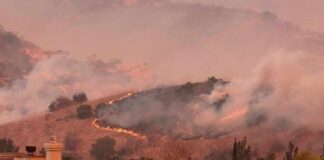
On February 28, 2026, while diplomatic negotiations over Iran’s nuclear program still simmered on back channels, American bombers and Israeli fighters launched a coordinated assault that President Trump openly declared would obliterate Iran’s military capabilities and topple its regime.
Story Snapshot
- The U.S. and Israel launched Operation Epic Fury and Operation Roaring Lion against Iran on February 28, 2026, targeting Tehran, Isfahan, Qom, Karaj, and Kermanshah with sustained strikes aimed explicitly at regime change
- Seven missiles struck the district housing Supreme Leader Ali Khamenei’s residence, with thousands of IRGC personnel reportedly killed or wounded across multiple military installations
- Iran retaliated by striking four U.S. military bases in Qatar, Kuwait, UAE, and Bahrain, with video evidence confirming damage to the Fifth Fleet facility in Bahrain
- Trump offered Iranian armed forces complete immunity for defection and called on civilians to overthrow the government once military operations conclude
- Former Defense Secretary Mark Esper warned the U.S. lacks sufficient weapons stockpiles and industrial capacity to sustain prolonged operations given prior commitments to Ukraine and Israel
The Shift From Diplomacy to Destruction
The strikes represent a fundamental pivot from containment to confrontation. Throughout January and early February 2026, Washington presented Tehran with three non-negotiable demands: permanently end uranium enrichment, accept strict limits on ballistic missile programs, and cease all support for Hamas, Hezbollah, and the Houthis. When Iranian negotiators failed to satisfy these conditions, Trump’s patience evaporated. By February 13, he publicly declared regime change would be the best outcome for Iran. Eleven days later, his State of the Union address accused Tehran of reviving nuclear weapons development. The diplomatic window had closed.
This wasn’t the first time American and Israeli forces struck Iranian targets in 2026. The June operation, dubbed the 12 Day War, targeted nuclear facilities specifically. That campaign demonstrated resolve but maintained boundaries. The current offensive abandons such restraint entirely. Trump’s own words leave no ambiguity about the objective: “We are going to destroy their missiles and raze their missile industry to the ground. It will be totally obliterated. We’re going to annihilate their navy.” This isn’t surgical precision aimed at specific facilities. This is comprehensive military destruction designed to collapse Iran’s capacity for regional power projection.
What the Bombs Actually Hit
The targeting revealed strategic priorities beyond nuclear concerns. Seven missiles hammered the district containing Khamenei’s residence, the presidential palace, and the National Security Council headquarters in Tehran. Military bases across Iran absorbed sustained bombardment, with Iran International reporting thousands of Islamic Revolutionary Guard Corps personnel killed or wounded. The port city of Bushehr took hits, though damage to the nuclear reactor there remains unconfirmed. Isfahan, Qom, Karaj, and Kermanshah all experienced strikes targeting military infrastructure rather than civilian centers.
Iran’s asymmetric response followed predictably. The IRGC launched missiles and drones at four U.S. installations: Al Udeid Air Base in Qatar, Al Salem in Kuwait, Al Dhafra in the UAE, and the Navy’s Fifth Fleet headquarters in Bahrain. Video footage captured smoke billowing from the Bahrain facility. Qatar’s air defenses intercepted at least one incoming Iranian missile, preventing additional damage. The retaliatory strikes achieved propaganda value for Tehran but inflicted minimal operational disruption compared to the devastation American and Israeli forces delivered to Iranian military capabilities.
The Regime Change Gambit
Trump didn’t merely authorize military action. He issued an explicit call for Iran’s armed forces to abandon the regime. Offering complete immunity for disarmament, he addressed Iranian military personnel directly, urging defection. To the broader Iranian population, his message carried revolutionary implications: “Take over your government” once American operations conclude. This rhetoric aligns with the administration’s assessment that domestic instability had reached critical mass, with tens of thousands of anti-government protesters reportedly killed by regime forces in recent months.
Netanyahu framed the campaign in existential terms, noting the Ayatollah regime’s 47-year mantra of Death to Israel and Death to America. Israeli Defense Minister Israel Katz characterized the strikes as removing threats that endangered Israel’s survival. The timing carried symbolic weight. CNN noted the attacks occurred ahead of Purim on March 2, a Jewish holiday commemorating Jewish survival against Persian destruction. Whether intentional or coincidental, the connection between ancient history and modern conflict wasn’t lost on observers tracking the operation.
Stockpiles, Strategy, and Sustainability Concerns
The operational ambition collides with logistical reality. Former Defense Secretary Mark Esper articulated concerns that should alarm anyone tracking America’s military readiness: “We simply don’t have the defense industrial base to do that, let alone the stockpiles of key weapons such as Patriot and THAAD and then strike weapons such as JASSMs.” The U.S. already committed substantial munitions to Ukraine’s defense and Israel’s operations against Hamas. Now Trump promises weeks of sustained bombardment against a nation significantly larger and more militarily capable than previous adversaries.
Arab allies in the region reportedly urged Washington to exercise restraint, warning that Iran signaled intentions to escalate retaliation using medium-range missiles, drones, and proxy forces like Hezbollah. These concerns reflect legitimate fears about regional stability. The initial Iranian response targeted four U.S. bases. If Tehran activates proxy networks across Lebanon, Syria, Iraq, and Yemen simultaneously, American forces and regional partners face threats across multiple theaters without sufficient defensive systems to protect all installations adequately.
The campaign’s long-term success hinges on variables beyond military superiority. Will Iranian armed forces defect in significant numbers? Can domestic opposition movements capitalize on regime vulnerability to seize power? Does sustained bombardment accelerate or delay Iran’s nuclear timeline if facilities survive or disperse? Trump’s approach rejects incremental pressure in favor of decisive action aimed at fundamentally altering Middle Eastern power dynamics. The consequences of that gamble, whether triumph or catastrophe, will define regional security for decades.
Sources:
US and Israel launch airstrikes on Iran as Trump pursues regime change – Fortune