
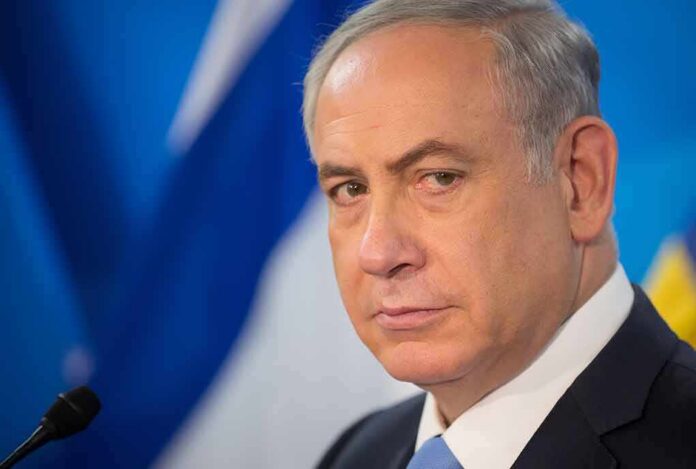
Israeli Prime Minister Benjamin Netanyahu told the United Nations General Assembly that striking Iran was a matter of survival, saying, “If we hadn’t done it, we’d all be dead.”
Story Snapshot
- Netanyahu addressed the UN General Assembly’s 81st session in New York on September 24, defending Israel’s wars in Iran and Gaza.
- He said attacking Iran was “one of the easiest decisions I’ve ever had to make” and called it necessary for Israel’s survival.
- Dozens of delegates walked out before he spoke, prompting him to call them “moral cowards.”
- He rejected genocide accusations tied to the Gaza war as “the greatest lie of the century.”
- Netanyahu described a seven-front conflict involving Iran, Gaza, Hezbollah, Syria, Yemen and Iraq-linked militias.
Netanyahu Frames Iran Strike As Life-Or-Death Choice
Speaking to world leaders, Netanyahu defended Israel’s military campaign against Iran in blunt terms. “If we hadn’t done it, we’d all be dead,” he said, describing the strike as a defensive necessity rather than a war of choice. He added that hitting Iran’s nuclear facilities was “one of the easiest decisions” he has made as prime minister, framing the operation as unavoidable given the threat he says Iran posed to Israel’s existence.
Netanyahu closed his roughly 40-minute speech with a declaration of resolve. “We’re going to win. We have no other choice,” he told the assembly, tying the Iran campaign to Israel’s broader fight against what he called a multi-front terror network stretching across the Middle East. He held up a poster titled “The Curse,” which he said depicted Iran’s regional terror network reaching into Gaza, Lebanon, Syria and Yemen.
Delegates Walk Out As Prime Minister Defends Gaza War
Dozens of delegates left the hall as Netanyahu approached the podium, a protest tied to Israel’s ongoing military campaign in Gaza and mounting international criticism of Palestinian civilian deaths. Netanyahu responded directly, branding those who left “moral cowards” before continuing his speech to a partially emptied room. He vowed to keep fighting until what he described as the elimination of Hamas is complete.
Netanyahu spent a significant portion of his address rejecting accusations that Israel has committed genocide in Gaza. He called the charge “the greatest lie of the century,” arguing Israel’s military conduct is the “opposite of genocide” and pointing to humanitarian efforts, including vaccine distribution, as evidence against the claim. He also criticized Western governments that have moved toward recognizing a Palestinian state.
Prime Minister Warns Statehood Recognition Rewards Violence
Netanyahu sharply criticized countries that have recognized or moved toward recognizing Palestinian statehood since the war began. He argued that such recognition sends a dangerous message, saying it signals that “murdering Jews pays off”. The comment came as several Western nations have shifted their diplomatic posture on Palestinian statehood amid the prolonged Gaza conflict and rising civilian casualties.
He tied that argument to a wider narrative he has repeated since the October 7, 2023 attacks, describing Israel as fighting a defensive war across seven fronts: Gaza, Iran, Hezbollah in Lebanon, Syria, Yemen’s Houthi movement, and Iraq-linked militias. Netanyahu credited Israeli forces with degrading each of these threats, framing the campaigns as connected pieces of a single survival struggle rather than separate conflicts.
In fiery @UN speech, Netanyahu blasts Iran, Qatar, Turkey, slams Gaza genocide accusation https://t.co/7SPrZvuYJQ via @timesofisrael
— NYCREMilton (@NYCREMilton) September 25, 2026
The speech drew sharp reaction well beyond the assembly hall, with global audiences split along familiar lines over Israel’s military conduct and its justification. For Americans watching from home, the address is a reminder that the Israel-Iran-Gaza conflict remains a live flashpoint shaping U.S. foreign policy debates, even as domestic attention stays fixed on economic and political battles at home. Netanyahu’s defiant tone signals he does not expect international pressure to shift Israel’s course anytime soon.
Sources:
jns.org, nbcnews.com, ynetnews.com, dw.com, business-standard.com, sbs.com.au