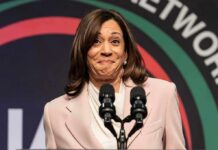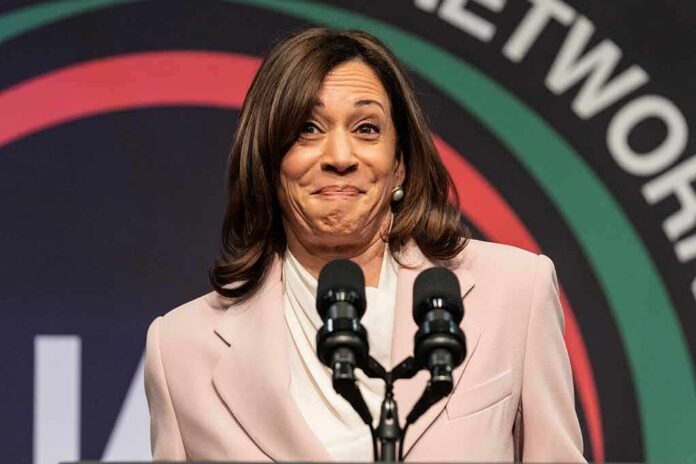
Kamala Harris spoke for nine minutes at a Sacramento campaign event, and her own team reportedly ordered reporters locked out of the room.
Quick Take
- Harris appeared at Richard Pan’s campaign headquarters in North Natomas to back his bid for California’s 6th Congressional District.
- She spoke for about nine minutes to roughly 100 supporters, mostly attacking Republican Representative Kevin Kiley.
- Several news outlets, including KCRA 3, were blocked from covering the event.
- Pan’s campaign says Harris’s office controlled the credentialing; a Harris aide points to Pan’s staff instead.
Harris Makes Brief Stop For Sacramento Candidate
Harris traveled to Sacramento on Friday to campaign for Richard Pan, a physician and former state senator running for the 6th Congressional District. She spoke for about nine minutes at Pan’s campaign headquarters in North Natomas, addressing a crowd of roughly 100 supporters. Her remarks centered on Pan’s opponent, Republican Representative Kevin Kiley, who recently dropped his party affiliation to run as “no party preference”.
Harris accused Kiley of trying to have it both ways with voters by distancing himself from the Republican label while keeping his record intact. She also praised Pan’s background as a pediatrician, saying she witnessed his work firsthand while serving as California’s attorney general. The appearance fit into a string of midterm stops Harris has made for California Democrats this fall, including an earlier fundraiser for a San Diego congressional candidate.
Some Reporters Turned Away At The Door
Several news organizations, including KCRA 3, say they were blocked from covering the public portion of the event. Pan’s campaign claims Harris’s team directed the exclusions, telling reporters that “all credentialing to the campaign office drop was directed by VP Kamala Harris’ office”. A Harris aide pushed back, placing responsibility on Pan’s own staff for handling press logistics at the headquarters that day.
The dueling explanations leave an unresolved question over who decided which journalists could enter. What is clear is that the restriction applied unevenly, with some outlets granted access while others, including at least one major local television station, were turned away entirely. The incident quickly drew attention well beyond Sacramento political circles.
Why A Campaign Stop Became National News
Conservative commentators seized on the story, framing it as proof that Democratic figures demand press freedom from the Trump administration while restricting it themselves. The episode arrived as the White House fought its own separate battles over barring certain outlets, including the Associated Press and CNN, from presidential events over coverage disputes. Courts have repeatedly ruled that government officials cannot deny access based on a reporter’s editorial choices.
Campaign events are different from government press pools in legal terms, since candidates are not bound by the same constitutional access rules that apply to federal officials. Still, the comparison resonated because it touches a concern shared across the political spectrum: that powerful people, regardless of party, often shape coverage to their advantage rather than let voters see unfiltered exchanges.
A Familiar Pattern In Modern Campaigns
Campaigns increasingly manage their own media environments, using credentialing, selective invitations, and closed-door formats to control message discipline. Researchers who study press-party relationships note that candidates no longer need traditional media as much to reach voters, thanks to social media and direct outreach tools. That shift gives campaigns more leverage to decide which journalists get access and which ones do not.
The Sacramento dispute shows how quickly a routine stump speech can turn into a flashpoint over transparency. Voters on the left and right have grown weary of institutions, political and media alike, that appear to play favorites rather than offer equal access. Whether the blocked outlets were excluded by Harris’s team or Pan’s staff, the underlying frustration remains the same for ordinary Americans watching from outside the room.
Pan is running in a competitive district against an incumbent who recently abandoned his party label, making the race one of the more closely watched contests in California this midterm cycle. The press-access controversy, regardless of its outcome, has already become part of the story voters will weigh as they decide who represents their interests in Congress.
Sources:
twitchy.com, thegatewaypundit.com, ground.news, hoodline.com, fresnobee.com, redstate.com, indivisible-roseville-ca.org, singtaousa.com, sacbee.com, thewrap.com, yahoo.com, cnn.com, pbs.org