Jurors found a former nurse guilty of six counts of second-degree murder after data showed her Mercedes accelerated to about 130 miles per hour and ran a red light before a fiery crash.
Story Snapshot
- Electronic data showed sustained full-throttle acceleration to about 130 miles per hour before impact.
- Surveillance video showed the car running a red light and striking cross traffic in a massive fireball.
- Prosecutors argued precise steering and no braking showed conscious control, not a medical emergency.
- The jury convicted on all six murder counts after roughly three hours of deliberation.
What The Jury Decided And Why It Matters
Los Angeles County jurors convicted Nicole Linton of six counts of second-degree murder in the 2022 Windsor Hills crash. Reporters at court said deliberations took about three hours, signaling jurors found the core evidence clear and strong. The verdict means jurors accepted that she drove with implied malice. That legal standard applies when someone knows a deadly risk and ignores it. Families of victims saw a rare murder conviction in a crash case, which often brings only manslaughter charges.
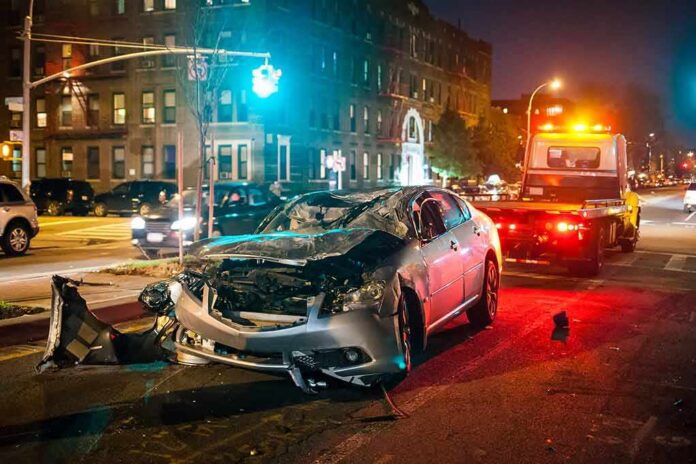
Prosecutors built their case around the car’s event data and video. Investigators testified the Mercedes recorded full-throttle input for five seconds, with speed rising from about 122 to 130 miles per hour before impact. Jurors also watched surveillance video of the car blowing a red light and slamming into cross traffic, which sparked a multi-vehicle fire. Prosecutors argued there was no braking, no swerving, and no distraction or intoxication evidence presented to jurors.
The Evidence That Carried The Day
Prosecutors told jurors Linton steered “with precision” while accelerating downhill toward the busy intersection, which they said showed control and awareness. A doctor who treated Linton the next day reportedly said she remembered leaving work angry and later expressed frustration about her car, which prosecutors said fit a motive-consistent mindset. The state framed the crash as preventable because the data showed no attempt to slow down or avoid the impact. Jurors accepted that view beyond a reasonable doubt.
Defense lawyers pushed a medical-emergency theory. They said Linton suffered a sudden seizure, did not know it was coming, and that a medical blackout is not murder. A neurologist testified he believed she likely suffered a seizure, and the defense pointed to an image of her arm outside the window as consistent with unconscious rigidity. They also argued she was not drunk, high, racing, or on her phone, and that steering movement before the crash was minimal. Jurors rejected that explanation.
Why This Case Hits Nerves Beyond One Intersection
This case shows how machine data can decide life-or-death questions in court. Modern cars store speed, throttle, and braking data that can cut through guesswork. That can help find truth. It also raises trust issues. People on both the right and left worry that powerful systems can choose winners before all records are public. Here, reporting leaned on testimony and summaries rather than a full public release of all technical files, which limits outside review.
LA jury finds former nurse Nicole Linton guilty of 6 counts of second-degree murder in the 2022 Windsor Hills crash that killed six — including a pregnant mother. Sentencing: Dec 1. ⚖️#NicoleLinton #WindsorHills #BreakingNews #TrueCrime #LA #NORTHLINE pic.twitter.com/pGq50lAbTe
— Nora Vale (@NoraValeLife) October 4, 2026
The shared public concern is simple: the system must be fair and transparent. Crash data can be reliable when properly collected and explained. But the public often sees only short clips and emotional scenes. That can drown out technical points from either side. The conviction brings real accountability for the victims’ families. It also reminds us to demand full, clean records in cases where a black box settles the question of intent in a split second.
Sources:
nypost.com, nbclosangeles.com, dailynews.com, mynewsla.com, foxla.com, abc7.com