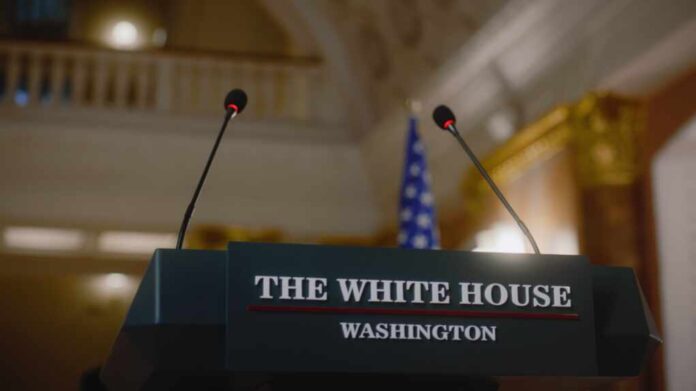
Federal courts have given orders to the White House to reverse course and restore sign language interpreters at all press briefings—a battle that exposes how even basic constitutional rights can be threatened by administrative overreach.
Story Snapshot
- A federal judge ordered the White House to provide American Sign Language (ASL) interpreters at all press briefings after the policy was abruptly discontinued.
- This decision follows aggressive advocacy and legal action from the National Association of the Deaf (NAD), setting a legal precedent for accessibility at the highest level of government.
- The ruling highlights the ongoing tension between administrative efficiency and constitutional protections for civil rights and government transparency.
- Restoration of ASL interpretation affirms the ethical and legal obligation to ensure equal access for deaf and hard of hearing Americans.
Federal Judge Mandates ASL Interpreters After White House Policy Shift
On February 4, 2025, a federal judge ordered the White House to resume providing American Sign Language (ASL) interpreters at all press briefings. This ruling arrived after the Trump administration ceased the previous policy in January, which had expanded accessibility for deaf and hard of hearing Americans since 2021. Advocacy organizations, led by the National Association of the Deaf (NAD), argued that captioning alone was insufficient and that ASL interpretation was a civil rights issue tied to transparency and equal access to government communications.
The legal challenge was initiated when NAD CEO Dr. Bobbie Beth Scoggins sent a letter to White House officials, demanding the restoration of ASL interpreters. The NAD’s push for inclusion dates back to the COVID-19 pandemic, when court rulings first required interpreters for health briefings. The federal judge’s order now enforces compliance at every press event, setting a precedent that strengthens the Americans with Disabilities Act (ADA) and related statutes. The White House has not publicly commented on the order, but compliance is expected immediately for all future briefings.
Federal judge orders White House to restore sign language interpreters at press briefings https://t.co/M2CqybUeEz pic.twitter.com/nKXIDEPQ43
— New York Post (@nypost) November 5, 2025
Accessibility and Constitutional Principles at Stake
This case highlights a critical intersection between accessibility, civil rights, and constitutional protections. The abrupt removal of ASL interpreters by the administration raised concerns about government overreach and disregard for transparency. NAD argued that real-time ASL interpretation is not just a convenience but a legal and ethical requirement, especially since more than 48 million Americans rely on accessible communications. The judge’s decision sends a clear message that core constitutional rights—like equal access to public information—must not be subordinated to bureaucratic priorities or budgetary constraints.
Previous legal victories set the stage for this mandate. In September 2020, courts first required the White House to provide ASL interpreters for COVID-19 updates. By early 2021, these policies expanded to all briefings, only to be rolled back in January 2025, forcing renewed advocacy and legal action. This ongoing tension between administrative efficiency and civil liberties concerns resonates with conservative values, reminding Americans of the need for vigilant defense of constitutional protections against government overreach.
Impact on Americans and Government Policy
The judge’s order has immediate and long-term implications. In the short term, deaf and hard of hearing Americans regain full access to information from the highest levels of government. Advocacy groups see this as a victory for accountability and inclusion, setting a new benchmark for accessibility standards across all federal agencies. Politically, the case underscores how vigilant oversight and legal activism can counteract policies that erode basic rights—whether intentional or accidental.
While some officials raise concerns about logistical costs, the court has reaffirmed that legal and ethical obligations outweigh such objections. This reinforces the principle that constitutional rights and family values—such as inclusion, transparency, and equal treatment—are not negotiable. The NAD and disability rights advocates will continue monitoring compliance, ensuring that future policy changes do not undermine hard-won protections for millions of Americans.
Legal Perspectives
Legal scholars in disability studies view the judge’s order as a milestone in government accountability and constitutional adherence. The NAD’s documentation and court filings provide authoritative evidence of both the timeline and impact. Communication professionals emphasize that captioning, while useful, does not meet the needs of many whose first language is ASL. The ruling serves as a reminder that vigilance, advocacy, and informed public pressure are essential tools for safeguarding rights in a changing administrative landscape.
Watch the report: US Court Orders White House to Provide ASL Interpreters
Sources:
Judge orders White House to restore sign language interpreters at briefings by Trump, Leavitt – POLITICO
Federal judge orders White House to restore sign language interpreters at press briefings