
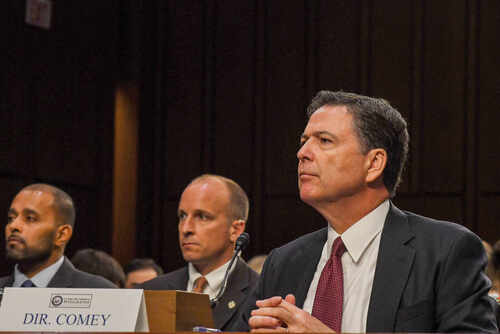
Former FBI Director James Comey now faces felony charges for allegedly threatening President Trump’s life through a cryptic social media post, raising profound questions about government weaponization and the erosion of free speech protections in America.
Story Snapshot
- Federal grand jury indicted James Comey on two felony counts carrying up to 10 years each for a May 2025 Instagram post showing seashells arranged as “86 47”
- Prosecutors interpret “86” as slang for murder and “47” as reference to President Trump, the 47th president, claiming the post constituted a knowing threat
- Trump administration officials including Acting AG Todd Blanche and FBI Director Kash Patel announced the charges, emphasizing zero tolerance for presidential threats
- Comey maintains the post was political expression without violent intent, marking his second indictment after a 2025 case was dismissed
Cryptic Social Media Post Triggers Federal Prosecution
On April 29, 2026, a federal grand jury in the Eastern District of North Carolina unsealed an indictment charging James Comey with two felony counts under federal threat statutes. The charges stem from a May 15, 2025 Instagram photograph showing seashells arranged to form “86 47,” which prosecutors allege constituted a deliberate threat against President Donald Trump. The post, which Comey later deleted, has been interpreted by authorities as coded language where “86” represents slang for elimination or murder and “47” references Trump as the 47th president.
Maximum Penalties and Legal Framework
Comey faces charges under 18 U.S.C. § 871, which criminalizes knowingly and willfully threatening to kill or inflict bodily harm on the president, and 18 U.S.C. § 875, addressing interstate transmission of threatening communications. Each count carries a maximum sentence of 10 years imprisonment. Acting Attorney General Todd Blanche and FBI Director Kash Patel jointly announced the indictment at a press conference, declaring that threats against the president “will never be tolerated.” An arrest warrant has been issued, requiring Comey to appear in federal court in North Carolina to face the charges.
Troubling Pattern of Selective Prosecution
This marks the second time Comey has faced federal indictment, following a 2025 case for alleged false statements to Congress that was ultimately dismissed. The timing raises serious concerns about political retribution, as the indictment comes just days after an assassination attempt on Trump at the White House Correspondents’ Dinner on April 26, 2026. The prosecution is led by Trump appointees Blanche and Patel, creating an unmistakable adversarial dynamic between the administration and its prominent critic. For many Americans watching this unfold, the pattern suggests the justice system is being weaponized against political opponents rather than applied equally under the law.
Free Speech Versus Government Overreach
Comey has consistently maintained that his Instagram post was intended as political commentary, not a genuine threat of violence. The case pivots on whether prosecutors can prove “knowing and willful” intent to threaten based on ambiguous symbolism. Legal experts note this prosecution could set a dangerous precedent for criminalizing vague or symbolic online expression, potentially chilling political speech across the spectrum. The government’s interpretation requires accepting that a photograph of seashells constitutes a serious expression of intent to harm, a standard that many civil libertarians find deeply troubling regardless of their opinion of Comey or Trump.
Broader Implications for Americans
The Comey indictment reflects a disturbing reality that transcends partisan divisions: government institutions increasingly appear more concerned with settling scores than protecting constitutional principles. For conservatives frustrated with the Obama-era FBI’s treatment of Trump, this prosecution may seem like overdue accountability. Yet the same legal framework used against Comey today could easily be turned against ordinary citizens expressing political dissent tomorrow. For liberals alarmed by expanding executive power, this case exemplifies their warnings about authoritarianism. The common ground here is unmistakable—when the Department of Justice pursues ambiguous social media posts as federal felonies, every American’s liberty is diminished, and the deep state grows stronger at the expense of the people it purports to serve.
LIVE: DOJ Charges Comey with Threatening To Harm President Trump https://t.co/BQzUXQtiuA
— One America News (@OANN) April 28, 2026
Whether Comey ultimately faces conviction remains uncertain, but the prosecution itself sends a chilling message about the boundaries of acceptable political expression in modern America. The case will test the limits of threat prosecution statutes and may determine whether symbolic speech receives meaningful First Amendment protection or becomes another casualty in the escalating weaponization of federal law enforcement against political adversaries.