
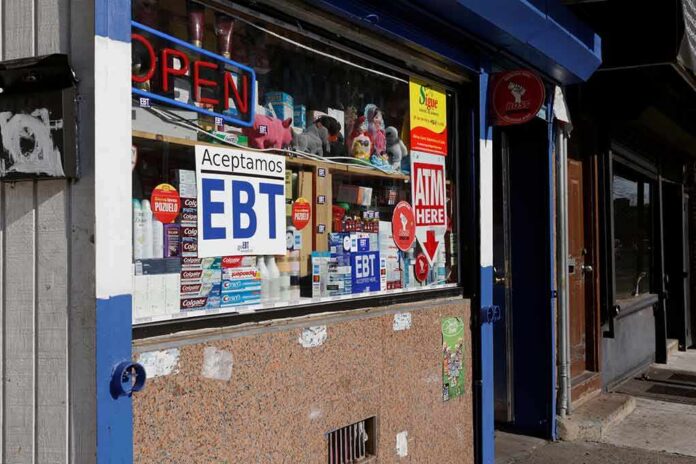
Federal prosecutors say a South Florida shop owner turned food aid into cash and bulk goods worth more than $500,000, striking at a program meant to feed families.
Story Snapshot
- U.S. Attorney charges Hollywood store owner Al Amin with two conspiracies tied to food aid fraud.
- Prosecutors allege Electronic Benefit Transfer cards were bought for about half their value, then used to buy bulk goods.
- Court filings tie the activity to Kwik Stop 72 from October 2023 through March 2026.
- An undercover deal allegedly swapped about $64,388 in benefits for $29,474 in cash.
What Prosecutors Allege Happened
The U.S. Attorney’s Office for the Southern District of Florida charged Al Amin with conspiracy involving the unauthorized use of Supplemental Nutrition Assistance Program benefits and conspiracy to commit wire fraud. The office says Amin and others bought Electronic Benefit Transfer cards from recipients for cash worth about half of the cards’ balances. Prosecutors allege they then used the cards to buy bulk merchandise. Some goods allegedly stocked Amin’s store, while other items were sold to different shops.
Federal court reporting identifies the store as Kwik Stop 72 in Hollywood and places the activity between October 2023 and March 2026. A local broadcast summary, citing court records, echoes the government’s account that more than $500,000 in benefits flowed through the scheme. The complaint cites a concrete example: an undercover exchange where cards holding about $64,388 in benefits were traded for $29,474 in cash, showing how the discount-for-cash model allegedly worked.
The Charges and Possible Penalties
The complaint lists two federal conspiracy counts. One involves unauthorized acquisition or use of Supplemental Nutrition Assistance Program benefits under Title 18, Section 371. The other alleges conspiracy to commit wire fraud under Title 18, Section 1349. Each offense carries separate maximum penalties under federal law if a jury convicts. Reports note that conspiracy tied to food aid can bring up to five years, while conspiracy to commit wire fraud can bring up to twenty years.
These are charges, not findings. The Department of Justice describes the conduct as alleged. The available materials do not show a plea or verdict as of publication. That said, the detailed method the government lays out—discount purchases of Electronic Benefit Transfer card value and bulk goods bought with those cards—matches patterns seen in past food aid trafficking cases, which often center on small retailers and resale channels.
Why This Case Matters Beyond One Store
This Hollywood case lands as South Florida becomes a pilot site for a federal push against fraud in the Supplemental Nutrition Assistance Program. The timing suggests the government is trying to show visible wins and deter copycats. National studies estimate that about 1.6 percent of benefits were trafficked during 2015 to 2017, which the Department of Agriculture translated into roughly $1.27 billion a year at the time. Even low rates add up when total spending is large.
Hollywood Convenience Store Owner Charged in Alleged $500,000 SNAP Fraud Scheme https://t.co/ouy3SvlSyl
— 🌺🌿kam🌿🌺 (@pjkate) November 2, 2026
For taxpayers, alleged schemes like this hit twice. First, they divert aid meant to buy food for families in need. Second, they can fuel calls to cut or clamp down on the program, which can slow help for honest recipients. For honest store owners, fraud probes can bring more audits and rules. For those worried about waste, the case shows why careful oversight matters. For those worried about access, it shows why clean, fast enforcement is just as important.
Sources:
townhall.com, justice.gov, cbsnews.com, sun-sentinel.com, storage.courtlistener.com