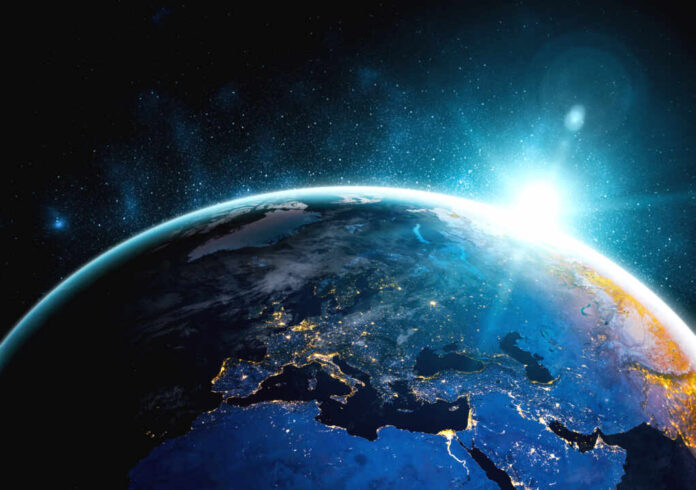
Life on Earth may have been engineered, a theory stirring clashes between tradition and bold new science.
At a Glance
- Francis Crick and Leslie Orgel proposed directed panspermia in 1973.
- Chandra Wickramasinghe argues gaps in abiogenesis may support engineered origins.
- Harvard labs created synthetic cells that mimic living functions.
- Webb Telescope detected dimethyl sulfide on exoplanet K2-18b.
A Theory Older Than Aliens in Hollywood
In 1973, Francis Crick and Leslie Orgel floated the idea of directed panspermia. They suggested life could have been seeded on Earth deliberately. At the time, the claim was more provocation than accepted theory, but it found believers in later decades.
Astrobiologist Chandra Wickramasinghe became one of its most vocal champions. He argued unresolved gaps in abiogenesis pointed to engineered origins, though his critics called the claim speculative. Biochemist Jack Szostak countered that natural chemical processes still offered the best path for life’s spark.
Watch now: Life on Earth Engineered by Aliens?
Arizona State’s Paul Davies added fuel with his work in astrobiology. He noted synthetic biology now provides testable ways to examine theories of life’s rise. Still, mainstream science has not budged from abiogenesis as the leading view.
Synthetic Biology Upsets the Equation
Harvard’s Wyss Institute brought the debate forward with experiments that mimic life. Jack Szostak and his team built cell-like systems that act like crude versions of living organisms. The systems can grow and replicate functions without being truly alive.
These synthetic cells are not proof of engineered life, but they reshape the line between chemistry and biology. They provide models for how lifelike systems might emerge, or how they might be designed. Each advance complicates the debate over whether life had a natural start or a guided one.
The idea unsettles researchers, but it also equips them with sharper tools. The more biology is simulated, the more testable claims of panspermia or directed origins become.
Signals From Distant Skies
The James Webb Space Telescope deepened the riddle by spotting dimethyl sulfide on K2-18b. On Earth, this molecule is only made by living organisms, suggesting possible biosignatures in alien skies.
Sara Seager of MIT stressed caution. She said biosignatures hint at life but not at design. Still, the detection opened questions about whether life’s chemical markers are universal or unique to Earth’s story.
Watch now: Exoplanet Biosignature Discovery Explained
The discovery widened the field of evidence. Instead of looking only at Earth’s chemistry, scientists now weigh signals from across the galaxy. Each signal may support or weaken the case for life’s engineered origins.
What’s Next in the Search
NASA’s 2023 Astrobiology Strategy pointed to synthetic biology and biosignature detection as top priorities. The agency sees these fields as central to unraveling the origin of life.
Future experiments may provide evidence that narrows the gap between natural chemistry and engineered systems. But even strong results may not settle whether Earth’s spark was chance or design. The question now drives a larger cultural debate.
If engineered life were ever confirmed, the impact would shake not just science but philosophy and religion. It would challenge assumptions about human uniqueness and evolution itself. For now, the argument remains unresolved, suspended between test tubes and telescopes.
Sources