
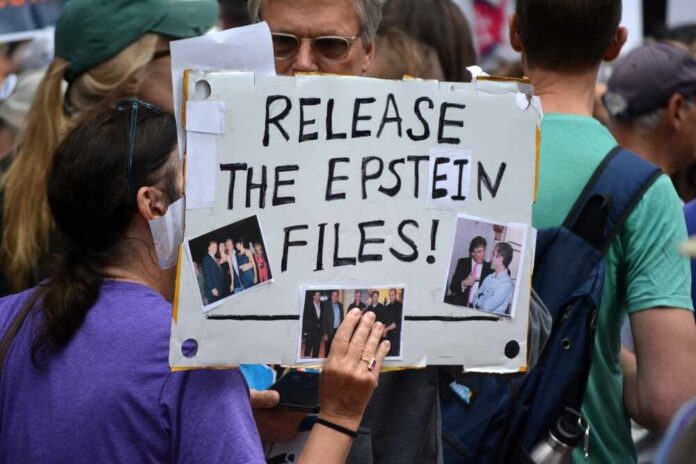
A law meant to force sunlight onto the Epstein scandal is now forcing a federal watchdog to ask why the Justice Department missed deadlines, heavily redacted records, and even pulled files back after posting them.
Quick Take
- The DOJ Office of the Inspector General has opened an audit into whether DOJ followed the Epstein Files Transparency Act’s release requirements.
- The act required all Epstein and Ghislaine Maxwell-related DOJ records to be released within 30 days, but the deadline passed without full compliance.
- DOJ later said it published about 3.5 million pages plus thousands of videos and images, yet a separate analysis reported tens of thousands of files were removed after publication.
- Critics argue DOJ over-redacted and may have excluded categories of records like internal communications; DOJ says it prioritized victim privacy and active investigations.
Why the Inspector General Stepped In
The Justice Department’s Office of the Inspector General announced an audit focused on DOJ’s compliance with the Epstein Files Transparency Act, the 2025 law President Trump signed requiring a rapid release of records tied to Jeffrey Epstein and Ghislaine Maxwell. The review targets how DOJ identified documents, applied redactions, and handled post-release concerns. The IG’s involvement matters because it is one of the few institutional checks inside the federal system with the authority to examine DOJ processes in detail and publish findings.
Congress wrote the law to prevent the familiar Washington pattern where “transparency” arrives late, incomplete, or in forms that defeat public scrutiny. Under the statute, DOJ had 30 days to release the materials after enactment. That deadline passed, and criticism grew from multiple directions, including survivors and Democratic lawmakers demanding a review. The IG audit now becomes a test of whether a congressionally mandated disclosure regime can actually constrain a powerful bureaucracy when the subject is politically and socially explosive.
What DOJ Says It Released—and What Critics Say Changed
DOJ announced it had published more than 3 million additional pages—nearly 3.5 million pages total—along with about 2,000 videos and 180,000 images, presenting the move as full compliance. DOJ described a massive review operation involving roughly 500 attorneys and said the department “erred on over-collecting” rather than under-collecting. Officials also emphasized victim protection, including steps to avoid disclosing identifying information or sensitive content while meeting the law’s demands.
At the same time, outside scrutiny raised questions about whether “published” meant “stayed published.” A subsequent analysis reported that DOJ removed around 47,000 files, representing about 65,500 pages, after the initial posting, leaving roughly 2.7 million pages available publicly. That sequence—post-release takedowns after a transparency law—has predictably fueled suspicion across the political spectrum. The IG audit is positioned to clarify whether removals were corrections, privacy protections, technical issues, or something that conflicts with what Congress required.
The Dispute Over Redactions and “Missing” Categories of Records
A major point of contention is what the law required DOJ to treat as “records relating to Epstein and Maxwell.” The Democracy Defenders Fund argued DOJ’s approach was too narrow and leaned on redaction and withholding in ways that undercut the statute’s purpose. Among the allegations: that DOJ excluded internal communications such as emails, and that the department over-redacted material beyond what is necessary to protect victims or active investigative work. The group’s repeated letters helped keep pressure on DOJ to explain its methodology.
DOJ leadership has countered that privacy and ongoing investigative sensitivities are real constraints, not excuses. Deputy Attorney General Todd Blanche publicly pushed back on claims that the department is shielding prominent individuals, describing a larger universe of collected pages than what was ultimately released. DOJ also pointed to processes intended to ensure victim information was not accidentally exposed, with the U.S. attorney’s office in the Southern District of New York certifying that victim-identifying material was not left unredacted. The IG audit will need to weigh these claims against documented procedures.
What the Audit Could Change—and Why It Matters to Voters
The inspector general has not provided a timeline for completion, but the office said it will issue a public report when the audit concludes. The practical outcomes could include recommendations for clearer redaction standards, improved document-tracking, or changes to how DOJ posts and maintains large public releases. If the IG finds DOJ’s process fell short of the statute, it could prompt re-releases, revised searches, or greater congressional oversight—outcomes that matter regardless of party because the underlying question is whether federal agencies obey the law.
For conservatives who have watched “deep state” controversies multiply across decades, the Epstein release fight is a familiar stress test: a politically sensitive issue, a massive federal bureaucracy, and a public demand for transparency that runs into institutional incentives to control information. For liberals skeptical of elite impunity, the same facts trigger similar concerns. The most defensible position right now is also the simplest: allegations of tampering or protection are not proven, but DOJ’s missed deadline, heavy redactions, and post-publication removals make an independent audit the minimum standard for public confidence.
Justice Department's OIG Reviewing Dept's Compliance With Law That Released Epstein Fileshttps://t.co/zWyGZ6Odgv
— RedState (@RedState) April 24, 2026
Until the audit is finished, the public is left with competing narratives and incomplete visibility into decision-making inside DOJ. That uncertainty is exactly what laws like the Epstein Files Transparency Act were meant to reduce. If the IG’s report clearly documents how DOJ searched, what it withheld, and why files were taken down, it could become a model for future high-profile disclosures. If it doesn’t, distrust in federal institutions will continue to harden—one more sign that accountability in Washington often depends on who has the power to demand it.
Sources:
Justice Department watchdog launches probe into compliance with Epstein files law
Department of Justice Publishes 3.5 Million Responsive Pages in Compliance with Epstein Files