President Trump defied a Supreme Court ruling striking down his tariff authority by immediately imposing new import taxes using an alternative legal mechanism, perpetuating uncertainty for American businesses and consumers already burdened by billions in tariff costs.
Story Snapshot
- Supreme Court ruled 6-3 that Trump’s emergency tariffs exceeded presidential authority, rejecting billions in import taxes
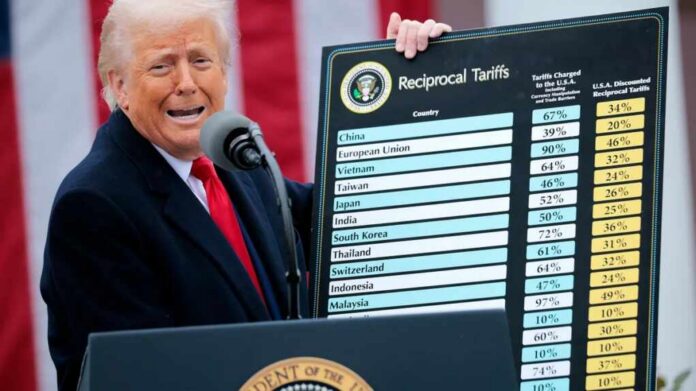
- Trump responded within hours by enacting new 10% global tariffs under untested legal authority with a five-month time limit
- Businesses face chaos over $133-175 billion in refunds while navigating new tariff regime vulnerable to legal challenges
- Three Trump-appointed justices joined liberals in majority, highlighting constitutional limits on executive power
Supreme Court Rejects Emergency Powers Tariffs
The Supreme Court delivered a 6-3 ruling striking down President Trump’s global tariffs imposed under the 1977 International Emergency Economic Powers Act. The Court determined that IEEPA does not grant presidents authority to levy import taxes, a power the Constitution explicitly reserves for Congress under Article I. Trump had collected between $133 billion and $175 billion through these tariffs on imports from nearly every country, with rates reaching up to 50 percent on goods from Canada, Mexico, and China. The ruling represents the first time the Supreme Court has rejected Trump’s use of emergency trade powers.
Trump Appointees Join Liberals in Constitutional Check
Three justices appointed by Trump—Neil Gorsuch, Amy Coney Barrett, and Chief Justice John Roberts—joined the Court’s liberal wing to form the majority against the administration’s tariff authority. This alignment underscores a fundamental constitutional principle that transcends political appointments: Congress alone holds the power of taxation. The decision creates a significant precedent limiting executive branch authority over trade policy. For Americans frustrated with government overreach regardless of party, this ruling demonstrates that constitutional constraints can still function when unelected judges prioritize law over political loyalty, even against the president who elevated them to the bench.
Immediate Replacement Tariffs Raise New Legal Questions
Within hours of the Supreme Court ruling, Trump announced new 10 percent baseline tariffs on imports from nearly every country using different statutory authority, likely Section 122 of trade law. This provision, historically unused for broad tariff implementation, permits temporary tariffs for balance-of-payments purposes but imposes a five-month time constraint. Trump declared, “We’re immediately instituting the 10 percent provision, which we’re allowed to do.” Legal experts warn this rapid pivot has “unleashed a whole new set” of potential legal challenges. The move ends uncertainty about whether tariffs would continue while creating fresh doubts about the durability and legality of the replacement mechanism.
Refund Chaos Compounds Business Uncertainty
American businesses now confront what trade lawyers describe as a “bumpy ride” navigating refunds for the invalidated tariffs while adapting to the new tariff structure. U.S. Customs and Border Protection must process refund claims for the $133-175 billion collected under the struck-down authority, with importers—not consumers—likely receiving reimbursements according to trade law experts. The National Retail Federation is pushing for expedited refunds to provide economic relief, while states like Illinois demand family rebates averaging $1,700. Meanwhile, businesses must simultaneously comply with the replacement tariffs and prepare for potential legal challenges that could invalidate those as well within months.
The situation exemplifies a pattern troubling to Americans across the political spectrum: government officials pursuing policies that create instability and hardship for ordinary citizens and businesses trying to plan and prosper. Whether one supports or opposes tariffs as policy, the whiplash of implementation, judicial invalidation, massive refund obligations, and legally questionable replacements suggests a government more focused on asserting power than providing the stable, constitutional governance essential for economic success. This episode raises fundamental questions about whether elected leaders and unelected bureaucrats prioritize their authority over the practical needs of families and entrepreneurs struggling to navigate an already challenging economy.