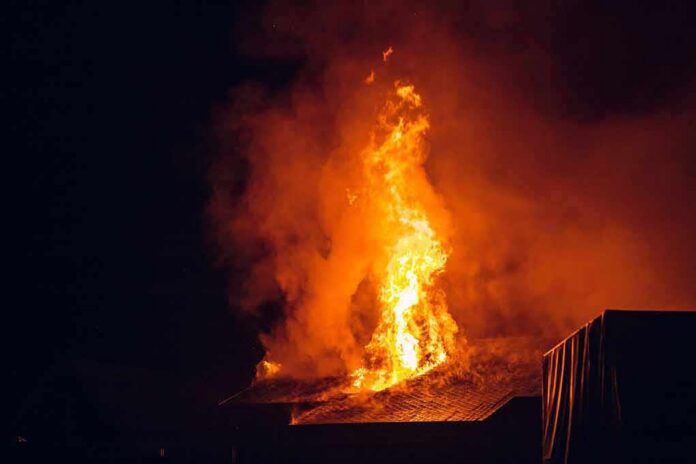
A man with a violent record is now accused of sparking Spokane’s largest wildfire as public trust in both safety and government competence burns with it.
Story Snapshot
- Spokane County officials charged 37-year-old Aaron Farinacci with first-degree arson in the Old Trails Fire.
- The Old Trails Fire is the largest of three Spokane-area fires that destroyed hundreds of buildings and forced mass evacuations.
- Court records show police questioned Farinacci about two other fire investigations in 2025 but never charged him.
- The case highlights how rarely arson cases end in convictions and how hard it is to prove what starts a wildfire.
Man charged with starting Spokane’s biggest wildfire
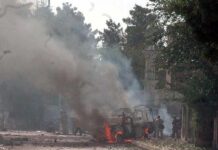
Spokane County Sheriff John Nowels announced that deputies arrested 37-year-old Spokane resident Aaron F. Farinacci on Monday on a charge of first-degree arson connected to the Old Trails Fire. Officials say this fire is the largest of three blazes that erupted around Spokane over the weekend, destroying hundreds of buildings and forcing tens of thousands of people to leave their homes. A judge set Farinacci’s bond at $1 million as prosecutors argue he is a danger to the community while the case moves forward.
Investigators say a citizen tip helped them find their suspect. A witness reported a man bending or kneeling near grass in the area where the Old Trails Fire later started. Deputies detained a man matching that description on Saturday, identified him as Farinacci, questioned him, and released him that day. As the investigation advanced, major crimes detectives obtained an arrest warrant and picked him up again on Monday at his Spokane home without incident, also serving a search warrant on the property.
What investigators say happened at the fire scene
Fire investigators told the sheriff they believe the Old Trails Fire was intentionally started in dry roadside grass using either matches or a butane lighter. When deputies first contacted Farinacci on Saturday, they say he had waterproof matches and a butane lighter in his possession, which matched that ignition theory. Authorities have not publicly released full forensic details, but they say scene work and interviews led them to conclude that the fire was arson rather than an accident. Investigators stress that the probes into the other two Spokane fires remain open, with no cause announced yet.
According to a probable cause statement described by national and local outlets, Farinacci has a serious criminal past, including a manslaughter conviction in Arizona after killing his father in 2010. Court records also show that Spokane-area law enforcement talked to him in 2025 about two separate fire-related incidents. One case involved several “bus-sized” fires near his apartment complex, while the other involved a wildfire in a state park that triggered evacuation notices. Police did not arrest or charge him in either earlier case, but detectives later saw those contacts as important background once his name surfaced in the Old Trails Fire investigation.
How this case fits a larger pattern of arson investigations
Arson investigators across the country face a core problem that reaches beyond Spokane: fire often destroys the very evidence needed to prove how it started. National guidance for wildland fire work says every wildfire scene must be treated as a possible crime scene at first, and investigators should only decide on a cause once the physical evidence and witness accounts support a clear ignition story. That process is slow and careful, because picking arson too quickly can lead to bad calls, weak cases, and even wrongful convictions later.
Older Justice Department research shows why the stakes are high. A study of several cities found that suspects were identified in fewer than one-third of arson cases, and only about four percent of cases ended with an adult conviction. Federal crime data from the same era showed that only 19 percent of reported arsons were even cleared by arrest. Those numbers are dated but still used in arson-prosecution guides to show how rare it is to move from suspicion to solid proof when fire has wiped out the scene.
Shared public fears: safety, competence, and accountability
The Old Trails Fire has hit Spokane at a time when many Americans on both the right and the left already feel the system is failing them. Residents who lost homes or saw their neighborhoods burn want to know why someone with a violent record and two prior fire contacts with police was still free if he is now proven guilty. Others worry about the flip side: that in the rush to respond to public anger, officials may lean on thin evidence in a highly emotional case.
National wildland fire guidance and arson-law manuals both stress that investigators must protect evidence, follow the scientific method, and meet probable-cause rules before seeking warrants. That balance—acting fast enough to protect communities while building cases that can stand up in court—is exactly where many citizens feel government often falls short. Whether you worry more about crime and chaos, or about state power and mistakes, this Spokane case shows how fragile trust can be when massive damage, past failures, and complex science collide in one investigation.
Sources:
youtube.com, spokesman.com, x.com, weartv.com, fs-prod-nwcg.s3.us-gov-west-1.amazonaws.com, gbv.de, wvlawreview.wvu.edu, research.fs.usda.gov, law.justia.com