The Justice Department sued California and asked a court to set aside mail ballots linked to about 20,000 “likely” noncitizens until citizenship can be confirmed, putting ballot counting on hold in the nation’s largest state just weeks before a federal election.
Story Snapshot
- Justice Department filed a federal complaint alleging about 20,000 likely noncitizens on California’s voter rolls.
- Federal request seeks to set aside related mail ballots until citizenship is verified.
- California leaders reject the demand, citing lack of disclosed proof and methods.
- Prosecutors also announced 28 voting-related criminal cases tied to the broader probe.
What The Justice Department Filed And What It Wants
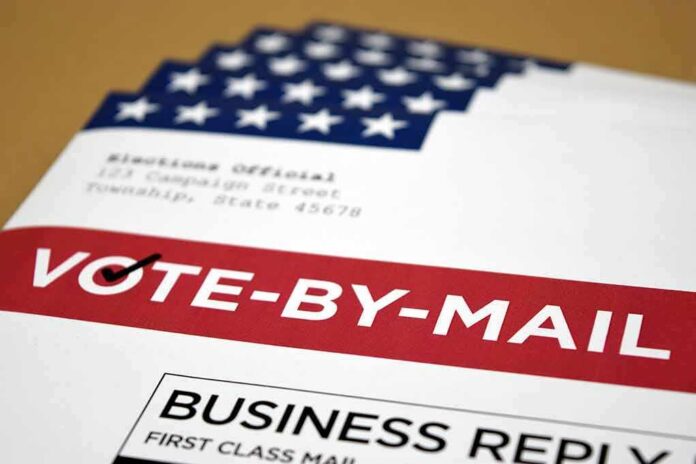
On October 15, 2026, the Department of Justice filed suit against California, its Secretary of State, and Los Angeles County. The complaint alleges that more than 20,000 likely noncitizens were registered or voted in a federal election. The filing asks a judge to bar California from counting vote-by-mail ballots from those flagged voters until officials verify citizenship. The requested order would require setting aside those ballots during the check.
Justice Department officials said they provided California with a spreadsheet of about 20,000 names, including birth dates and addresses. Reporting says the data arrived on a password-protected thumb drive. A spokesperson said the listed voters had been “manually verified,” while warning the number could grow. California officials control election records and processes, so any match review depends on state action and court direction.
How California Officials Responded And Why It Matters
California’s Secretary of State said the federal government did not provide proof that the identified voters are noncitizens and warned the state would not disenfranchise voters based on unproven claims. State leaders said the list lacked detail and usable function for investigation, and they would review solid evidence if provided. The Attorney General questioned earlier federal estimates that fell from about 190,000 to 20,000, calling the shift evidence of weak methods.
California leaders also argued that counts, recounts, and audits have not found widespread voter fraud. Election law experts noted the lawsuit did not share a detailed identification method. According to reporting, the federal approach used checks by United States Citizenship and Immigration Services, comparing voter rolls with internal immigration data to find likely matches. Critics said such database matches can create errors without voter-by-voter documentation.
The Criminal Cases And The Limits Of What They Prove
Days after filing the lawsuit, federal prosecutors announced charges against 28 people for election-related offenses in California. Reports said the defendants were among those identified through the federal list process. These cases show concrete examples the government says back its claims. But the existence of 28 cases does not confirm the citizenship status for the rest of the roughly 20,000 flagged names or prove how many ballots were returned or counted.
This is from the pending federal case United States v. State of California, Shirley N. Weber (Secretary of State), and Dean C. Logan (LA County Registrar-Recorder/County Clerk), No. 2:26-cv-12025 (C.D. Cal.).
The U.S. Department of Justice sued in mid-October 2026 seeking a… pic.twitter.com/9ldfIfb0Zn
— Breaker of Sheeple (@SheepleBreaker) October 21, 2026
Past studies have found that noncitizen voting in federal elections is rare. Reviews of millions of votes across many jurisdictions found very few suspected cases, and many alleged fraud reports trace back to data errors. That history does not settle this dispute. But it does explain why both accuracy and timing matter. Large database matches near an election can sweep in errors and fuel distrust if the methods and records are not open to verification.
What To Watch Next: Evidence, Process, And Voter Confidence
Courts may order an independent review that compares the 20,000 names to ballot-return records and citizenship documents while protecting privacy. A clear, documented method could measure the error rate and show which names, if any, tie to returned ballots. Federal officials could also file a voter-level evidentiary index showing the fields matched, dates, and records used. Transparent steps on both sides could reduce mistakes and help the public trust the result.
The clash reflects a deeper problem: systems built on trust, speed, and mass mail voting meet rising demands for proof. California says it will not block ballots without evidence. The Justice Department says it has enough to pause counting for a narrow set while checking status. Voters across parties want both secure rolls and fair access. The path forward is simple in principle: show the records, test the matches, and count only eligible votes, quickly and openly.
Sources:
thegatewaypundit.com, justice.gov, usatoday.com, abcnews.com, newsweek.com, latimes.com, usnews.com, politico.com, apnews.com, kpbs.org, kqed.org, brennancenter.org, snopes.com