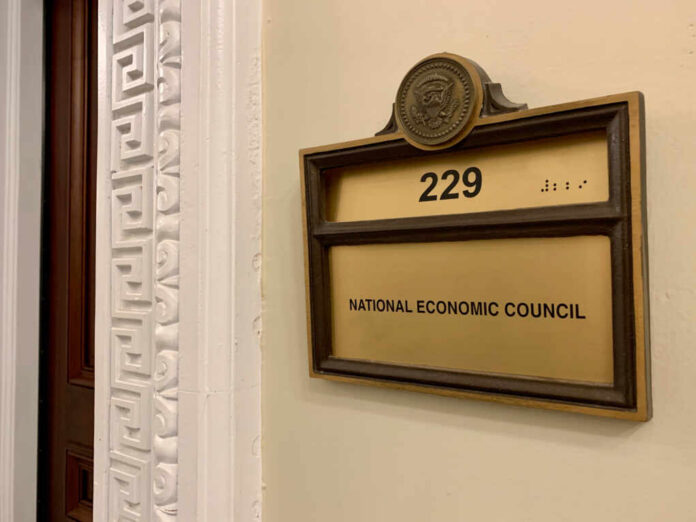
Trump’s top economic adviser is claiming real incomes are soaring under the president’s watch — but the numbers behind that headline deserve a closer look before Americans celebrate.
Quick Take
- National Economic Council Director Kevin Hassett says the typical American family has gained about $3,000 in real income since Trump took office.
- Hassett’s claim rests on real wage data for select sectors, not a comprehensive national income measure, leaving the full picture open to debate.
- A separate proposal to send Americans $2,000 checks funded by tariff revenue remains undelivered and contingent on congressional approval.
- Critics on both the left and right point out that administration economic claims routinely rely on favorable subseries rather than the broader official statistics most economists use.
Hassett Makes the Case for Trump’s Economic Record
Kevin Hassett, Director of the National Economic Council, appeared on television Sunday to defend the Trump administration’s economic performance, declaring that “real incomes are soaring.” Hassett stated that if you examine real wage data, the typical American family has gained approximately $3,000 since President Trump took office. He specifically highlighted rising real wages in manufacturing and mining as concrete examples of working-class gains under current policy.
Hassett also promoted a separate proposal in which Americans would receive $2,000 checks funded by tariff revenue collected from foreign trading partners. The idea is framed by the administration as a way to return trade-policy gains directly to ordinary citizens. However, Hassett acknowledged on CBS News’ “Face the Nation” that any such payments would depend entirely on what happens with Congress, meaning the proposal requires a congressional appropriation before a single dollar reaches any household.
Why the Numbers Are Being Questioned
The core dispute is not simply partisan spin — it reflects a recurring structural problem in how economic progress gets measured and communicated. Official assessments of whether Americans are truly better off rely on a specific set of data series: Bureau of Labor Statistics wage data, Census Bureau household income figures, Bureau of Economic Analysis personal income reports, and inflation measures such as the Consumer Price Index or Personal Consumption Expenditures index. Administration claims that lean on narrower sector-level wage data, rather than these headline national measures, are harder to independently verify.
Hassett has a history of making ambitious economic forecasts that later drew scrutiny. Former Treasury Secretary Lawrence Summers publicly challenged Hassett’s analysis of the Trump tax plan, arguing that wage-growth projections tied to corporate tax cuts were not supported by mainstream economic modeling. More recently, reporting indicates Hassett navigated carefully around questions about whether the president had overstated inflation figures, choosing instead to redirect toward favorable job-market data rather than directly address the discrepancy.
The Bigger Problem Both Sides Should Recognize
Whether you lean left or right, the pattern here is familiar and frustrating. Government officials — from both parties across many administrations — routinely cherry-pick economic indicators that support their preferred narrative while downplaying the broader picture. When the administration says real incomes are soaring, it is worth asking: soaring for whom, measured how, and compared to what baseline? Those are not partisan questions — they are the basic questions any informed citizen should demand answers to.
NEC Director Kevin Hassett says real incomes are rising and that the typical American family has gained about $3,000 in real income since President Trump took office. pic.twitter.com/XgbuuTkR81
— Moshe Schwartz (@YWNReporter) May 31, 2026
The $2,000 tariff-check proposal adds another layer of complexity. Tariffs are taxes paid by American importers, and their costs are frequently passed on to consumers through higher prices. Whether tariff revenue can meaningfully offset those price increases — and whether Congress will ever authorize direct payments — remains unresolved. For millions of Americans already stretched thin by years of inflation, the gap between a White House press appearance and an actual deposit in their bank account is not a minor detail. It is the whole story.
Sources:
[1] Web – Kevin Hassett Defends President Trump’s Record on the Economy, …
[2] Web – Top White House economic adviser Kevin Hassett says $2,000 tariff …
[3] Web – ‘Disgusting’: Trump’s Top Economic Adviser Brags About Killing …
[4] YouTube – Kevin Hassett says $2,000 tariff checks for Americans will …
[5] Web – Hassett’s flawed analysis of the Trump tax plan
[6] Web – Hassett defends president’s claims on jobs – Media Lens Reader
[7] Web – Hassett’s flawed analysis of Trump tax plan – Lawrence H. Summers