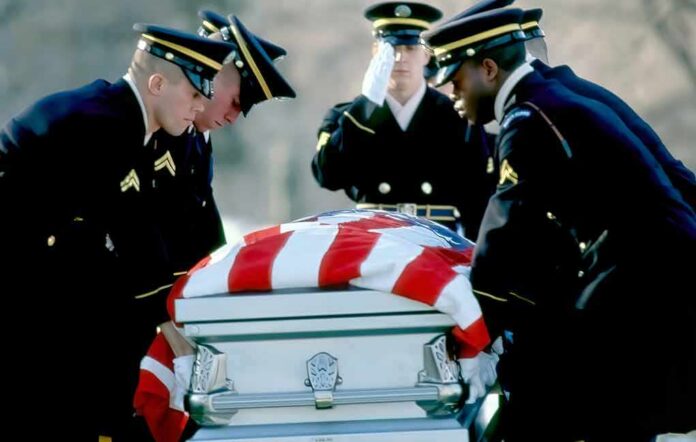
As six fallen American soldiers came home from Iran’s war front, the quiet ceremony meant to honor them turned into another test of trust between the people and those who lead them.
Story Snapshot
- President Trump attended a dignified transfer at Dover Air Force Base for six soldiers killed in an Iranian drone attack in Kuwait.
- The ceremony highlighted how much ordinary families sacrifice while Washington wages a long, unclear war against Iran.
- The event fit a larger pattern in which presidents’ behavior at Dover becomes a national scorecard for respect toward the military.
- Mixed media coverage and rising partisan anger fuel doubts about whether leaders treat these solemn rituals as duty or as political optics.
What Happened At Dover Air Force Base
President Donald Trump traveled to Dover Air Force Base in Delaware to attend a dignified transfer for six United States service members killed in an Iranian drone attack in Kuwait during the war with Iran. The ceremony brought home the first American soldiers killed in that conflict, making it a major moment in a war many citizens struggle to follow or understand. Trump, First Lady Melania Trump, Vice President JD Vance, and Defense Secretary Pete Hegseth walked onto the flight line with top military officers as the transfer began.
Military personnel slowly carried flag‑draped transfer cases from a transport aircraft to waiting vehicles, while families stood nearby in silence and grief. The ceremony lasted roughly half an hour and followed standard dignified transfer protocol, which the United States Armed Forces use to honor remains returning from overseas combat zones. The bodies were then taken to the base mortuary, where they would be prepared for burial and returned to loved ones who must now live with the permanent cost of choices made far away in Washington.
Who These Fallen Soldiers Were
The Pentagon said all six soldiers were Army Reserve members assigned to the 103rd Sustainment Command, a unit that handles food, fuel, water, ammunition, and other supplies that keep front‑line troops alive and moving. They were killed at Shuaiba port in Kuwait, a commercial harbor that doubles as a logistics hub for the United States military, when Iranian drones struck in the opening hours of the war. Eighteen other service members were wounded in the same attack, showing how deadly the strike was and how exposed support units can be.
The Defense Department publicly named the fallen as Sgt. 1st Class Nicole M. Amor, Sgt. Declan J. Coady, Capt. Cody A. Khork, Chief Warrant Officer 3 Robert Marzan, Maj. Jeffrey R. O’Brien, and Sgt. 1st Class Noah L. Tietjens. These soldiers came from communities in Minnesota, Iowa, Florida, California, and Nebraska, reminding us that wars fought in Kuwait, Iran, Iraq, or Jordan always reach back into American towns and families. For both conservatives and liberals who feel ignored by elites, their deaths underscore that ordinary people still pay the highest price for foreign policy decisions.
Why Dignified Transfers Matter So Much
A dignified transfer is the formal process by which the military returns the remains of fallen service members from the theater of operations where they died. The ritual grew more visible after President Barack Obama became the first sitting president to attend one at Dover in 2009, and it has since become a major test of how presidents show respect for the troops. Analysts note that every president who goes—or chooses not to go—faces intense scrutiny, because these ceremonies are among the most solemn duties of the commander in chief.
World News Tonight: "Pres. Trump attended the dignified transfer at Dover Air Force Base honoring four U.S. soldiers killed during the war in Iran."https://t.co/TuCso6UYXL
— XOOAA 🇺🇸 🇮🇱 🇰🇷 (@X_O_O_A_A) July 23, 2026
Coverage of Trump’s visits has followed that pattern. Some reports focus on his decision to attend and to salute as the cases passed, framing it as a serious effort to honor the dead. Others highlight earlier controversies over hats, photos, and political messaging around similar events, which feed long‑standing fears that leaders turn even the most sacred moments into stage‑managed images. The ceremony itself, however, remained quiet and tightly controlled, driven by military protocol rather than campaign slogans.
Public Anger, Media Framing, And A War Few Understand
This dignified transfer took place as United States and Israeli forces continued strikes linked to the war with Iran, a conflict that has stretched on for months with shifting goals and limited public debate. Many Americans on the right blame decades of globalist foreign policy and weak deterrence for dragging the country into yet another Middle East war. Many on the left see endless conflict as proof that military‑industrial interests and political elites override voters’ desire for peace and investment at home.
Media reports on Trump’s Dover visits often mix hard facts with emotional headlines, which can deepen mistrust. One outlet even had to apologize for airing old dignified transfer footage by mistake, showing how confusing coverage can become. When citizens already believe a “deep state” runs policy in the shadows, every error or sensational frame around a solemn ceremony looks like more evidence that they are not being told the full story. That frustration spans party lines and feeds the sense that Washington treats war deaths as a backdrop rather than a warning.
What This Says About The Federal Government Today
Trump’s attendance at Dover fits a larger picture of a federal government that speaks the language of honor while many citizens feel its actions do not match its words. Republicans now direct both Congress and the White House, yet long wars, high costs, and political showmanship still define much of what people see from Washington. For older conservatives, this Dover ceremony sits alongside anger at inflation, illegal immigration, and energy policy. For older liberals, it joins worries about growing inequality and cuts to social support.
At the flight line, the ceremony was simple: six soldiers came home in silence, and the president and military leaders stood by as families watched. Outside the base, the same event became another fight over optics, motives, and blame. That split between ritual respect and political noise is exactly what makes many Americans doubt that any side in Washington really puts ordinary people first. The dignified transfer shows the military still works hard to honor its dead. It also reminds us that trust in the leaders who send them into danger is badly broken.
Sources:
youtube.com, abcnews.com, bbc.com, pennlive.com, instagram.com, reddit.com, abcnews.go.com