When a Texas roller coaster full of children stalls 100 feet in the air and the only detailed explanation comes from the company that profits from the ride, it reinforces why so many Americans no longer trust the institutions that claim to keep them safe.
Story Snapshot
- Eight Houston students on a school field trip were stranded high on a Galveston roller coaster for hours before firefighters brought them down safely.[1][2]
- The park’s owner says the Iron Shark coaster “malfunctioned” but stopped “as designed,” while offering no public technical report showing what actually failed.[1][2]
- Local news highlighted the dramatic rescue, but the cause of the stoppage and details of state oversight remain largely unexplained.[1][2]
- The incident underscores growing public concern that corporations and regulators protect reputations first and families’ safety second.[1][2]
What Happened On The Iron Shark In Galveston
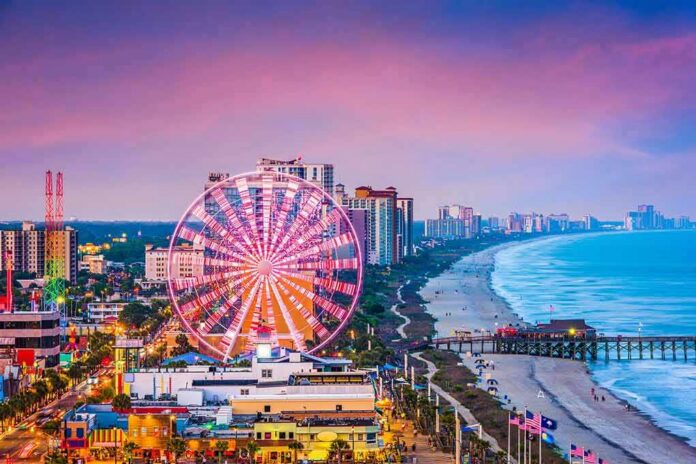
On a June afternoon in Galveston, Texas, eight riders became stranded near the top of the Iron Shark roller coaster at Pleasure Pier after the train stopped close to its 100-foot vertical lift hill.[1] Houston school officials later confirmed the riders were students from Energized for STEM Academy Middle School and STEM Academy High School on a district field trip, not adult thrill seekers.[1][2] Fire officials said they received a call around 5:37 p.m., and television review suggested the coaster had been stopped since about 5:21 p.m.[1]
Emergency crews from the Galveston Fire Department responded with a ladder truck, positioning the ladder near the stalled train so firefighters could reach the students suspended high above the pier.[1] Firefighters climbed onto the structure, secured each rider in a harness, and then lowered them one by one to the ground in a methodical rescue that played out live on local and national broadcasts. Coverage from several outlets reported that all eight students were safely evacuated with no immediate injuries.[1][2]
Official Story: “Malfunctioned, But Stopped As Designed”
Pleasure Pier’s owner, Landry’s Incorporated, said the Iron Shark “experienced a malfunction” but emphasized that the train stopped as it was engineered to do in order to keep passengers safe.[1][2] In statements carried by local media, the company said its focus shifted immediately to riders’ safety and that the fire department was called to assist with removal.[1] Park officials also said the coaster would remain closed until a “thorough inspection” was completed and that ride-safety testing would occur before reopening to the public.[1][2]
Some reporting cited the operator’s explanation that a sensor failed, triggering the stop, and that the issue could not have been detected beforehand based on what the company knew at the time.[1][2] However, none of the available coverage includes the underlying maintenance logs, fault codes, or state inspection paperwork that would be needed to independently verify this narrative.[1][2]
What We Still Do Not Know About The Ride’s Failure
Across the news reports, key facts like the number of riders, the location of the stall, and the basic rescue method are consistent, but important technical details remain unresolved.[1][2] Coverage varies on how long the students were trapped, with references to roughly two hours, more than two hours, or simply “hours,” leaving the precise duration uncertain.[1] Accounts also differ on whether the riders were fully upside down or merely in a steep near-vertical position, and there is no engineering reconstruction in the record clarifying the train’s exact orientation.[2]
The public material does not include sworn statements from the students, chaperones, or firefighters detailing their minute-by-minute experience on the ride and during the rescue.[1][2] There is also no publicly available incident packet from the Galveston Fire Department, such as radio logs, after-action reports, or detailed timelines, that would help establish the sequence beyond the broad outlines seen on television.[1] Likewise, there is no confirmed documentation from Texas amusement-ride regulators showing whether a formal investigation found design flaws, maintenance lapses, or simply an isolated sensor failure.[1][2]
Why This Resonates With Growing Distrust Of Elites
For many Americans across the political spectrum, this episode feels familiar: a dramatic failure, reassuring statements from a large company, and very little transparent data that ordinary citizens can check for themselves.[1][2] Conservatives who worry that corporate interests and government regulators often downplay risk may see another example of a profit-driven operator controlling the narrative about what went wrong.[1][2] Liberals who focus on safety standards and inequality may note that working families send their children on school trips trusting systems that are largely explained behind closed doors.[1][2]
🇺🇸 Coaster stall strands students high above Galveston waters
What happened:
Eight students were left dangling nearly 100 feet up on the Iron Shark roller coaster at Pleasure Pier when it stalled on May 29. Rescue teams used ladders to safely bring them down after three to four… pic.twitter.com/QhdhROTdxi— The States Brief (@TheStatesBriefX) May 30, 2026
The broader pattern in amusement-ride incidents is that early reporting documents the rescue clearly but leaves the technical “why” unanswered until deeper records emerge, if they emerge at all.[1][2] Here, the company’s claim that the ride “stopped as designed” remains the dominant story, even though it has not been tested publicly against maintenance data or independent engineering review.[1][2] In an era when many believe a small group of elites protects its own interests first, the gap between dramatic images and thin public evidence feeds the sense that institutions ask for trust they have not fully earned.[1][2]
Sources:
[1] YouTube – Texas roller coaster riders rescued after hours stuck 100 feet up
[2] Web – 8 students rescued after getting stuck on Pleasure Pier roller coaster …