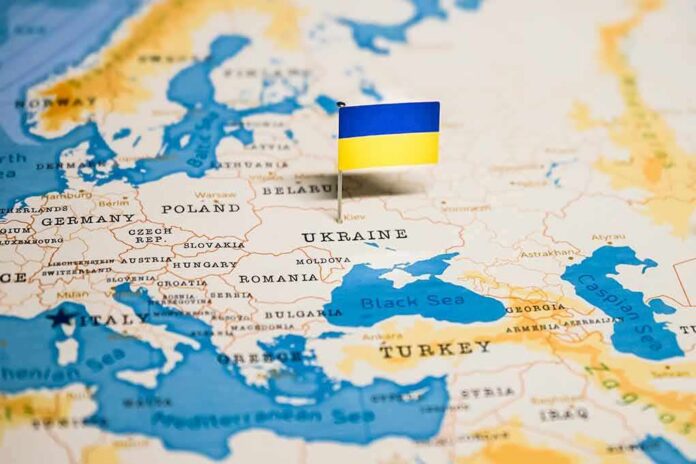
Ukraine’s latest long‑range strike did not just hit Russian assets—it blew open a new front by targeting Iran‑linked cargo ships in the closed waters of the Caspian Sea.
Story Snapshot
- Ukraine says it struck a Russian warship and vessels moving Iran‑linked military cargo in the Caspian Sea.
- Iran says the hit was on a “commercial” ship, killing one sailor, and warns the attack “will not go unanswered.”
- The strike shows the Russia‑Ukraine war is now reaching deep into a region long kept away from open conflict.
- The dispute highlights how powerful states use “commercial” routes to move weapons while regular people pay the price.
Ukraine’s Caspian Strike and What Zelensky Claims It Hit
President Volodymyr Zelensky announced that Ukrainian forces used long‑range weapons to hit targets deep inside Russia, including in the Caspian Sea, a landlocked body of water ringed by Russia, Iran, and several smaller states. In a post on X, Zelensky said Ukraine “achieved very strong results” by striking “vessels used in military cargo shipments involving Iran, as well as a warship,” framing the operation as part of a wider campaign to punish Russian military logistics far from the front line. Ukrainian security services later briefed media that at least one of the vessels was moving military cargo between Iran and Russia while dodging international sanctions.
These claims fit a pattern Ukraine has talked about for months: Russian and Iran‑linked ships quietly moving weapons, drones, and other gear through supposedly civilian routes. The Caspian Sea, closed off from the world’s oceans, offers the perfect hidden corridor for such transfers. By hitting ships there, Kyiv is signaling that no part of Russia’s supply chain is off‑limits, even if it sits far from the fighting ordinary Americans usually hear about. That kind of long‑reach strike raises big questions about where this war stops—and whether global trade routes are still safe from becoming battlefields.
Iran’s Reaction: “Commercial Vessel” Claim and Promise of a Response
Iran’s Foreign Ministry tells a very different story. Officials in Tehran say Ukraine attacked an Iranian “commercial vessel” in the early hours of Saturday, causing an explosion that killed one sailor and wounded another. Iran’s statement calls the strike “an act of aggression” and warns that the country “will not hesitate to defend itself” under international law. They say Ukraine has openly admitted responsibility and accuse Zelensky’s government of following an “illogical and hostile approach” toward the Islamic Republic, language meant to paint Kyiv as reckless and criminal.
Iran has summoned Ukraine’s top diplomat and is pressing the European Union and other governments to hold Kyiv accountable for what it insists was an attack on civilian commerce. That framing matters because it aims to turn global opinion against Ukraine, cast doubt on Western support, and rally sympathy for Iran as a supposed victim. At the same time, Iran’s leaders are hinting at possible retaliation, including threats that “all of Ukraine is within reach” of their missiles, according to regional media reports. For people watching from the United States, this sounds like yet another foreign crisis that could drag on for years while regular citizens worry that elites are playing war games over shipping lanes.
Closed Seas, Shadow Cargo, and Expanding War Risks
The Caspian Sea has long been a quiet zone, used for oil, gas, and shipping between Russia, Iran, and their neighbors. Now it is turning into a battlefield. Ukraine argues that striking Russia’s Iran‑linked supply route is a lawful way to cut off weapons and equipment helping Moscow keep its war going. Iran argues the same strike was an illegal attack on a commercial ship. Outside observers do not get to inspect the cargo, so they cannot easily prove which story is true. Instead, regular people are asked to trust statements from governments that already have long records of secrecy and spin.
This clash fits a wider wartime pattern: one side calls a ship “military logistics,” the other calls it “civilian trade.” Both use legal language, but the facts are hard to verify because evidence on board may be destroyed in the blast or hidden behind classified files. When wars spill onto sea lanes, insurance costs rise, shipping gets riskier, and the price of energy and goods can climb. That hits families on tight budgets in America and Europe, even as they watch leaders in Washington, Moscow, and Tehran argue over whose cargo was “legal.” Many on both the right and left already feel that the global system serves arms dealers and energy giants, not workers trying to keep the lights on.
Why This Matters for Ordinary Americans and the Global System
For Americans who feel the federal government ignores their struggles, this story feeds a familiar worry: powerful states quietly move weapons and oil across the world while telling citizens the system is about “free trade” and “rules‑based order.” In the Caspian Sea, a closed, heavily controlled waterway, ships apparently under sanctions still carried what Ukraine calls military cargo between Iran and Russia. That suggests enforcement of sanctions and rules is weaker than officials admit, and that elites on every side find ways around the law.
https://t.co/ND4sdQtojd
Zelensky wrote on X that Ukraine “achieved very strong results with long‑range strikes in the Caspian Sea—including vessels used in military cargo shipments involving Iran.”— Beelzebub2049 (@ShuzoA) July 27, 2026
At the same time, the strike shows how fast one war can bleed into another. Ukraine says it is defending itself by hitting Russia’s supply chain; Iran says Ukraine is dragging the region toward a bigger conflict. Each side talks about defending “national interests,” yet the cost falls on sailors killed at sea, taxpayers funding drones and missiles, and citizens who face higher prices and growing risk of wider war. For many Americans, this reinforces a grim belief: the global security game is run by a small circle of governments and corporations, while regular people are left to hope the next missile does not hit their energy bills or their children’s future.
Sources:
reuters.com, youtube.com, jpost.com, euronews.com, biz.chosun.com, arabtimesonline.com, aljazeera.com