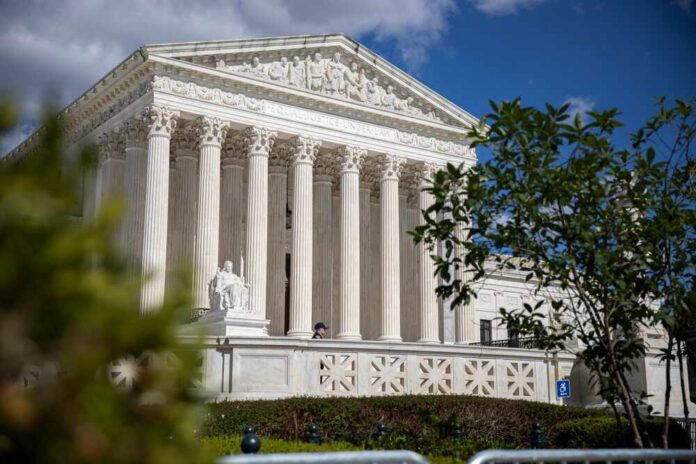
The Supreme Court has cleared Alabama to use a congressional map that a federal panel already declared intentionally discriminatory — and Justice Sonia Sotomayor is calling it a blueprint for chaos.
Story Snapshot
- The Supreme Court lifted a lower-court block and allowed Alabama to use its 2023 congressional map, which contains only one majority-Black district, ahead of this year’s elections.
- A federal three-judge panel had previously ruled the Republican-drawn map intentionally discriminated based on race and violated Section 2 of the Voting Rights Act of 1965.
- The case is a direct sequel to the Court’s own 2023 ruling in Allen v. Milligan, which found Alabama’s earlier map illegally diluted Black voting strength — yet Alabama drew a nearly identical replacement.
- Justice Sotomayor issued a sharp dissent, warning the decision would “unleash chaos” on voting rights protections across the country.
What the Supreme Court Actually Did
The Supreme Court issued an order allowing Alabama to proceed with its 2023 congressional map — one that preserves a single majority-Black district out of seven total seats — for this year’s elections. The ruling came as an emergency stay, meaning the Court halted the lower court’s block without issuing a full written opinion explaining its reasoning on the merits. That procedural reality is important: the public sees a result, but not necessarily a complete legal rationale behind it.
Emergency redistricting orders like this one have become a familiar pattern in American election law. Because ballot printing and candidate filing deadlines create hard calendar constraints, courts are repeatedly forced into rushed decisions about which map governs a given election cycle. The Supreme Court has intervened in similar fashion in states including North Carolina, Louisiana, and Georgia, often siding with legislatively drawn maps over court-ordered remedial ones while full litigation continues below.
A Direct Defiance of the Court’s Own Prior Ruling
What makes Alabama’s case especially striking is its history. In 2023, the Supreme Court itself ruled in Allen v. Milligan that Alabama’s previous congressional map likely violated Section 2 of the Voting Rights Act of 1965 because it packed Black voters into too few districts. Alabama’s legislature responded by drawing a new map — the one now cleared for use — that the federal three-judge panel said still failed to create a second district where Black voters had a meaningful opportunity to elect a representative of their choice.
The three-judge panel went further, finding that Alabama lawmakers “well knew” the new map would continue to dilute Black electoral power and drew it that way regardless. That is a finding of intentional discrimination — a high legal bar — based on a full trial record. The Supreme Court’s decision to allow the map to be used while that finding remains on appeal is what prompted Justice Sotomayor’s pointed dissent and has drawn criticism from civil rights organizations who argue the Court is undermining the very statute it upheld just three years ago.
Why This Matters Beyond Alabama
Redistricting battles like this one are not just about one state’s congressional seats. They reflect a deeper and unresolved tension in American democracy: who controls the lines that determine which voters elect which representatives? When legislatures draw maps that courts find discriminatory, and those maps are then allowed to stand through election cycles while appeals drag on for years, the practical effect is that the discrimination shapes actual election outcomes before any remedy arrives.
Supreme Court allows Alabama GOP-backed congressional map for midterms https://t.co/uIjc5wJNyS #FoxNews
— Greg Shields (@GregShield83077) June 3, 2026
For voters across the political spectrum who already distrust that the system works for ordinary people, this case offers fresh evidence of how legal and procedural complexity can insulate powerful actors from accountability. Whether the concern is racial gerrymandering suppressing minority voters or partisan gerrymandering locking in one-party dominance, the underlying complaint is the same: maps drawn by those already in power tend to keep those people in power. The Alabama fight, now heading back through the courts, is unlikely to be resolved before the votes are cast.