
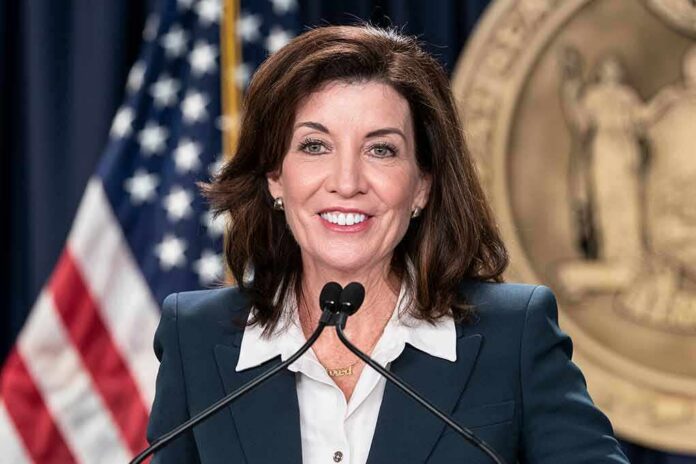
New York’s governor linked “sky-high” antisemitism at home to Israel’s leadership abroad, and the backlash shows how global wars now shape local safety and politics.
Story Snapshot
- Gov. Kathy Hochul said her job would be “a lot easier” if Benjamin Netanyahu lost office.
- She argued Israel’s “overreach” shifted global opinion and fueled political blowback.
- Antisemitic incidents in New York hit a record 1,437 in 2024, then fell 19% in 2025.
- Critics say Hochul is dodging state responsibility; city officials ramped up enforcement.
What Hochul Said And Why It Matters
Gov. Kathy Hochul told POLITICO her job would be “a lot easier” if Israeli Prime Minister Benjamin Netanyahu lost power, while describing antisemitism as “sky-high right now” in New York. She said she warned Israel after October 7 that an “overreach” in Gaza could erode support and change the tone worldwide. She tied the issue to her duties to protect Jewish New Yorkers and fund security for synagogues and yeshivas. Her comments drew fast criticism and national attention.
Hochul also outlined a policy alternative. She said she wants Israeli leaders “of goodwill” who ensure Israel’s security and also build “a safe Palestinian state,” arguing Netanyahu is not aiming for that outcome. That framing tries to separate criticism of a leader from hostility toward Jews. It also places her views inside a diplomatic debate. Still, the statement links a foreign government’s choices to rising hate at home, which is a charged claim in U.S. politics.
The Incident Numbers In New York
The Anti-Defamation League reported 1,437 antisemitic incidents in New York in 2024, up 18 percent and the highest the group has recorded in the state. New York City officials said Jewish New Yorkers made up 54 percent of all reported hate-crime victims in the prior year, and 62 percent in the first quarter of 2025. In 2025, the Anti-Defamation League counted 1,160 incidents statewide, a 19 percent drop from 2024, while assaults rose from 82 to 90. These totals track pressure on police and schools.
These figures show scale, but they do not prove cause. The reports combine harassment, threats, vandalism, and assaults. They do not tag each case to a motive like response to Israeli policy versus local extremist ideology. That limits firm claims about why incidents rose or fell in a given month. The mixed 2025 picture—fewer total cases but more assaults—also complicates any simple trend line that ties changes to one leader or a single policy step.
Pushback From Critics And The Local-Government Lens
Republican Representative Mike Lawler said Hochul was repeating talking points instead of dealing with New York antisemitism directly, calling her “feckless” and accusing her of blaming Jews for hatred against Jews. Republican gubernatorial candidate Bruce Blakeman said antisemitism grew under Hochul’s watch and argued she failed to protect Jewish students during campus protests, while tying unrest to New York City politics. These critics want attention on state and city enforcement, not foreign leaders.
New York City moved on that front. City Hall created a Mayor’s Office to Combat Antisemitism and cited the share of hate-crime victims who are Jewish, reinforcing a local enforcement and services frame. The mayor later signed an executive order and proposed laws to codify a working definition that addresses discrimination tied to nationality and other categories, aiming to help agencies respond faster. That approach keeps the focus on arrests, school safety, and public order rather than geopolitics.
What The Evidence Can And Cannot Show Right Now
Hochul’s position tracks a known “spillover” risk: overseas violence can activate bias and make diaspora Jews targets. Past research finds antisemitic acts often rise during Gaza wars, through media and protest channels, even if the conflict is not the root cause of those beliefs. But the current public data in New York do not connect specific incidents to named Israeli decisions. Hochul’s reported private warning to Israel is not backed by documents in the record provided.
How can Jewish New Yorkers back Hochul after she Blames Netanyahu for rise in Antisemitism?!?!
*NY Governor says job would be 'a lot easier' if Netanyahu loses*
New York State Governor Kathy Hochul claims she is doing her best to protect Jewish New Yorkers and blames Netanyahu…
— Chava (@ChavaL1018) October 28, 2026
For readers worried about safety and accountability, two facts hold at once. First, the incident load has been severe, straining police, campuses, and synagogues. Second, the counting systems track outcomes, not motives, so a hard causal link to a single foreign leader is not proven. That leaves room for leaders to act where they control tools: consistent enforcement, clear rules on campus, targeted security grants, and transparent data that show what is working and where it is not.
Sources:
twitchy.com, politico.com, nyc.gov, nynj.adl.org, docs.house.gov, hotair.com