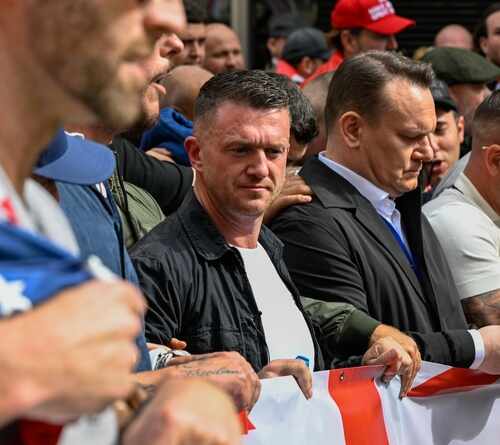
An ISIS-linked magazine has reportedly singled out British activist Tommy Robinson for “unconditional” murder—raising fresh questions about whether the West can protect outspoken dissidents without tripping over its own red tape.
Quick Take
- An Islamic State Pakistan Province/Khorasan outlet launched a new magazine that urges lone-actor attacks and prominently targets Tommy Robinson by name.
- Robinson says he left the UK after Bedfordshire Police warned him of intelligence tied to the publication, which authorities treat as proscribed material.
- The magazine’s messaging leans on older Islamist justifications and fits a broader “Terrorize Them!” propaganda theme aimed at inspiring individual violence.
- Reporting notes uncertainty in naming (ISPP vs. ISKP; “Invade” vs. “Yalghar”), but multiple outlets converge on the core claim: a real threat stream and a police warning.
What the ISIS publication reportedly called for
Reporting says the Islamic State Pakistan Province—also described as Islamic State Khorasan Province in some accounts—released the first issue of a magazine titled Invade (also rendered as Yalghar) on February 9, 2026. The publication allegedly included a poster naming Tommy Robinson (Stephen Yaxley-Lennon) and called for his “unconditional” killing. The issue reportedly launched a “Terrorize Them!” series intended to encourage lone-actor attacks against non-Muslims.
The messaging matters because it is designed to bridge distance: even if leadership sits in Afghanistan/Pakistan networks, propaganda aims to move a self-radicalized supporter in the UK—or anywhere else—to act alone. That model has repeatedly challenged Western law enforcement, since the “planner” can be a PDF, an encrypted share, or a social post rather than a direct handler. Officials must then manage both a personal protection problem and a broader public-safety risk.
Police warning, proscribed material, and Robinson’s reported exit
Nation.Cymru reported that Bedfordshire Police contacted Robinson by phone and warned him about intelligence indicating that an ISIS publication was encouraging violence against him. Robinson later said he left the UK following the warning. The same reporting indicates police confirmed the call’s legitimacy while also treating the magazine as prescribed material—an important detail because it underscores how counterterror rules can complicate transparency when a targeted person asks to see the material.
That tension—public safety versus due process and practical self-defense—hits a nerve across the political spectrum. Conservatives tend to see a recurring pattern: the state is quick to police speech and slow to protect citizens from ideologically driven violence. Liberals often worry about backlash and collective blame. The hard reality is that a credible threat environment requires clear, lawful protection for individuals while avoiding broad-brush suspicion of peaceful communities.
Why propaganda targets high-profile “blasphemy” critics
Coverage describes the magazine as using a quote attributed to medieval theologian Ibn Taymiyya alongside Robinson’s image, framing the target through an older “punishment for insult” logic rather than a narrow geopolitical grievance. Analysts connect that approach to a broader jihadist tradition: publicizing a named target can energize sympathizers, create “proof” of ideological seriousness, and shift the operational burden to a lone attacker with minimal communications.
Robinson’s profile also fits why propagandists choose symbolic figures. He has been prominent for years for activism focused on immigration, grooming-gang scandals, and criticism of Islamism, and he has faced prior threats. His supporters view him as a free-speech test case; his critics see him as provocative. Either way, extremist messaging benefits from the spotlight: it turns a political controversy into a recruitment narrative and dares governments to appear either powerless or heavy-handed.
What’s confirmed, what’s unclear, and what to watch next
Several points align: an ISIS-aligned provincial media outlet published a magazine issue that names Robinson as a target; Robinson amplified the report on X; and local police warned him about intelligence connected to the publication. Some specifics remain murky in open reporting, including the exact branding of the magazine (Invade vs. Yalghar) and whether the correct label is ISPP or ISKP, which may reflect overlapping usage for the same network.
ISIS Calls on Muslims to Murder Tommy Robinson – https://t.co/Ee2Zji9KKu pic.twitter.com/zFuGq5rGM0
— Robert Spencer (@jihadwatchRS) April 12, 2026
The next signposts are concrete: whether UK authorities announce protective measures, whether any arrests emerge tied to threat activity, and whether additional issues of the magazine expand the target list. For Americans watching from afar, the bigger question is familiar: can Western governments defend liberal-democratic basics—like the right to criticize religion and ideology—without burying citizens in bureaucracy or letting fear set the boundaries of lawful speech?
Sources:
ISIS Calls on Muslims to Murder Tommy Robinson
Tommy Robinson says he has left UK after being named in IS publication
ISIS Calls on Muslims to Murder Tommy Robinson