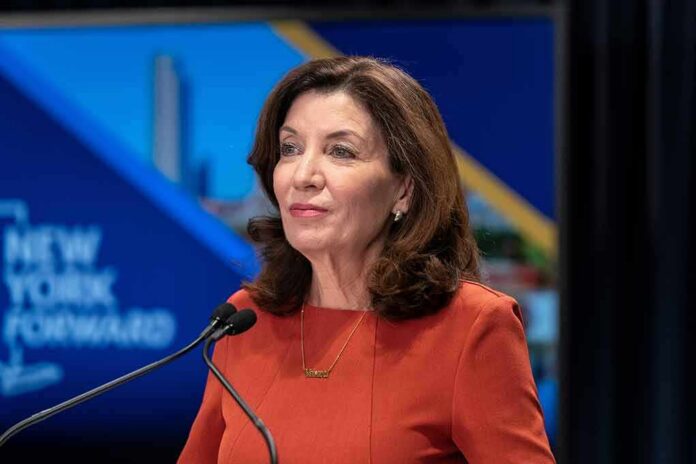
New York’s governor just expanded free, taxpayer-funded health care for sex workers, and the bill is growing.
Story Snapshot
- Governor Kathy Hochul extended a pilot health program for sex workers through 2028, raising total cost to about $2.5 million [3].
- The state added $1.5 million to the initial $1 million, with services in New York City and Buffalo only [3].
- Critics say the move bypassed the Legislature and lacks proof of results after the first phase [1].
- Opponents argue current public programs already offer many of these services, calling the pilot redundant [2].
What New York Extended And Who Pays
New York’s Department of Health will keep a pilot program running that gives primary, behavioral, gynecological, and dental care to sex workers. The program began in 2023 with $1 million in public funds and is now extended to June 2028 with another $1.5 million. That brings the total taxpayer tab to about $2.5 million. State documents and press reports say two healthcare contractors will serve people in New York City and Buffalo under this plan [3].
Officials say the goal is to close health gaps among a marginalized group and offer wellness checks and full-scope care. The state’s justification frames this as a public health effort. But the public record offered so far gives few hard numbers. There is no published state evaluation yet that shows better health outcomes, lower infection rates, or reduced crime tied to this program. That lack of data fuels the larger fight over cost and priorities [3].
Process, Oversight, And The Democratic Check
Assemblyman Steve Hawley says the governor authorized the program without approval from the Legislature. He calls that undemocratic and says the move forces taxpayers to fund care for an illegal trade. His statement also warns that such programs risk encouraging prostitution and could invite more crime and violence. These claims raise process and safety questions that the administration has not answered with public, verifiable results from the pilot phase [1].
Fiscal oversight questions now center on the extra $1.5 million and how contractors will prove performance. Lawmakers can request an audit to show what services were delivered, to whom, and with what impact. Without that record, taxpayers cannot see whether this spending is efficient or redundant. An audit could also test claims that the program advances a wider push to decriminalize prostitution by following the money and the contracts that guide services [1].
Is The Program Redundant Or Targeted?
Civil rights attorney Robert Patillo notes that federal Title Ten programs and New York State clinics already provide free wellness screenings, contraception, and testing and treatment for sexually transmitted diseases. Critics ask why the state needs a separate program if those services exist and are open to people in need. Supporters answer that sex workers face stigma and barriers in regular clinics. The state, however, has not yet shown unique outcomes from this pilot to justify its special track [2].
Geography adds another sticking point. The program serves New York City and Buffalo only. Former New York City council member Joe Borelli questioned why other areas are excluded if this is a statewide priority. If the state says this improves public health and safety, then the narrow footprint undermines the claim. It also invites charges of political targeting and raises fairness issues for taxpayers who live outside those two cities [3].
What Data Would Settle The Debate
Clear data could reduce the noise. A formal state evaluation should show enrollment counts, clinic visits, testing rates, treatment starts, and follow-ups. It should also report cost per patient, wait times, and referral outcomes. If the program claims to improve community safety, then police and public health trend lines in program zones should be compared to similar areas without the pilot. Absent that, the public sees a headline cost and no proof of return [3].
You can’t make this sh*t up.
New York State’s Governor Kathy Hochul snuck into her bill an extension for free healthcare coverage for hookers at a cost of $2.5 million taxpayer dollars. For the "Sex Worker Health Pilot Program.”
UN “F’N BELIEVABLE!!!
— Retired Penguin (@RetiredPenguin2) June 22, 2026
Lawmakers can also call sex workers who used the program to give testimony on access and results. If the program helps people get faster care with better outcomes, that should be easy to document. If not, the state should end the pilot and route people to existing clinics. Either way, the next step is simple: publish the evaluation, open the books for an audit, and let voters judge whether this is smart care or mission creep on the taxpayer’s dime [1].
Sources:
[1] Web – Democrat Governor Kathy Hochul is spending another $1.5 million of …
[2] Web – Hawley Denounces Free Health Care Program for Sex Workers
[3] YouTube – Attorney panel talks Hochul’s health care proposal for sex workers