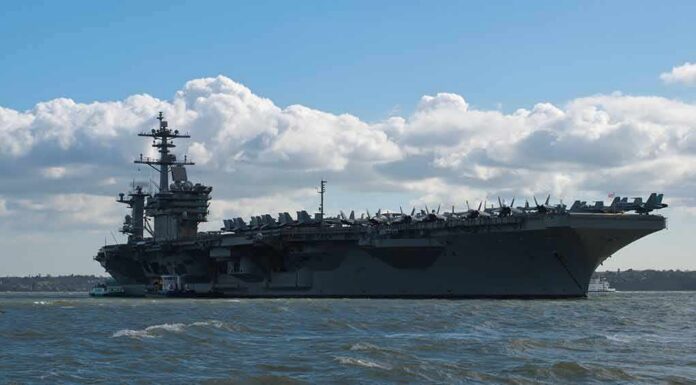
After more than eight months at sea, the aircraft carrier USS Abraham Lincoln is finally heading home as another carrier races to relieve it, spotlighting how far U.S. deployments now stretch beyond the Navy’s seven-month goal.
Story Snapshot
- The USS George Washington is deploying to replace the USS Abraham Lincoln after an extended tour.
- Navy officials say Lincoln’s return is a planned rotation after months in tense waters.
- Recent carrier tours across the fleet often exceed seven months due to global demands.
- Sailor strain and maintenance backlogs fuel bipartisan worries about readiness.
Carrier Swap Signals End of Lincoln’s Extended Tour
U.S. officials said the aircraft carrier USS George Washington is headed to the Middle East to replace the USS Abraham Lincoln, which has been deployed for more than 250 days, marking the final phase before Lincoln’s return to San Diego. Navy leaders framed the turnover as a scheduled rotation, the standard term when one carrier relieves another on station. The move keeps a large U.S. naval presence in a volatile region while enabling the Lincoln’s crew to head home after months of sustained operations.
The Navy has long aimed for seven-month deployments, but global crises and gaps in relief timing have pushed many tours longer in recent years. Vice Chief-level planning signals earlier this year even raised the prospect of an 11-month deployment for another carrier, showing how demand can outrun the schedule. The Lincoln’s swap with George Washington fits that broader pattern, where the service balances deterrence, alliance commitments, and shipyard timelines against human limits and ship wear.
What “Planned Rotation” Really Means
When Navy leaders call a homecoming a “planned rotation,” they signal control and continuity to allies and rivals alike, even if the schedule slid beyond the goal line. That messaging matters for deterrence, but it also masks hard trade-offs. Longer cruises stack stress on sailors and families and delay maintenance that keeps ships ready for the next fight. Lawmakers recently cited the Lincoln’s more than 250 days deployed and over 200 days without a port call to press the Pentagon for answers on crew welfare and readiness.
The pattern is not new. During earlier deployments, Lincoln set endurance marks that became talking points for both pride and concern inside the fleet. Today, carrier demand spans the Middle East, Europe, and the Indo-Pacific, where near-constant tasking can stretch strike groups beyond the ideal cycle. Each extension buys time in one hotspot but costs time in training, rest, and repairs elsewhere. That math rarely adds up cleanly when the Navy is short hulls and shipyard capacity.
Why Both Sides Are Watching Readiness
Families and veterans worry about sleep, food, and mental health when port calls vanish and workdays run long. Defense hawks worry that deferred maintenance and crew fatigue will show up later as broken gear and safety risks. Recent reporting described how multiple carriers exceeded the Navy’s seven-month target, deepening concern about the sustainability of today’s tempo. These are shared concerns across party lines: people want a strong Navy that can fight tonight, but not by burning out sailors or skipping critical repairs.
This carrier swap matters beyond one ship. It is a test of whether the Pentagon can keep persistent presence abroad while rebuilding depth at home. It also tests whether leaders will level with the public about costs. When a rotation is on time, it shows planning works. When it runs long, it signals the force is stretched. The George Washington’s deployment to relieve Lincoln is meant to restore that balance, at least for one strike group.
What Comes Next for Lincoln and the Fleet
Once Lincoln pulls into Naval Air Station North Island in San Diego, the crew will reset, and the ship will enter maintenance that piled up during the long cruise. That yard time is vital. Skipping repairs today means longer, pricier overhauls tomorrow, and more schedule slips down the line. The Navy’s own historical releases show how the service celebrates homecomings but depends on disciplined upkeep to make the next deployment possible. Strong fleets are built as much in dry docks as at sea.
Military service has always entailed hardship, extended deployments, and imperfect conditions—that is part of what volunteers knowingly accept when they raise their right hand. If Governor Moore wishes to honor the sailors of the USS Abraham Lincoln, he might begin closer to…
— Burdock (@NoLieCipher) August 16, 2026
The larger fix requires steady budgets, clear priorities, and honesty about limits. Americans across the spectrum see a pattern: missions grow, promises slip, and the burden falls on working sailors while leaders argue over talking points. A transparent schedule, predictable port calls, and enough ships to share the load would help. For now, the George Washington takes the watch, and the Lincoln’s crew finally heads home. That is a win. But the system that forced this sprint still needs repair.
Sources:
newsnationnow.com, stripes.com, wsj.com, news.usni.org, navysite.de, youtube.com