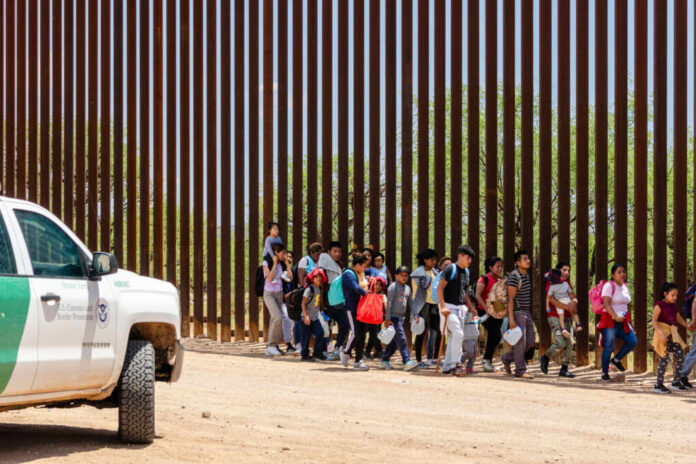
While Washington argues over speeches and soundbites, Mexican cartels are quietly using cheap drones and bullets to empty entire communities—just miles from the U.S. border.
Story Snapshot
- Weaponized cartel drones are no longer rare incidents but part of a systematic campaign that is pushing rural families off their land.
- Researchers have linked drone bombardments to forced displacement in multiple Mexican states, creating a largely invisible humanitarian crisis.
- Mexican authorities acknowledge some attacks yet struggle to track or respond to the scale of population flight.
- Americans on both the right and left see a familiar failure pattern: high-tech threats grow while governments protect their own power first.
Cartel Drone Warfare Turns Towns into Battlefields
Reports from Mexico describe cartels turning off‑the‑shelf hobby drones into airborne bombers, using them not just against rivals but against whole communities.[1] Analysts at a major United States research institute explain that since at least 2020, criminal groups have operated weaponized drones against security forces, enemies, and civilians.[1] In Michoacán, the Jalisco New Generation Cartel has used drones to lay explosive minefields and bombard rural areas, deliberately making villages unlivable so residents flee and territories can be seized.[1][3]
On the ground, those tactics translate into shattered daily life rather than headlines. Investigators have documented cases where cartel bombardments drove out tens of thousands of people, with drones used as tools of “scorched earth” warfare rather than isolated terror attacks.[1] Instead of trying to win loyalty, cartels simply clear out populations that might resist, replacing community structures with fear. Human rights advocates argue this is forced displacement by another name, even when it never shows up in official refugee counts.[3]
An Invisible Displacement Crisis Few Governments Count
Forced displacement in Mexico is notoriously undercounted because families fleeing cartel violence often move quietly to relatives’ homes or informal settlements, not official camps.[3] Local governments rarely maintain precise registries of who leaves under threat, and national statistics usually tally murders, not emptied villages. Analysts note this pattern has appeared in earlier waves of cartel violence; the drone era just adds a cheaper, more scalable tool to the same grim playbook of terror, flight, and territorial control.[1][3]
Experts who track cartel drone attacks stress that the numbers we do have show a rapidly escalating problem. One research project mapping weaponized drone incidents attributed to criminal groups in Mexico recorded 221 such cases between 2021 and 2025, with dozens of deaths and many more injuries. These incidents are spread across multiple states, suggesting a nationwide learning curve rather than a one‑off experiment. Yet there is still no comprehensive government system for tying these attacks to how many people are pushed from their homes.
Authorities Admit the Threat but Lag on Protection
Mexican officials no longer deny that weaponized drones are part of cartel arsenals. Public statements by security leaders, summarized in border‑security reporting, acknowledge explosive‑laden drone attacks that wounded police officers and even killed soldiers. Authorities also concede that drones are now used for assassination attempts and battlefield support against government forces. Those admissions undercut any claim that drone violence is a myth, but they stop short of recognizing the displacement crisis that community leaders and human rights advocates describe.
United States officials, meanwhile, are focused on the threat spilling over the border. A Texas public radio report notes growing concern that cartel drones used for smuggling and reconnaissance could be adapted for attacks on American soil or against law enforcement. That emphasis on cross‑border risk fits a familiar pattern: leaders in Washington frame the issue mainly through national security, while families on both sides of the border experience it as a basic safety and survival problem. The human cost in Mexican villages remains largely background noise in official debates.[1]
Why This Matters for Ordinary Americans
For Americans frustrated with both parties, the drone‑driven displacement crisis highlights a deeper failure of modern government. Mexican cartels exploit cheap technology, porous borders, and weak institutions to control territory, while politicians in Mexico City and Washington trade threats and talking points.[1][3] Conservatives see that as proof that globalism and lax borders have empowered ruthless criminal networks. Liberals see another case where poor communities pay the price while elites in both countries remain insulated.
Hi Nathaniel, I’ve been following your work closely — especially your reporting on cartel drone attacks, political risk, and U.S.-Mexico relations through Modern Mexico Podcast and Latin American Lens. Your insights have been incredibly valuable.Our Blue Star Institute is also…
— Blue Star / Regional (@singlesurp51896) May 14, 2026
What unites these perspectives is a shared sense that ordinary people are unprotected while powerful interests adapt slowly, if at all. Analysts warn that cartels are already learning from wars abroad, experimenting with more advanced drones and potentially artificial‑intelligence‑assisted targeting.[3] If governments continue to react piecemeal, the next phase could involve longer‑range strikes and broader displacement. Paying attention now is not about panic; it is about recognizing that an invisible humanitarian crisis at our doorstep is a warning sign of how far state authority has slipped.
Sources:
[1] Web – How Mexican cartels are using drones, now and in the future
[3] Web – Five Questions on Mexican Cartel Drones – OCCRP