
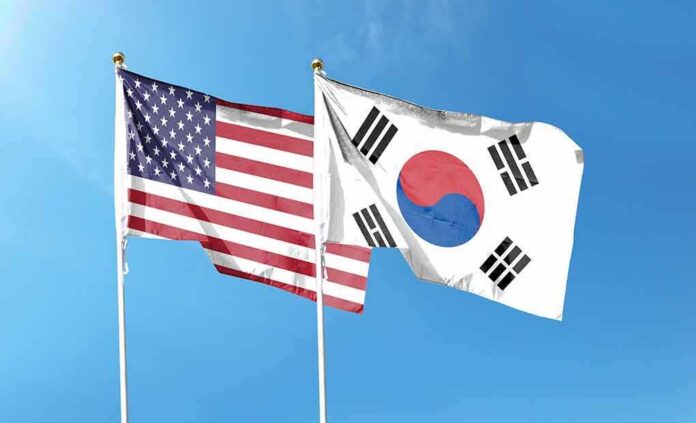
South Korea moved to fast-track control of its own wartime command just days after President Trump said joint drills would be scaled back, sharpening a long-running test of alliance trust and national sovereignty.
Story Snapshot
- President Lee reaffirmed wartime command transfer as a top goal tied to sovereignty.
- U.S.–South Korea plan keeps transfer “conditions-based,” with no fixed date set.
- Defense estimates suggest late 2027 to 2030 if agreed conditions are met.
- U.S. Forces Korea warns political timelines must not outrun readiness.
What President Lee Said And Why It Matters
President Lee Jae Myung said South Korea will push ahead with taking back wartime operational control during his term. He framed the move as a matter of sovereignty and self-reliant defense, arguing that the nation should lead its own protection on the peninsula. His government placed the handover in its policy plans last year. Lee has linked the goal to dignity and responsibility, which resonates at home whenever alliance decisions appear driven by Washington’s shifting priorities.
Lee’s stance followed fresh friction after President Trump said joint military drills would be scaled back. That announcement revived questions about who sets the pace in the alliance and how reliable large exercises will be from year to year. South Korean officials say the transfer is part of a long arc of modernization, not a snap reaction. Still, the timing makes the sovereignty push feel urgent for many in Seoul who fear sudden U.S. changes.
What “Conditions-Based” Actually Means
Both governments describe the transfer as conditions-based, not tied to a hard date. The plan would place a South Korean four-star in command of the Combined Forces Command, with a U.S. general as deputy. Each country would still control its own troops. This structure reflects South Korea’s military growth but keeps shared civilian oversight. U.S. congressional research says the timeline was delayed twice and remains open until benchmarks are met.
United States Forces Korea has restated that message. The command says the handover depends on Seoul’s ability to lead combined forces, on strong strike and air defenses, and on a stable security picture. Leaders warn that politics cannot outpace real readiness. Supporters say sticking to conditions makes both countries safer by reducing the chance of confusion in a crisis and by keeping deterrence clear to North Korea.
Timelines, Capability Gaps, And The North Korea Factor
South Korea’s defense planners have floated a window as early as late 2027, while other estimates run closer to 2030, depending on how talks and tests go. Reuters reported that Seoul seeks to finish within that range if capability goals are met with the United States. The varied dates show ambition but also uncertainty. The spread reflects an honest limit: public sources do not include the full evaluation reports that verify each readiness stage.
The scaling back of South Korea-U.S. joint military drills, following U.S. President Donald Trump’s social media post calling for a reduction, has increased uncertainty in Seoul’s push for an earlier transfer of wartime operational control (OPCON) from Washington.…
— The Korea Times (@koreatimescokr) August 19, 2026
The stakes are high because North Korea’s expanding missile and nuclear programs raise the cost of error. Critics of a quick shift fear mixed signals in a crisis. Backers argue Korean leadership would sharpen responsibility and speed. The agreed future setup keeps U.S. nuclear decisions with Washington and preserves tight coordination. That balance aims to pair Korean lead with continued U.S. deterrence, but it will only work if both sides validate command performance in rigorous exercises.
Why Americans Should Care
For U.S. readers, this is about promises, cost, and control. When Washington trims exercises to save money or avoid risk, allies get nervous, and adversaries test lines. A stable, tested handover could lower the burden on U.S. forces while keeping deterrence strong. But rushing for headlines can waste taxpayer dollars if units must relearn basics later. Clear plans, public milestones, and honest risk checks protect both American troops and American credibility abroad.
What To Watch Next
Watch the fall Security Consultative Meeting, where both sides aim to set a firmer schedule and define what “ready” looks like. Look for joint after-action reports from command-post drills that show Korean-led teams can fight, communicate, and reinforce under stress. Expect U.S. lawmakers to ask for risk assessments before any switch. If leaders release more of the underlying evaluations, the public will be able to judge progress without spin from either capital.
Sources:
english.hani.co.kr, bernama.com, chosun.com