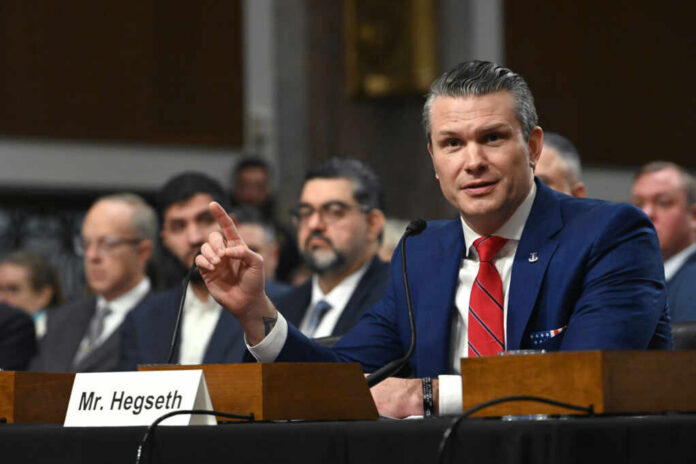
As America’s war dead were honored on the cliffs of Normandy, the sitting U.S. defense chief warned that Europe’s beaches are being “stormed” again—not by Nazi armies, but by “dangerous ideologies” arriving by boat.
Story Snapshot
- Pete Hegseth used a solemn D-Day ceremony to link modern migration into Europe with a new “invasion” of dangerous ideologies.[1][2]
- His comments tapped into deep public anger over border failures and political elites on both sides of the Atlantic.[1][2]
- Critics say the speech relied on rhetoric and analogy, not hard evidence that current migration equals a literal invasion.[1][2]
- The clash highlights how World War II memory is being weaponized in today’s fights over borders, sovereignty, and national identity.[1][2][3]
What Hegseth Actually Said on the D‑Day Beaches
United States Defense Secretary Pete Hegseth spoke at the Normandy American Cemetery in France for the eighty‑second anniversary of D‑Day, honoring soldiers who stormed the beaches in 1944 to liberate Europe from Nazi rule.[1][2] During the address, he shifted from history to the present, saying that “sadly, today different European beaches are stormed by different dangerous ideologies.”[2] He then listed “beaches in Spain, in Italy, in Greece, and Bulgaria” where “boats and men arrive,” and asked, “When will European capitals do something about that invasion?” before adding, “I pray not, and I believe not” that it is too late.[1][2]
Hegseth never used the word “immigration” directly, but his language clearly pointed to migration by sea and echoed long‑standing Trump administration criticism of Europe’s border and asylum policies.[1] Coverage of the speech shows he framed current challenges as an “increasingly complex threat environment,” arguing that the freedom secured in 1944 could prove temporary if today’s leaders fail to defend it.[1][2][3] He used the D‑Day setting to call for stronger alliances where every nation “pulls its weight,” stands “shoulder to shoulder,” and shares real risks instead of relying on American power as a permanent security subsidy.[2][3]
Rhetoric, “Invasion,” and the Missing Evidence
The controversy centers less on what was literally said—there is broad agreement on the quoted lines—and more on what those words are meant to prove.[1][2] Hegseth’s choice to describe migration flows as an “invasion” draws from a wider political tradition that treats uncontrolled borders as a civilizational threat, not just a management problem.[1][2] However, the speech itself did not offer concrete evidence that Europe faces invasion in the military sense: it provided no casualty counts, territorial seizures, or named groups tied to the “dangerous ideologies” supposedly landing on those shores.[1][2]
Analysts who reviewed the full remarks argue that this portion of the speech functions as analogy and warning, not as a data‑backed threat assessment.[2][3] The bulk of the address focuses on honoring the “Greatest Generation,” explaining the stakes of D‑Day, and urging allied readiness, while the migration passage serves as a sharp rhetorical pivot.[2][3] The available reporting and video do not show Hegseth identifying which migrants, movements, or doctrines he considers dangerous, leaving listeners to fill in the blanks based on their own fears or political leanings.[1][2] That absence of specificity fuels criticism that the line between legitimate security concern and broad-brush alarmism remains blurry.
Why This Speech Hits Nerves Across the Political Spectrum
The uproar over Hegseth’s Normandy comments connects directly to frustrations shared by many conservatives and liberals who feel their governments no longer control borders or tell the truth about the consequences.[1][2] On the right, his words resonate with long‑standing anger at what is seen as “open borders,” imported extremism, and elites in Brussels, Paris, and Washington who preach globalism while everyday citizens absorb the social and economic shocks.[1] On the left, critics worry that casting migration as an invasion dehumanizes vulnerable people, distracts from corporate and government failures, and risks justifying heavy‑handed crackdowns that hit minorities and the poor hardest.[1][2]
QT Pete Hegseth’s D‑Day clip.
The most honest speech Europe has heard in years.
Our beaches are being stormed – not by Allied soldiers but by endless boats of illegal migrants, traffickers and the “dangerous ideologies” our elites refuse to confront.
Labour’s answer?
Issue…
— Stuey Beef 🇬🇧🏴 (@stuey_beef) June 6, 2026
Both sides, however, share a deeper unease that came through in the reaction: D‑Day, once a symbol of unity and sacrifice, is now another stage for leaders to wage today’s culture and identity wars.[1][2] Clip‑driven media coverage amplifies the single most inflammatory phrase—“that invasion”—while squeezing out sober debate about actual border data, asylum backlogs, and the real scale of extremist threats.[1][2] As a result, citizens who already suspect that “the elites” are playing them see one more example of grand speeches, strong words, and little transparent accounting about whether Western governments are truly protecting both security and the rule of law.[1][2][3]
Sources:
[1] YouTube – HEGSETH GOES NUCLEAR ON EUROPE’S OPEN BORDERS ON D-DAY ANNIV.
[2] YouTube – Hegseth uses D-Day speech to attack immigration in Europe
[3] Web – Hegseth attacks Europe over migration in D-Day speech