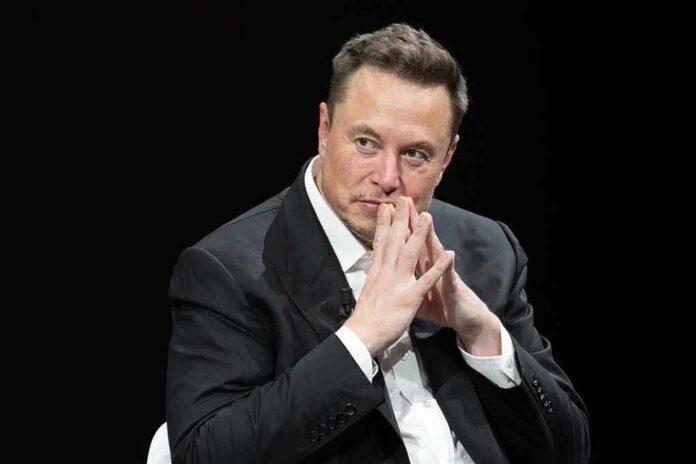
Elon Musk says a Mars colony could save humanity from pandemics and rogue artificial intelligence, even as his own company just delayed the Mars mission to focus on the Moon instead.
Quick Take
- Musk claims a self-sustaining Mars settlement would act as “life insurance” for humanity against war, disease, and AI threats.
- SpaceX announced in February 2026 that it is pushing back Mars plans by five to seven years to prioritize lunar missions.
- Scientists say Musk’s timelines keep shifting and question whether Mars could ever truly become self-sufficient.
- SpaceX pay deals tie Musk’s compensation to hitting Mars settlement goals, raising questions about motive.
A Backup Plan for Civilization
Elon Musk has spent years arguing that Mars offers something the Moon cannot: distance. He told an audience at SXSW that a Martian settlement is more likely to survive a global conflict than a Moon base, because “we must ensure that a portion of human civilization exists elsewhere to help rebuild” if disaster strikes Earth. Musk has repeated this basic argument in interviews and speeches for nearly a decade.
The idea goes beyond simply visiting Mars. Musk wants full self-sufficiency, meaning a colony that grows its own food, builds its own tools, and survives without help from Earth. He has described plans to ship plants and animals aboard SpaceX’s Starship rocket, comparing it to Noah’s Ark, so early settlers could build greenhouses and start producing food on Mars soon after landing.
The Case Scientists Say Doesn’t Add Up
Outside experts push back hard on this vision. Scientists interviewed by Business Insider say Mars lacks enough carbon dioxide to hold a breathable atmosphere and has no magnetic core to protect it, meaning any atmosphere humans built could simply blow away over time. Critics also note nobody knows if humans can safely have children in Mars’s weak gravity, a basic requirement for any settlement meant to outlast its first generation.
A separate critique published by Unherd makes a sharper point: even a million-person Mars outpost could not survive a full collapse of civilization back on Earth, because it would still depend on supply runs, spare parts, and expertise from home. Musk himself has acknowledged the danger involved, telling CNN in 2021 that “a bunch of people probably will die” during early Mars missions and that “you might not come back alive”.
Timelines That Keep Moving
Musk’s own predictions have shifted so many times that they undercut the confidence behind his claims. In 2016, he said a self-sufficient Mars society could take 40 to 100 years to build. By 2024, he told SpaceX employees a million people could live there in roughly 20 years. Then in February 2026, SpaceX confirmed it was delaying Mars work by five to seven years to build a lunar base first, a move one report says could threaten Musk’s broader Mars ambitions altogether.
That pivot toward the Moon marks a real, measurable change in strategy, not just talk. Reporting on the shift describes it as “postponing” Mars plans in favor of building what’s been called a Moon city, a project that competes for the same rockets, engineers, and money Musk once promised to Mars. Supporters call it a practical detour; skeptics call it proof the original Mars promises were overstated.
Money, Power, and Public Trust
Financial incentives add another layer of complexity to Musk’s Mars rhetoric. Reporting shows SpaceX has tied part of Musk’s compensation package to hitting a Mars settlement milestone of at least one million residents, a detail that invites questions about whether the redundancy argument doubles as a pitch to boost his own payout and SpaceX’s valuation. Legal scholars have also pushed back on the notion that Mars offers a clean escape from Earth’s rules, arguing the planet “is not a legal vacuum” and remains subject to international oversight even if humans settle there.
None of the research reviewed shows Mars settlement has ever protected anyone from a real pandemic, cyberattack, or AI failure, because no such settlement currently exists. The redundancy argument remains a forecast, not a demonstrated outcome. Whether Mars ever becomes humanity’s backup plan, or stays a delayed promise competing with a Moon base, depends on engineering and biology questions nobody has yet answered.
Elon Musk says Mars settlement could protect humanity from deadly pandemics, rogue AI — and perhaps lead us to alien lifehttps://t.co/aFvXdhTLk0
— Insider Paper (@TheInsiderPaper) July 27, 2026
Sources:
insiderpaper.com, bbc.com, reddit.com, independent.co.uk, businessinsider.com, ndtv.com, youtube.com