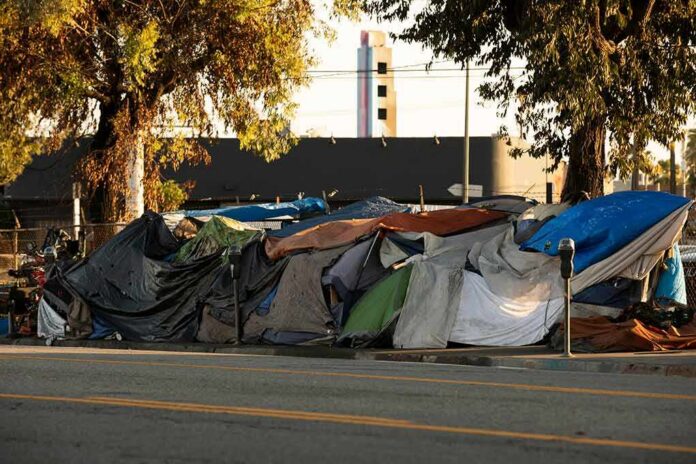
California gubernatorial candidate Steve Hilton has promised that if he wins, every homeless encampment in the state will be gone by the end of 2027.
Story Snapshot
- Hilton set Labor Day 2027 for local cleanup action and December 31, 2027, as his final statewide deadline.
- His plan pairs encampment removal with new “Homeless Recovery Centers” offering beds, treatment, and job training.
- Sunbreak Ranch in San Diego County is the test site for the proposed network of centers.
- The campaign has not released cost estimates or said how many facilities the plan would actually need.
A Hard Deadline for Homeless Camps
Hilton made his pledge at a news conference on October 17 at Sunbreak Ranch in San Diego County. “By the end of 2027, every encampment will be cleared, and Californians will have their sidewalks and parks back,” he said. The plan sets Labor Day 2027 as a checkpoint for local governments and December 31, 2027, as the hard statewide deadline for finishing the job.
Hilton had already previewed the timeline months earlier. In a July 15 post, he wrote that people struggling with addiction or mental illness would not get their lives back while living on the streets. “One way or another, this will be cleaned up by the end of 2027,” he said, adding that more than 80% of homeless people deal with addiction or mental illness, though he did not cite a specific study.
Treatment Centers Modeled on Sunbreak Ranch
The campaign calls its proposal “Off the Streets and Back on Track.” It is built around Homeless Recovery Centers that would offer beds, meals, showers, medical care, psychiatric treatment, addiction recovery programs, job training, and one-on-one help moving people into stable housing. Sunbreak Ranch, the San Diego County site where Hilton announced the plan, is being presented as the model for this statewide network.
Hilton has described the goal in simple terms: get people “off the streets, away from drugs, and into mental health care and job training.” The plan also promises continued support for people who need long-term care rather than a one-time push into a shelter bed.
Enforcement Follows Local Deadlines
Under the plan, Hilton would meet with mayors and county leaders during his first month in office to set public deadlines for clearing camps in their areas. Public-camping bans would be enforced once “suitable” facilities were available, though the campaign has not defined what counts as suitable or how placement would work for people who refuse help. If local governments fail to act, Hilton says the state would step in using state resources.
Funding Fight Over Harm Reduction
Hilton’s policy platform also calls for redirecting roughly $30 million a year in harm-reduction funding between the 2027-28 and 2029-30 budget years, money currently used for programs like needle exchanges and overdose-prevention services. That proposal sets up a direct funding clash with organizations and local health programs that rely on those dollars, separate from the encampment-clearing timeline itself.
What the Plan Leaves Unanswered
News coverage of the announcement notes that Hilton’s campaign has not said what the recovery-center network would cost or how many facilities California would need to house its unsheltered population statewide. The pledge sets dates, but the public record so far does not include a bed count, staffing plan, or construction schedule to show the deadlines are achievable.
Steve Hilton wants to criminalize homelessness. I'm guessing either he &/ or his donors have money invested in private prisons.
Just say no to MAGA Steve Hilton.California governor candidate vows to clear every homeless encampment by end of 2027 | KTLA https://t.co/3qYxZFpZwF
— psychedelicatessen (@MentalRiot) October 18, 2026
What Research Says About Encampment Sweeps
Studies of past encampment clearings offer a mixed picture. A UCLA-affiliated study of Los Angeles County found that in over half of sweeps studied, people were not connected to housing afterward, while a separate modeling study published in JAMA Network Open found that city-sanctioned sweeps led to worse health outcomes and more deaths than leaving encampments in place, unless paired with real housing offers.
The legal landscape shifted in 2024 when the Supreme Court ruled in City of Grants Pass v. Johnson that cities and states can enforce public-camping bans even without enough shelter beds for everyone affected, reversing an earlier appeals court standard. That ruling gives a governor like Hilton more legal room to enforce the camping bans his plan depends on, though it does not resolve questions about capacity or cost.
Sources:
nypost.com, cbs8.com, ktla.com, hannity.com, uscannenbergmedia.com, lifezette.com, yahoo.com, ph.ucla.edu, vivo.weill.cornell.edu