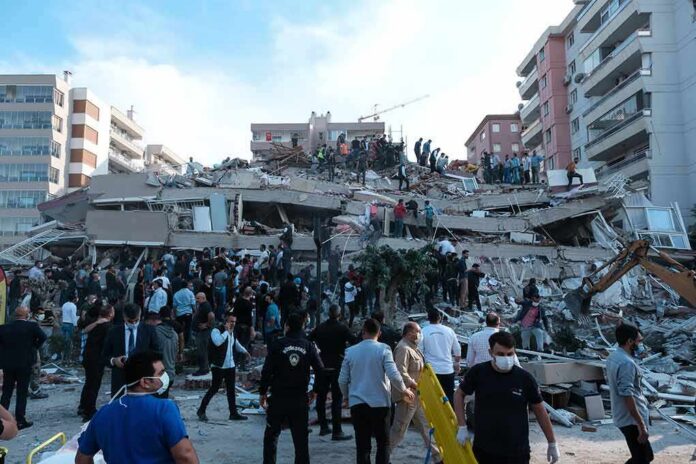
Residents in western Colombia searched through rubble after a 7.4-magnitude earthquake killed at least 111 people and flattened buildings across several cities.
Quick Take
- The quake hit near San José del Palmar in Colombia’s Chocó region.
- Officials reported at least 111 deaths, plus many injuries and collapsed buildings.
- People evacuated homes and offices in Colombia and neighboring Ecuador.
- Airport suspensions showed the quake disrupted key infrastructure fast.
What the Earthquake Did
A powerful earthquake struck western Colombia on Monday morning, with early reports placing the epicenter near San José del Palmar in Chocó. The quake measured 7.4 and shook a broad area that included Cali, Pereira, Quibdó, Manizales, and Bogotá. Reports said people rushed outside as buildings swayed, and rescue teams began pulling apart damaged structures while the death toll climbed through the day.
Colombian officials said the quake caused hundreds of buildings to be damaged and dozens to collapse. The Washington Post reported at least 111 dead, while The Guardian said the toll passed 110 as search and rescue work continued. That range shows how fast the picture changed in the first hours, but the core facts were not in dispute: this was a major and deadly quake with widespread structural damage.
Damage Across Major Cities
Local reporting pointed to heavy damage in several urban centers. The Guardian said collapsed buildings and damaged hospitals were reported in cities across the west, and BBC reporting described collapses in Cali, where the mayor said about 25 structures had fallen. Other coverage said residents were trapped under debris in multiple places, showing that the impact was not limited to one town or one department.
Officials also reported injuries and serious damage in Quibdó, the capital of Chocó. The quake’s depth and wide reach helped explain why it was felt far from the epicenter, including in Bogotá and across the border in Ecuador. Even where buildings did not fall, the shaking prompted evacuations and left many families waiting for word on homes, roads, and public services.
Why the Early Count Kept Changing
The early casualty count moved sharply as rescue crews reached more places and local officials updated records. That kind of shift is common after a major earthquake, especially when roads, communications, and hospital reporting are all strained at once. In this case, the United Nations said limited rural connectivity made it harder to assess the full scale of damage, which helps explain why the first public numbers changed so quickly.
BREAKING : COUNTRIES THAT GOT HIT BY 7+ EARTHQUAKE SO FAR IN 2026
🇨🇴 Colombia — M7.4 — 132 killed, 570+ injured — ONGOING Rescue operation
🇻🇪 Venezuela — M7.5 & M7.2 — 5,546 killed, 16,700+ injured
🇵🇭 Philippines — M7.8 — 55 killed, 1,120 injured, 38 missing
🇲🇽 Mexico —… pic.twitter.com/zonC1Jb1SP
— World Updates (@Updatesofwworld) August 11, 2026
The broader concern goes beyond one disaster. When early reports come through fragments of video, social posts, and fast-moving wire updates, the public can see a blurred version of events before the facts settle. That can feed confusion, rumor, and distrust at a time when families need clear information about dead, injured, missing, and displaced people. The quake in Colombia showed how fast a natural disaster can become an information crisis too.
Sources:
youtube.com, cnn.com, abc11.com, bbc.com, tmz.com, news.un.org, yahoo.com