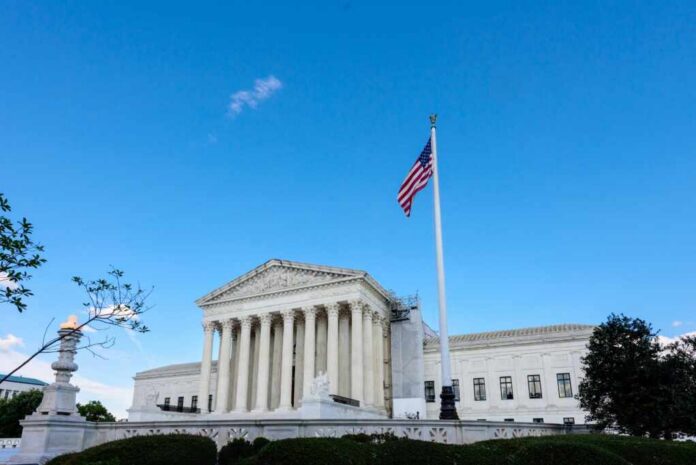
A single Supreme Court retirement rumor could become the kind of late-cycle political shock that rewires the 2026 Senate battlefield overnight.
Quick Take
- Republicans hold a narrow 52–48 Senate edge, and the 2026 map forces Democrats to play defense in several Trump-won states.
- A speculative “October Surprise” scenario centers on whether Justice Samuel Alito (76) might announce retirement in fall 2026—something not confirmed as of April 20.
- GOP strategists believe a high-stakes Supreme Court vacancy fight could energize conservative turnout, echoing the 2018 Kavanaugh confirmation dynamics.
- Neutral election handicapping points to structural Republican advantages in 2026 even without a late surprise.
Why the Alito “October Surprise” Theory Has Traction
Senate control in 2026 may turn less on a single policy debate than on whether voters view Washington as a functioning republic or an endless ideological brawl. A PJMedia report—citing The Hill—described private Republican hopes that Justice Samuel Alito could retire in fall 2026, creating a Supreme Court vacancy just as campaigns peak. As of April 20, no retirement announcement existed, making this a theory—not a confirmed plan.
Because the Supreme Court remains a cultural and constitutional flashpoint after Dobbs, a vacancy could immediately nationalize Senate races. That matters in an environment where many Americans—right and left—already suspect “elite” institutions operate to protect themselves. The key fact, though, is uncertainty: there is no public signal from Alito that he intends to leave, and no evidence of coordination with Senate Republicans beyond reported chatter.
The 2026 Senate Map Still Favors the GOP—Even Without a Surprise
The broader context is the calendar and the math. The 2026 midterm is set for November 3, and Republicans enter the cycle with a three-seat majority. The seat distribution gives Democrats fewer easy pick-up opportunities because they must defend seats in politically competitive territory while also trying to flip enough races to overcome the GOP edge. In practical terms, the map can be a stronger force than any headline.
Public election tracking underscores that structural advantage. Sabato’s Crystal Ball has described the 2026 Senate landscape as favorable to Republicans, reflecting how many Democratic seats sit in states that have recently been competitive or leaned right at the presidential level. That doesn’t mean outcomes are preordained—candidate quality and the national mood still matter—but it does mean Democrats may need near-perfect execution, especially if the campaign becomes a referendum on judges and courts.
What a Court Vacancy Would Do to Turnout and Messaging
A Supreme Court vacancy late in the cycle would likely reshape turnout incentives for both parties, but not equally in every state. Republicans see judicial fights as a base unifier, pointing to 2018 when the Kavanaugh confirmation battle coincided with GOP Senate gains even as the House flipped. Democrats, by contrast, often try to leverage court politics to mobilize college-educated and suburban voters, particularly on abortion and institutional trust.
The open question is how the post-Dobbs environment changes those incentives. The PJMedia framing suggests Democrats could overreact in a way that alienates swing voters, but that is an interpretation—not a proven forecast. What is more defensible is the basic mechanism: a nomination fight compresses attention, dominates news cycles, and forces every Senate candidate—especially in battleground states—to answer for national party messaging rather than local concerns like prices, crime, or border security.
Michigan, Georgia, and the High-Stakes Reality of “Nationalized” Elections
Two states illustrate why Republicans are even discussing an “October Surprise” concept: Michigan and Georgia. Democrats face heightened vulnerability in Trump-won states, including an open Michigan seat after Sen. Gary Peters’ retirement and the contest involving Sen. Jon Ossoff in Georgia. In close states, late-cycle enthusiasm and issue salience can decide marginal voters—or simply decide who shows up.
For conservatives frustrated with spending, inflation, and border dysfunction, a Supreme Court fight can also serve as a proxy for a larger argument: whether constitutional limits still matter. For liberals anxious about abortion and the Court, the same fight can become a rallying cry about rights and “democracy.” Either way, it tends to push campaigns toward national tribal warfare—exactly the dynamic that fuels the shared public suspicion that government is run for insiders rather than working families.
Bottom Line: It’s Speculation—But the Incentives Are Real
The most important factual constraint is also the simplest: no Alito retirement has been announced, and the “October Surprise” scenario remains speculative. Still, the incentives behind the chatter are clear. With narrow margins, parties look for turnout jolts, and Supreme Court vacancies are among the few events that can instantly dominate the agenda. In a system many voters already view as broken, that kind of spectacle can be politically decisive.
Democrats Fear THIS ‘October Surprise’ Will Cost Them the Senate in 2026 — and for Good Reasonhttps://t.co/5oVr6Yoeyq
— PJ Media (@PJMedia_com) April 20, 2026
If the retirement never materializes, Republicans may still benefit from the underlying map and from Democrats having to defend more exposed seats. If it does materialize, the Senate could become less about traditional campaigning and more about a referendum on judicial philosophy and institutional power. Either path reinforces a hard truth about modern Washington: high-stakes confirmations have become a stand-in for policy-making, because Congress struggles to govern on basics Americans can feel.
Sources:
Democrats Fear THIS ‘October Surprise’ Will Cost Them the Senate in 2026 — and for Good Reason