
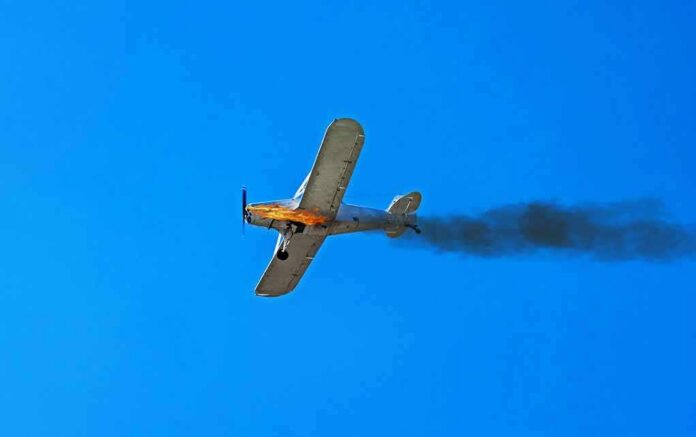
Doorbell video captured a Beechcraft A36 dropping short of Bowman Field and slamming into a neighborhood street, sending both people aboard to the hospital.
Story Snapshot
- Officials say the plane was trying to land on Runway 6 at Bowman Field but came down off airport property.
- The crash happened around 2:45 p.m. in the 2300 block of Emerson Avenue; no homes were struck.
- Two occupants were hospitalized; one had life-threatening injuries and one had serious injuries.
- Early reports point to a loss of engine power during approach; the cause is not yet final.
What Happened Near Bowman Field
Louisville officials reported that a Beechcraft A36 Bonanza crashed about half a mile short of Bowman Field’s Runway 6 on Tuesday afternoon. The aircraft came to rest off airport property on Emerson Avenue, a residential street between Bardstown and Taylorsville roads. The crash occurred at about 2:45 p.m., drawing a large response from fire and police units. A Louisville Regional Airport Authority spokesperson said the plane was attempting to land when it fell short of the runway.
The Louisville Fire Department said the crash did not strike houses, and there were no reported injuries on the ground. Two people aboard the plane were taken to local hospitals. Fire officials and local outlets reported one person in life-threatening condition and the other with serious injuries. Reporters on scene shared images of the bent airframe resting near trees and across the residential roadway as neighbors looked on from porches and sidewalks.
Plane, People, and Immediate Condition
Airport officials identified the airplane as a Beechcraft A36 Bonanza, a single-engine, six-seat model often used for personal and business travel. Aviation records list the registration as N3236G and show two occupants aboard during the flight. The owner is recorded as Avan LLC in public databases. Local stations repeated that both occupants survived the crash and were transported for care, with one listed as critical on Tuesday evening.
Responders quickly secured the scene and checked for fuel leaks or fire risk. Neighbors said they heard a loud impact and ran outside to help. Crews inspected nearby homes and yards, and they blocked traffic as investigators arrived. Louisville fire officials later confirmed that no structures were hit. The airplane appeared to have contacted trees near the roadway before stopping on Emerson Avenue, consistent with the short-of-runway landing attempt reported by authorities.
Early Indicators and What Comes Next
Multiple outlets quoted officials and records describing an apparent loss of engine power during approach, which lines up with how the aircraft descended short of Runway 6. An aviation incident database also recorded “loss of engine power during approach” in its entry for the crash. Federal investigators typically take weeks to release a preliminary report with basic facts and months to determine a probable cause, so any specific failure mode remains unconfirmed for now.
Doorbell camera footage captures the dramatic moment a small plane clipped trees and crashed onto a residential street in Louisville after losing engine power while approaching Bowman Field. According to reports, the pilot steered clear of nearby houses, leaving no one on the… pic.twitter.com/3umPpSFSCt
— The Express Tribune (@etribune) November 25, 2026
The crash highlights a broader aviation safety reality that affects communities near older airports like Bowman Field. General aviation, which includes small personal aircraft, accounts for most civil aviation accidents in the United States. In a past review year, general aviation represented 96 percent of civil aviation accidents, and most personal-flying accidents involved single-engine piston airplanes like the A36. Those base rates explain why approach and landing near neighborhoods draw special concern.
Why Neighborhood Streets Sit Under Approach Paths
Federal guidance urges airports and cities to keep homes and public gathering places out of the most exposed zones beyond runway ends. These areas, called Runway Protection Zones, exist to reduce risks to people on the ground. Many older airfields grew up next to neighborhoods long before today’s standards. That history leaves tight margins between backyards and approach paths, which makes every power loss on final approach a community event as well as a pilot emergency.
What Families Near Airports Should Know
City leaders and airport managers can review land use, tree heights, and emergency access routes near runway ends. They can also share clear guidance with residents about how to report hazards and what to do when they hear or see an aircraft in distress. For pilots, training for engine-out approaches and choosing landing spots with the least risk to people on the ground remain core safety steps. These layers together lower risk without shutting down daily life near airports.
Sources:
k105.com, whas11.com, rmb.reuters.com, wbko.com, wlky.com, militarycompatibility.maryland.gov, faa.gov