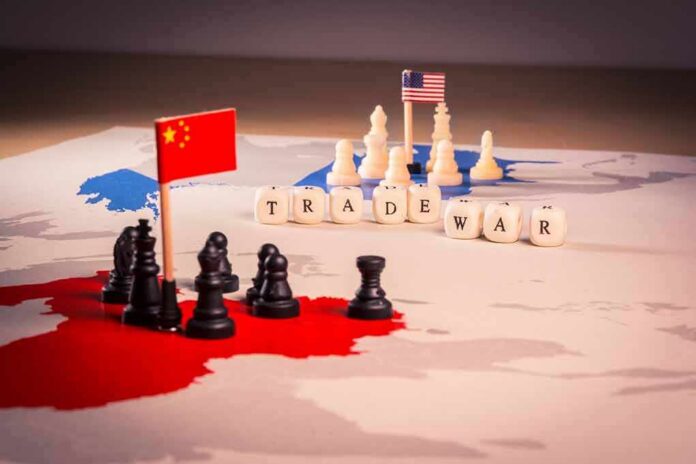
China publicly warned Washington that new U.S. tariffs would hurt both countries and urged talks instead of escalation.
Story Snapshot
- China called for “equality, respect and mutual benefit” as the U.S. weighed new tariffs.
- Reports said the Trump administration prepared tariffs covering China and other major partners.
- Beijing said tariff and trade wars “are not in anyone’s interest”.
- Details on final tariff rates and timing were still unsettled in reporting.
China’s Warning and Call for Stable Trade Ties
China’s Foreign Ministry spokesperson Guo Jiakun urged the United States on November 25 to solve trade issues through consultation. Guo said talks should be based on equality, respect, and mutual benefit, and that both sides should support the stable growth of trade. Guo added that tariff wars and trade wars do not help anyone. The comments answered media reports that the United States planned new tariffs affecting China and other economies.
Guo’s message echoed earlier Chinese statements that stress dialogue and stability. The tone aimed to lower tensions as headlines pointed to a coming U.S. move. Beijing’s focus stayed on process, not a point-by-point response to U.S. claims about subsidies or excess capacity. The statement did not lay out numbers or potential countersteps. It framed escalation as a shared risk, while leaving China’s options open if tariffs move ahead.
U.S. Plans Under Review and What They Target
News outlets reported that the Trump administration was preparing new tariffs tied to a broad trade inquiry. Reports said the measures could reach beyond China to the European Union, Japan, South Korea, and other partners. The effort was linked to concerns about heavy state support, excess factory output, and damage to global markets. Reuters described a live process and an expected announcement tied to the inquiry led by U.S. trade officials.
The Associated Press also reported that the administration was readying tariffs covering multiple partners in response to subsidized production. Coverage stressed that rates and product lists were still being set, and that the final package could shift before release. This means the risk of tariffs was real, but the exact hit to prices, supply chains, and jobs remained uncertain at the time of China’s appeal.
Why Both Sides Say They Are Defending Fairness
U.S.–China trade fights often follow a set pattern. Washington cites unfair practices, like subsidies and forced tech transfer. Beijing denies the charges and urges talks to avoid harm to both economies. During the 2018–2019 trade war, the United States set tariffs on roughly $350 billion of Chinese imports, and China answered with tariffs on about $100 billion of U.S. exports. The new warning from China fits that familiar pre-escalation script.
Research on past tariff rounds shows costs do not fall cleanly on one side. A broad review found that U.S. importers and consumers paid much of the added costs, and real income fell in both countries. The losses were modest when compared with the whole economy, but they were real for many families and firms. That history explains why both sides now stress fairness while trying to avoid open-ended escalation that spreads pain.
What It Could Mean for American Households and Firms
New tariffs can raise prices on goods that many Americans buy, from tools to electronics. They can also hit small manufacturers that rely on parts from abroad. Big firms can switch suppliers more easily than small shops can. Past rounds showed that the burden often lands down the chain, where margins are thin and choices are few. That risk connects to public frustration with high costs and supply shocks in recent years.
If China responds with its own tariffs, U.S. farmers and exporters could face fewer sales overseas. That happened in prior rounds, when China raised duties on American goods and rerouted purchases. Retaliation can also slow investment, as companies wait for clarity. Both right and left worry that these policy swings reward insiders who can lobby for carve-outs, while regular workers and small businesses shoulder the shock.
The Politics: Tough Talk, Real Tradeoffs
President Trump and Congress hold strong tools on tariffs, and leaders say they aim to fix unfair trade. Supporters argue that pressure is needed to curb subsidies and excess capacity. Critics fear higher prices and more market angst. China’s call for talks spotlights a choice: push hard now and risk a hit at home, or seek targeted deals that protect key sectors. Reports made clear an announcement was expected, but final details were still in motion.
Sources:
insiderpaper.com, straitstimes.com, nampa.org, edition.cnn.com, ecb.europa.eu