
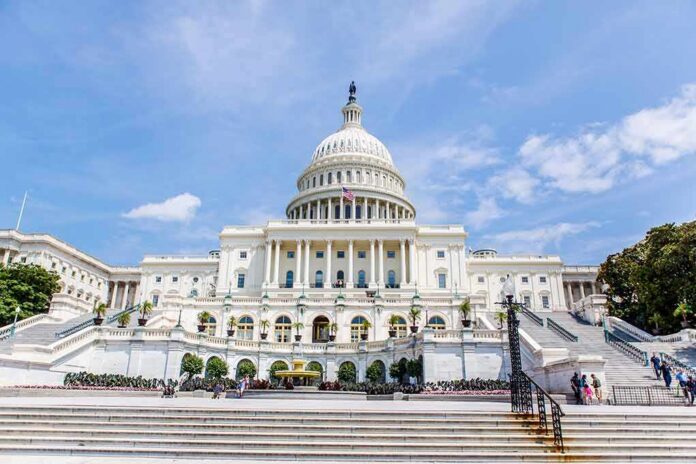
Democrats have flipped both chambers of Congress, ending Republican control just two years into President Trump’s second term.
Quick Take
- Democrats hit the 218 seats needed to win the House, flipping a chamber Republicans held 219-214 before the election.
- Democrats also won the Senate, picking up seats in red-leaning states like Texas, Kansas, South Carolina and Iowa.
- House Speaker Mike Johnson admitted Republicans lost their House majority.
- The exact size of the new Democratic majority is still not final, and Republicans can still block big Senate bills.
- President Trump stays in office, so Washington now has divided government again.
Democrats Clinch the House Majority
Democrats reached the 218 seats needed to take the House, according to live results reported by the New York Times. The outlet’s count was still being updated as of November 4, 2026, and the final size of the Democratic majority remained unknown. Republicans had entered Election Day holding 219 seats to Democrats’ 214, with two vacancies, according to CBS News. The flip erases a narrow Republican edge built just two years earlier.
The shift hands Democrats the gavel on committees, control over the legislative calendar, and subpoena power over the Trump administration. It also means Democrats can shape which bills get a vote and which investigations move forward, a major change from the current Republican-run chamber.
Senate Flips Add to the Wave
Democrats did not stop at the House. The Associated Press reported Democratic Senate wins in Texas, Kansas, South Carolina, North Carolina, Ohio and Iowa, including Josh Turek’s victory over Republican incumbent Ashley Hinson in Iowa. USA Today confirmed the same pattern, reporting that Democrats captured both chambers of Congress on the strength of these flips. Several of those states have leaned Republican for years, making the wins notable.
Before the election, the Senate stood at 53 Republicans to 47 Democrats, according to NBC News affiliate reporting. Winning seats in states like Kansas and Texas suggests the swing reached beyond traditional battlegrounds. NBC News reported that the combined House and Senate wins mean Democrats will hold full control of Congress starting in January.
Republican Leaders Concede the Loss
House Speaker Mike Johnson acknowledged that Republicans had lost control of the House to Democrats, according to Politico. A sitting Speaker conceding a chamber loss on the record underscores how clear the outcome was on election night, even as some individual races were still being finalized. The acknowledgment came as counting continued in a handful of competitive districts.
A Familiar Midterm Pattern
The results fit a pattern seen for decades. From 1934 through 2014, the president’s party lost an average of 27 House seats and four Senate seats in midterm elections, according to data compiled by the American Presidency Project. Since 2000, House control has changed hands four times and Senate control seven times, according to the Council on Foreign Relations. Midterm swings have often tracked closely with how the president’s party performed in the prior presidential race.
What Full Control Actually Means
Winning both chambers does not hand Democrats unlimited power. The New York Times noted that Republicans can still block major legislation from the Senate minority, since most bills need 60 votes to overcome a filibuster. President Trump remains in the White House, meaning any Democratic bill still needs his signature or enough votes to override a veto. That reality points to two years of divided government and likely gridlock on major legislation.
Democrats picked up a Republican Senate seat in North Carolina and are gaining ground in Florida House races, signalling they could wrestle control of Congress from Trump's party in the midterms. #World #T24News pic.twitter.com/eteHa73Gfj
— T24 Network (@T24_Network) November 4, 2026
Voters on both sides have spent years frustrated with a federal government many see as more focused on reelection than results. This split outcome, a Democratic Congress facing a Republican president, guarantees more fights over spending, judicial nominees and oversight investigations. Whether that produces real solutions or more stalemate will likely shape how both parties frame the 2028 election.
Sources:
youtube.com, nbcwashington.com, theeagleswire.usatoday.com, cbsnews.com, nbclosangeles.com, nbcphiladelphia.com, politico.com, pix11.com, presidency.ucsb.edu, cardinalscholar.bsu.edu