
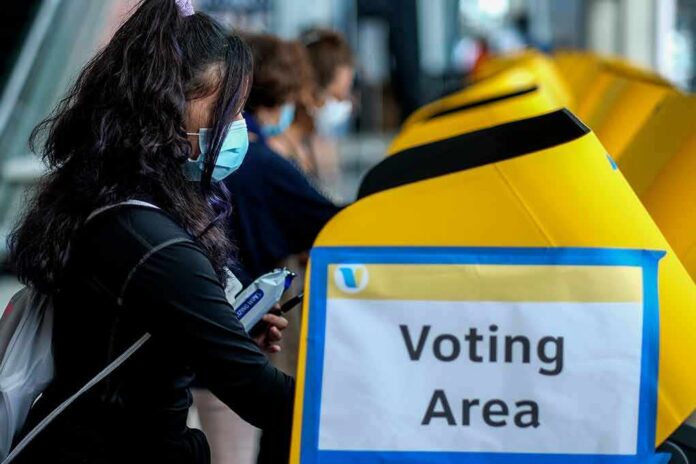
A record wave of early ballots is rewriting turnout assumptions in key states, raising real risk that 2026 polls are modeling the wrong electorate.
Story Snapshot
- Early voting is sharply higher in several states, challenging old turnout baselines.
- Ohio’s rules hide party identity, making partisan early-vote reads uncertain.
- Some polling shows tight races within error margins, underscoring volatility.
- Experts say big early totals do not prove who benefits or final turnout.
Early Voting Surges Are Large Enough To Test Polling Assumptions
Associated Press reporting showed early voting climbed fast in several states. Texas rose about 74 percent from 2022. Ohio, North Carolina, and Maine each ran more than 30 percent above the same point that year. A separate report said more than 41 million people had already voted early nationwide, with Georgia topping 2 million, and Ohio passing 1 million. When so many ballots arrive before Election Day, small mistakes in who pollsters expect to vote can swing forecasts.
Pollsters try to model who will vote, not just who picks up the phone. If the mix of voters changes late, models built on older patterns struggle. That is why these early-vote spikes matter. They do not prove a winner. They do force a hard question: are likely-voter screens tuned to the 2026 electorate, or to a past one? When millions vote early, even a modest miss on age, region, or enthusiasm can tilt a close race.
Why Ohio Is A Blind Spot For Partisan Early-Vote Reads
Ohio does not register voters by party. The New York Times reported that statewide comparisons are difficult and that county absentee data were not standardized until 2023. Not all counties report results by vote method. That means outside observers cannot verify if the early surge leans right or left. This gap invites spin and fuels distrust. Voters on both sides already believe the “system” hides key facts. Ohio’s data rules make it harder to check claims in real time.
Campaigns fill that vacuum with stories that fit their goals. Republicans emphasize that “midterms really come down to turnout,” placing focus on who shows up rather than persuasion. One cited survey even showed a 47 percent to 47 percent tie within a plus or minus 5.2 point margin of error. Those facts support a turnout-first view. But without party tags on ballots, no one can say early votes favor one side. In this environment, confidence outpaces proof until votes are counted.
What The Polls Capture—and What They Miss
Many polls now blend voter-file history with stated intent to build likely-voter screens. The New York Times and Siena approach uses both prior voting and current intention. NBC News explains that likely voters are registered voters who signal they will vote, checked against past behavior. After 2016, pollsters also improved weighting methods to fix sample gaps, according to Reuters and Forbes. These methods help. They still depend on turnout assumptions that can shift late.
Large early-vote totals do not guarantee higher final turnout. Experts warn that many early voters would have voted on Election Day anyway. That is called timing substitution. Reports citing the University of Florida Election Lab stressed that early counts track participation, not winners. In states with party registration, early voters have sometimes leaned Democratic in the data this cycle. But Ohio’s rules block a clean read. The lesson is simple: measure what you can, and label what you cannot.
How To Read The Signals Without Getting Spun
Treat early-vote surges as a real constraint on polling, not a verdict. Early ballots in Texas, Georgia, and Ohio mean the electorate may look different from recent midterms. If that is true, likely-voter screens that rely on past midterm behavior could misfire. At the same time, polls that mix voter history and intent have improved since 2016, and several show very close races within error bands. Both statements can be true. That tension is the core story.
For citizens who feel the system serves insiders first, this is another case where rules and data gaps keep the public in the dark. Ohio’s missing party labels and uneven county files limit outside checks. Media framing can also race ahead of facts, tagging early votes as “good news” for one side before counts settle. The safest read skirts hype: high early voting raises the stakes of turnout modeling, but it does not tell us which party will gain when the last ballot is tallied.
Sources:
pjmedia.com, kmbc.com, apnews.com, whio.com, newsnationnow.com, english.elpais.com, spectrumlocalnews.com, theatlantic.com, palmbeachpost.com, pewresearch.org