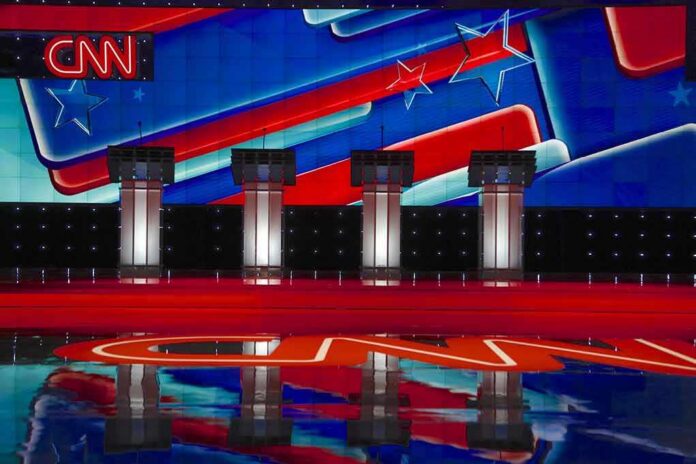
A Maine senator’s heckler and a candidate’s “shut up” turned a single debate moment into campaign ammunition, showing why more and more candidates are skipping debates altogether.
Story Snapshot
- In a Maine Senate debate, Democrat Troy Jackson told incumbent Senator Susan Collins to “shut up,” and the clip quickly became a Republican attack ad.
- More than half of this year’s Senate races and about a third of governor’s races happened without any debate between the top candidates.
- Strategists from both parties say debates rarely help a campaign but can badly hurt one when a bad moment goes viral.
- Research on past debates shows they barely move the needle on who voters pick, even though they can teach people about where candidates stand.
A Single Outburst Becomes Campaign Ammunition
On October 15, 2026, a protester interrupted Senator Susan Collins during a Maine Senate debate. Democratic nominee Troy Jackson responded by telling Collins to “shut up.” CBS News reported that clip did not stay inside the debate hall. It was cut up and slotted straight into a Republican attack ad within days.
The moment had nothing to do with policy. It was not even aimed at a question from the moderator. But it outlived the debate itself, reshaped by paid advertising for an audience that never watched the exchange live. That pattern is becoming the rule, not the exception, in how campaigns treat debate footage this cycle.
Why Strategists Call Debates a Bad Bet
Republican strategist Terry Sullivan put the math bluntly to CBS News. “Ninety-five percent of what happens in debates does not matter,” he said. “You’re banking on not making the 5% mistake and trying to force the other guy to make the 5% mistake”. Democratic strategist Chuck Rocha offered a similar warning: debates rarely win a race, but they can absolutely lose one.
That thinking shows up in the numbers. Eighteen of 35 Senate races and 12 of 36 governor’s races this cycle had no debate at all between the major-party candidates, according to CBS News. Campaigns increasingly see the format as pure downside, a stage where one slip can outweigh an hour of substance.
Viral Moments Overshadow Policy Talk
CBS News found that the debates that did happen were often remembered for “mudslinging and character assaults that wound up viral online,” citing flashpoints in Maine, Michigan, and Alaska. A Maryland debate produced a similar clip, with Republican Representative Andy Harris scolding the crowd during a question about a Trump-era diesel deal. A Michigan debate between Abdul El-Sayed and Mike Rogers also went viral after a sharp exchange over the Muslim Brotherhood. These moments spread fast because they are short, emotional, and easy to share, while policy answers rarely get the same attention.
What the Research Actually Shows
Academic research complicates the claim that debates are purely risky. A Harvard Business School summary found that televised debates generally do not shift vote shares or decide elections. A separate study of 56 debates across 31 elections in seven countries estimated the average effect on vote choice at no higher than 0.7%, with persuasion maxing out around 3%. On its face, that supports the idea that debates offer little upside for candidates chasing votes.
But other research pushes back on the idea that debates are worthless. The National Democratic Institute points to experimental evidence that debates help voters learn where candidates actually stand on issues. Studies of the 2016 presidential debates found viewers who watched and followed coverage afterward knew more about the candidates’ positions than people who tuned out. In Sierra Leone, lawmakers who debated later spent more on their districts and met with constituents more often than those who skipped the forums.
A Format Under Strain From a Faster Media Cycle
Debates once served two jobs at once: teaching voters about the candidates and giving campaigns a platform to make their case. Today’s nonstop clipping and reposting pulls those jobs apart. A single sentence can be stripped from its context, turned into an ad, and judged by people who never saw the full exchange. That shift rewards caution over candor, and it helps explain why so many campaigns this cycle chose silence over the stage.
How political debates became high-risk and low-reward in the viral era. https://t.co/GqwAbYJTDY
— CBS News (@CBSNews) October 29, 2026
None of this proves debates are useless to voters. It shows candidates and their consultants increasingly believe the personal risk outweighs the public benefit, a calculation that leaves voters with fewer chances to see candidates face each other directly before Election Day.
Sources:
cbsnews.com, niskanencenter.org