When the United States fires a Hellfire missile into a commercial tanker’s engine room in international waters to enforce a blockade, it raises the question of whether Washington is protecting security or normalizing undeclared economic warfare.
Story Snapshot
- The United States says the Botswana-flagged tanker M/T Lexie ignored 24 hours of warnings before it was disabled by a Hellfire missile near Iran.
- The strike is part of President Trump’s wider naval blockade aimed at pressuring Tehran during faltering peace talks.
- Critics argue this looks less like routine sanctions enforcement and more like coercive blockade tactics that stretch international law.
- The episode feeds a broader fear that unelected security bureaucracies decide war-and-peace steps with little transparency or accountability.
What exactly happened to the tanker near Iran?
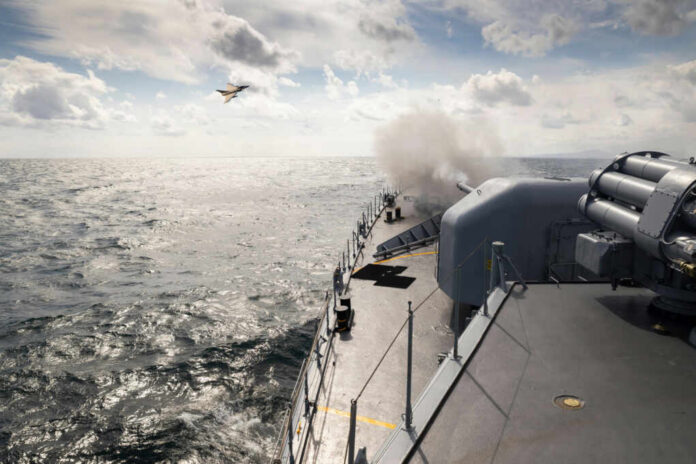
United States Central Command reported that on June 2 American forces intercepted the Botswana-flagged tanker M/T Lexie as it transited international waters toward Kharg Island, one of Iran’s main oil export terminals.[1] According to Central Command, the crew ignored repeated directions from United States forces “multiple times over a 24-hour period,” refusing to alter course or halt under blockade instructions.[1][4] A United States aircraft then fired a Hellfire missile into the ship’s engine room, disabling the vessel and preventing it from reaching Iranian waters.[1][3][4] Military officials said the tanker was unladen and not carrying oil at the time.[1]
Marine industry reporting based on the Central Command release describes the Lexie as stateless or Iran-linked and says this was the sixth commercial vessel disabled by American forces since the blockade around Iran began.[3][4] Video released by Central Command and carried in news segments shows a precision strike into the machinery space, with the ship left drifting near the Strait of Hormuz.[3][5] Central Command has not publicly released the underlying radio logs or bridge-to-bridge audio that would show the exact sequence of warnings and the crew’s responses.[3][4]
How is Washington justifying the use of a missile on a commercial ship?
United States officials frame the action as **blockade enforcement**, not a battlefield attack. Central Command’s public statement says the Lexie was intercepted under a “United States-enforced maritime blockade” and labels the vessel “non-compliant” after it allegedly ignored repeated lawful instructions.[1][4] Coverage citing United States military sources ties the strike directly to President Trump’s broader effort to pressure Tehran back to negotiations on American terms, using control of oil shipping lanes as leverage.[2][4][5] Officials emphasize that the missile strike targeted the engine room specifically to disable propulsion rather than to sink the ship or cause mass casualties.[1][3][4]
From a legal perspective, however, neither Central Command’s written release nor the media reports explicitly identify the precise domestic or international authority invoked to fire on a foreign-flagged commercial ship in international waters.[3][4] The public record so far does not specify whether the administration is treating this as an extension of sanctions enforcement, an exercise of wartime rights under a formal armed conflict with Iran, or some hybrid blockade authority.[3][4] That ambiguity fuels concern for both conservatives and liberals who see a pattern of major security decisions being made and justified after the fact, with ordinary citizens and even many members of Congress left guessing about the rules being applied.
Why does this incident worry Americans across the political spectrum?
For many conservatives, the Lexie strike fits a long-running fear that the national security state is drifting into permanent, undeclared conflict that risks American lives and tax dollars without clear objectives or constitutional accountability. The fact that a United States aircraft used a precision anti-armor missile originally designed for battlefield targets to disable a commercial ship underlines how far military tools have migrated into gray-zone economic warfare.[3][4][6] Those already angered by decades of costly overseas interventions and ballooning federal debt see another episode that expands commitments while Congress remains largely sidelined.
US strikes Qeshm Island military ground station. Iran retaliates, missiles at Kuwait airport & Bahrain, claims hitting US 5th Fleet HQ in Bahrain.
CENTCOM claimed that Iranian strikes failed or were intercepted, and US Hellfire also disabled an Iranian 7th oil tanker. pic.twitter.com/KrMHhIST1z— Digital Debate (@digdebate) June 3, 2026
For many liberals, the same strike reinforces concerns about international law, civilian safety, and the precedent of using force to police global energy flows. The tanker was reported to be unladen and sailing through international waters when it was disabled, raising questions about proportionality and the rights of neutral or third-country shipping caught between Washington and Tehran.[1][3] Critics note that the public has not seen the communications that allegedly went unanswered over 24 hours, so the gap between official narrative and verifiable evidence remains large.[3][4] In a climate where trust in federal institutions is already low, that opacity deepens suspicion that powerful actors operate by one set of rules while everyone else is expected to simply accept their word.
How does this fit into the larger pattern of blockades and “economic war” by sea?
The Lexie incident is part of a broader shift in which the United States increasingly uses maritime interdictions to enforce sanctions and pursue geopolitical goals, blurring the line between law enforcement and blockade. Analysts evaluating earlier seizures of Venezuelan oil cargoes noted that Washington framed such actions as legitimate sanctions enforcement while also using them as a “new lever” in a pressure campaign, showing how economic and strategic motives stack together. The current United States blockade affecting Iran-linked shipping echoes that pattern: shipping companies, crews, and energy markets experience the immediate risk, while the strategic logic remains concentrated in a small circle of political leaders and security officials.
Ordinary Americans watching this episode see familiar themes. A distant clash between governments turns into direct pressure on global energy flows, with potential knock-on effects for fuel prices at home. Complex legal theories are asserted but rarely explained in plain language, and citizens are asked to trust defense statements without seeing primary evidence such as warning logs or investigation reports. Whether one leans right or left, the feeling is that decisions with enormous consequences for peace, prosperity, and the rule of law are being made in closed rooms by elites who will never personally bear the costs if things spiral out of control.
Sources:
[1] YouTube – US fires Hellfire missile at tanker heading toward Iran
[2] Web – U.S. Disables an Iran-Linked Tanker With a Hellfire Missile
[3] Web – US Hellfire Missile Fired At Iranian Tanker – Marine Link
[4] YouTube – US fires missile at tanker heading to Iran
[5] Web – CENTCOM Disables Non-Compliant Vessel in Arabian Gulf
[6] YouTube – U.S. military fires HELLFIRE MISSILE into tanker’s engine room to …