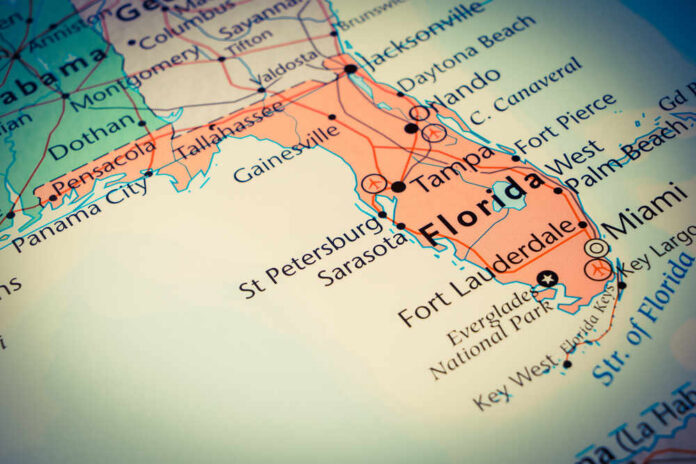
Florida’s latest redistricting push has triggered a familiar Washington cycle: politicians treating your vote like a chess piece while they taunt each other on national TV.
Quick Take
- Florida lawmakers opened a special session to consider new congressional maps that could create up to four additional Republican-leaning seats.
- California Gov. Gavin Newsom mocked President Donald Trump and Florida Gov. Ron DeSantis, claiming aggressive GOP mapmaking can backfire by putting incumbents at risk.
- Newsom has used Trump-style all-caps messaging and public videos to frame a blue-state “counterpunch,” including warnings that California would “neutralize” red-state gains.
- The fight underscores a bipartisan frustration: elections are increasingly shaped by map lines and court battles instead of persuasion and policy.
Florida’s Special Session Puts House Control Politics Front and Center
Florida lawmakers began a special session Tuesday to review proposed congressional maps that, according to reporting on the effort, could produce up to four more Republican-leaning districts by stretching Democratic-leaning areas into surrounding GOP territory. The immediate goal is straightforward: strengthen the state’s contribution to the House majority. The broader context is more corrosive, because it reinforces a public perception that both parties prioritize structural advantage over accountability to local communities.
Gov. Gavin Newsom seized on Florida’s process as a chance to needle President Trump and Gov. Ron DeSantis, telling Fox News Digital that Trump “got beat at his own game” and predicting “collateral damage” for Republicans if the lines get drawn too thin. Newsom’s argument is tactical, not moral: maximize the advantage too aggressively and you may end up endangering incumbents when political winds shift or when litigation forces revisions.
Newsom’s Taunts Highlight a Hard Truth About Modern Redistricting
Newsom’s comments landed because they speak to what many voters already suspect—redistricting has become a nationalized power struggle rather than a routine state responsibility. After the 2020 Census, Republicans controlled many state legislatures and pursued maps favorable to the GOP, helping shape House math for years. The new wrinkle is the push for mid-decade redistricting in some places, a move that can be legal but inflames distrust when it looks like rules are changing midstream.
Axios reported that Newsom has leaned into open political theater, with his press office mimicking Trump’s all-caps social style while touting California’s own map strategy. In other words, Democrats are not merely complaining about gerrymandering; they are signaling retaliation. That approach may energize partisan bases, but it also validates a wider, cross-ideological grievance: when leaders treat elections as a procedural game, everyday concerns—prices, energy reliability, public safety, border enforcement—often get relegated behind the next tactical maneuver.
The Texas-Florida-California Triangle Shows How Interstate Politics Is Replacing Local Representation
The dispute is not confined to Florida. Reporting on the broader battle shows Trump pressing Texas Gov. Greg Abbott for additional GOP seats through redistricting, with talk of aiming for as many as five. Newsom responded with a video warning Trump to “stand down” and promising California would “neutralize” whatever Texas does. That language illustrates how governors now posture like national party generals, using their state’s map power as leverage in a larger war over Congress.
This escalation matters for conservatives and moderates who want limited government and clearer accountability. Redistricting battles tend to centralize power in party leadership, political consultants, and legal teams, not neighborhoods. When districts are engineered for safety, primaries become the real contest, and candidates often feel pressure to appeal to the loudest activists rather than the broad middle. The report does not include independent academic analysis, but the political incentives described is align with what many voters observe: less competition can mean less responsiveness.
What We Know—and What We Don’t—As Florida’s Maps Move Forward
At this stage, the biggest uncertainty is outcome. Florida’s proposals were under deliberation as the special session began, and the ultimate lines could change through legislative negotiation or court review. Newsom argues Republicans risk self-inflicted losses if they overreach, but that prediction is not a confirmed result—just a strategic warning based on how narrow margins can flip. The only firm fact is that both sides are preparing for a prolonged “saga” of map fights.
Newsom taunts Trump with multiple jabs as Florida redistricting fight ramps up: 'Beat at his own game' https://t.co/xLGNDTQUPX
— ConservativeLibrarian (@ConserLibrarian) April 27, 2026
For citizens already convinced the federal government is failing them, the optics are brutal: leaders trading insults while the rules of representation get rewritten to suit whichever coalition currently holds power. Conservatives will view this as another example of politics drifting away from first principles like equal representation and transparent governance. Liberals will argue the stakes justify aggressive countermeasures. Either way, the episode reinforces a shared suspicion that the system is designed to protect political careers first, and voters second.
Sources:
Newsom social media Trump redistricting