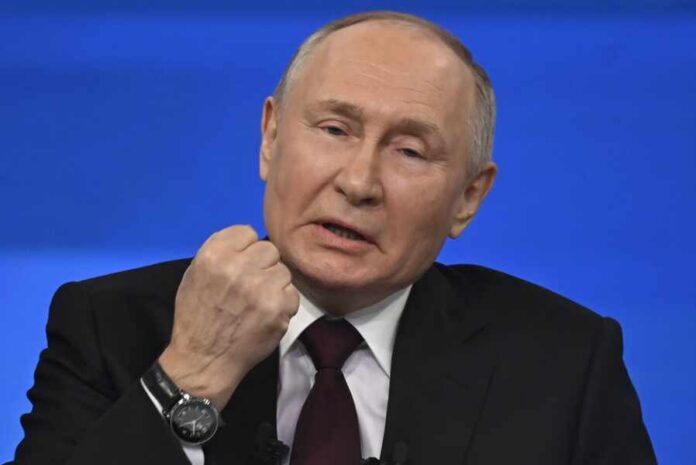
Putin is openly reminding Europe that energy dependence is still a weapon—just as EU leaders prepare new Russian gas restrictions and the Iran war squeezes global supply.
Quick Take
- Vladimir Putin warned on Russian state TV that Moscow could halt gas shipments to Europe if EU restrictions take effect this spring.
- EU measures are expected to start around late April 2026, with additional tightening aimed toward a possible broader ban by 2027.
- Europe has diversified since 2022, but rising prices and the storage refill season make the continent sensitive to new shocks.
- The Iran conflict has disrupted energy flows, including reported impacts tied to Qatar’s LNG, pushing European benchmark gas prices sharply higher.
- So far, there is no confirmed immediate cutoff—this is a conditional threat tied to future EU policy.
Putin’s warning targets Europe’s remaining energy exposure
Vladimir Putin used a state television appearance, reported March 4–5, to suggest Russia might stop supplying gas to Europe if the European Union moves ahead with new restrictions on Russian gas. He framed the idea as a practical response to “unreliable” partners and said it could be “significantly more beneficial” to halt shipments and redirect volumes to more promising markets. The core point was leverage: sanctions would carry consequences.
EU policy timing matters because the first stage of planned curbs is expected to begin in late April 2026, with further restrictions discussed for 2027. That calendar creates a narrow window where traders, utilities, and governments must weigh whether Russia could act before formal bans arrive. Current reporting does not confirm Russia has cut additional flows yet, meaning the immediate impact is psychological and price-driven rather than a verified supply shutdown.
Europe is better prepared than 2022, but not immune to price shocks
Europe’s vulnerability looks different than it did in 2022, when Russian pipeline gas was a dominant supply source and prices surged dramatically. Since then, the EU reduced Russian imports sharply and built new LNG import capacity while leaning more heavily on the United States, Norway, and other suppliers. Even with that diversification, Europe still faces exposure through price: global LNG competition sets the marginal cost, and geopolitics can move that cost fast.
Market numbers in early March showed how quickly fear spreads. European benchmark gas prices rose from about €31.9/MWh on Feb. 28 to roughly €54.3/MWh by March 3, a jump associated with the widening Middle East conflict and disruption risks around LNG. Europe also entered a seasonal period when countries refill storage for the next winter. Higher prices during refill season can flow into household bills and industrial costs, even without physical shortages.
Iran war disruptions tighten LNG markets and amplify Russia’s leverage
Energy analysts have focused on the Iran conflict because it pressures the global LNG system that Europe increasingly depends on. Reporting highlighted disruptions tied to Qatar, a major LNG player in global trade and a supplier to Europe, as well as broader risks to shipping routes and regional infrastructure. When LNG tightens, Europe must often outbid Asian buyers for cargoes, making “diversification” feel expensive and politically painful.
That dynamic can indirectly benefit Russia even if European leaders insist they are “better prepared” than in the past. Higher global prices can lift revenues for major exporters, while European consumers and manufacturers absorb the cost. Experts quoted in European reporting described the recent move as sharper than normal but still less extreme than 2022, with the biggest variable being how long the conflict lasts and whether shipping chokepoints face sustained disruption.
What’s verified—and what remains uncertain—about a potential cutoff
Putin floated halting supplies if EU restrictions proceed, rather than announcing an immediate cutoff. The key uncertainty is timing and follow-through, because the most widely cited reports do not pin down the exact date of Putin’s remarks beyond early March coverage, and they do not show a confirmed new shutdown. That distinction matters for credibility and for policy response planning.
For conservatives watching from the U.S., the broader lesson is familiar: energy security is national security, and global instability quickly turns into inflation pressure. Europe’s attempt to sanction its way out of dependence faces the reality of tight global LNG markets and wartime disruption. Meanwhile, Americans should note how rapidly overseas shocks can ricochet through allied economies—especially when governments have limited flexibility and expensive “transition” mandates.
It makes it hard to quantify how much Russian gas still reaches Europe today compared to pre-2022 levels, or to specify which EU legal instruments will govern the April restrictions. What is clear is the trajectory: EU policymakers are planning new constraints, Moscow is signaling it can retaliate, and the Iran war is pushing prices higher at the worst time of year for European storage economics. Consumers, not bureaucrats, usually pay first.
Sources:
Iran war revives spectre of energy crisis in Europe fuelling economic anxiety (Euronews)
Oil and gas stocks as Iran-Israel-US tensions move markets (The Telegraph)