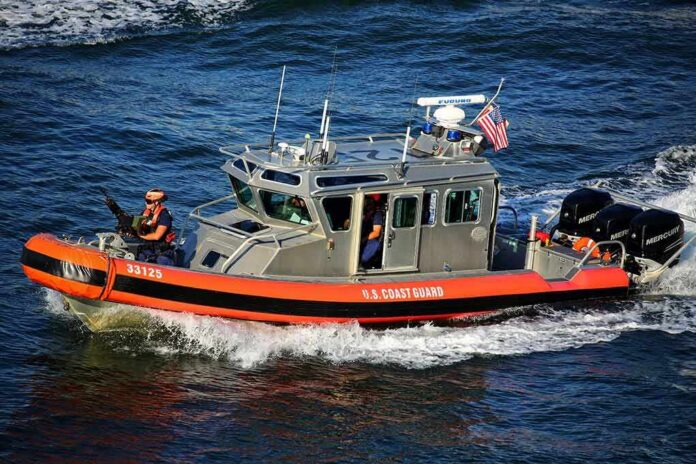
A 15-year-old Alaska boy was found alive clinging to a capsized skiff in the Bering Sea after days adrift, while his brother and cousin were found dead.
Story Snapshot
- Coast Guard aircrew spotted the teen on the overturned skiff near St. Lawrence Island.
- A nearby fishing vessel, the Northwest Explorer, pulled him from the water after gear was dropped to help.
- The boy showed signs of hypothermia; two relatives were recovered deceased.
- The 18-foot fishing skiff left Savoonga on Friday and never returned as planned Sunday.
Rescue Sequence Near St. Lawrence Island
United States Coast Guard crews launched a search when a small fishing skiff from Savoonga, on St. Lawrence Island, failed to return as planned. On Monday around midafternoon, a Coast Guard HC-130 Hercules plane spotted a survivor holding onto the 18-foot boat’s overturned hull. The crew dropped a life raft and survival gear to mark and support the scene. The motor vessel Northwest Explorer then reached the site and recovered the boy alive from the capsized craft.
Officials said the survivor was 15 years old and showed symptoms of hypothermia when rescued. The Coast Guard coordinated medical care after recovery. Crews also recovered the bodies of two other people who had been on the skiff. Early reports identified them as the boy’s brother and cousin, though authorities did not immediately release names in public statements. The search area sits in the Bering Sea, where conditions are cold, remote, and often dangerous for small boats.
From Weekend Trip To Days Adrift
Reports say the group left Friday on an 18-foot fishing skiff and was expected back early Sunday but did not return. Family members and local contacts helped officials identify the last known location, which guided the search plan. The precise time of the capsize and total hours adrift are not yet fixed in one public timeline, and some outlets differed by a day in describing duration. The Coast Guard’s operational focus remained on locating the skiff and recovering all aboard.
In cold seas near St. Lawrence Island, survival often depends on staying with the boat and reducing exposure. Cold water can sap strength fast, and even trained mariners struggle to last long in near-freezing conditions. Historical rescue studies from Alaska waters show that minutes matter, and those who reach rafts or remain with a floating hull have a far better chance. The teen’s decision or ability to remain on the overturned skiff likely helped save his life.
Why This Rescue Stands Out
This rescue highlights how distance, weather, and sparse infrastructure shape outcomes in Alaska. Search aircraft may fly hundreds of miles, and surface vessels can take hours to reach survivors. That gap makes partnerships vital. In this case, the Coast Guard aircrew found the boy and dropped gear, while a nearby commercial vessel performed the hands-on recovery. That shared response mirrors earlier Alaska cases where fast coordination turned a likely tragedy into a life saved.
Rescuers found a 15-year-old who had gone missing on a fishing trip with two others, sitting on top of a capsized boat in the Bering Strait between Alaska and Russia.
— Riyaz Khan (@RiyazKh53010786) September 11, 2026
The loss of two family members underscores the harsh math of cold-water exposure. Scientific references on the Bering Sea note that exhaustion and unconsciousness can come within minutes in very cold water, and total survival time is often short without flotation or shelter. The teen’s survival is a rare victory in a setting where many families wait longer for answers because of distance and weather. Communities across Alaska know these risks and often join searches to speed results.
Sources:
independent.co.uk, apnews.com, theguardian.com, adn.com, cbc.ca, youtube.com, apps.dtic.mil