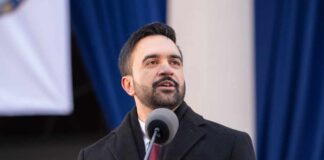
A Florida GOP frontrunner just floated a permanent federal ban on Muslim immigration—raising a hard question for conservatives: how do you defend national security without letting courts and Washington redefine the Constitution in the process?
Story Snapshot
- Florida gubernatorial candidate Paul Renner called for a “permanent and comprehensive” federal ban on Muslim immigration during a campaign news conference.
- Renner argued Islam is incompatible with American law and the U.S. Constitution, and paired the proposal with denaturalization and deportation policies for specific offenses.
- He also urged defunding schools he says promote Sharia concepts, expanding state-style restrictions on foreign law in courts, and pursuing FTO designations for the Muslim Brotherhood and CAIR.
- Gov. Ron DeSantis previously attempted an executive-order approach to FTO designations, but a federal judge blocked it on First Amendment grounds.
Renner’s proposal: a federal immigration ban framed as a constitutional firewall
Paul Renner, a former Florida House Speaker now running for governor in 2026, used a Tuesday news conference to call for what he described as a permanent federal ban on Muslim immigration. Renner said the “long-term compatibility” of Islam with America “does not exist,” tying his pitch to constitutional and cultural concerns rather than a narrower, country-based security screen. The move places immigration—mostly a federal power—at the center of Florida’s GOP primary fight.
Renner’s plan did not stop at entry restrictions. He also advocated denaturalizing and deporting people he says have terrorist ties, have committed serious crimes, or have engaged in taxpayer fraud. In addition, he called for ending public funding for schools that “promote” Sharia concepts and for keeping foreign legal principles—including Sharia—out of American courtrooms. Those elements reflect a broader strategy: using both immigration controls and domestic policy levers to limit foreign ideological influence.
DeSantis precedent shows the legal wall conservatives keep hitting
Florida already provides a political template Renner is trying to expand. Renner pointed to state-level efforts to prevent foreign law from influencing court decisions, and he referenced Gov. Ron DeSantis’ earlier attempt to designate the Muslim Brotherhood and CAIR as Foreign Terrorist Organizations. That DeSantis executive order was blocked by a federal judge on First Amendment grounds, underscoring a recurring reality: even popular “tough-on-extremism” steps can collapse in court if they are written too broadly or target protected speech.
That court intervention matters for conservative voters who want security but are also wary of government overreach. When judges strike down executive actions, the fight often shifts from “what’s safest” to “what survives constitutional scrutiny,” especially under the First Amendment and equal-protection principles. Renner’s push for a religiously defined immigration ban would almost certainly face the same problem—regardless of intent—because U.S. law typically requires the government to justify distinctions without turning faith into a legal category.
Security arguments are central—yet the available evidence in the reporting is narrow
Renner and supportive coverage tied his proposal to post‑9/11 concerns and to more recent extremist-linked incidents, including a shooting example involving Mohamed Bailor Jalloh, described as an ISIS supporter and former Army National Guard member. This is framed as part of a “recurring pattern” of violence. Still, no broader statistics or a comprehensive threat assessment comparing vetting systems, overstay rates, or radicalization pathways, leaving readers with examples rather than a full evidentiary case.
Primary politics: Florida’s 2026 race collides with national immigration authority
Renner launched his gubernatorial bid in summer 2025, entering a crowded Florida contest with DeSantis term-limited and President Trump backing Rep. Byron Donalds. That context helps explain why Renner picked an issue that signals toughness and identity—immigration, national security, and cultural integration—even though governors cannot unilaterally impose federal immigration bans. Renner’s proposal functions as a message to Washington: he wants Congress and the White House to adopt a hardline national policy.
The immediate effect is likely intraparty debate rather than immediate policy change. Renner has not introduced legislation because he cannot, and no federal bill is tied to his announcement. The longer-term impact depends on whether national Republicans treat his idea as a campaign talking point, a negotiating position, or a serious template for federal action. Given recent court pushback to similar state initiatives, any durable approach would likely require narrowly tailored measures built to withstand constitutional challenges.
For conservatives burned out on endless foreign interventions and frustrated by Washington’s habit of expanding power in the name of “safety,” the key question is not only whether Renner’s approach would reduce risk, but whether it would invite new constitutional precedents that later get used against other freedoms. It shows Renner framing the issue as defending American law and culture; it also shows courts can—and do—block measures that sweep too broadly. Voters will have to weigh security goals against constitutional durability and the risk of empowering federal authorities in ways that outlast today’s politics.
Sources:
https://floridapolitics.com/archives/786745-renner-islam-sharia-muslim/