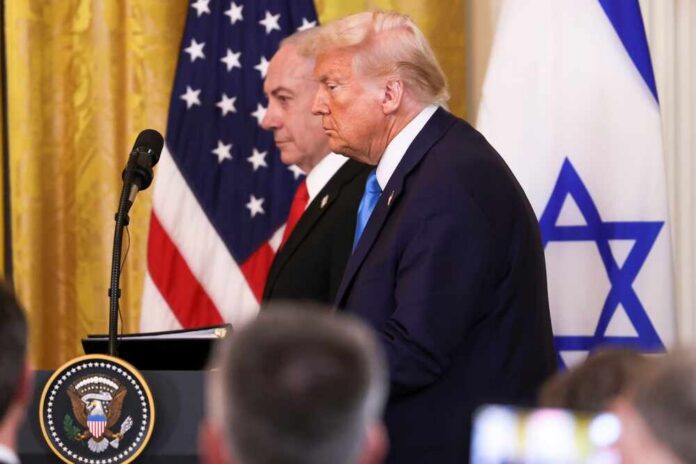
Trump’s second-term Iran war has turned a core MAGA promise—no new endless conflicts—into a live test of whether America can defend its interests without getting locked into another open-ended Middle East fight.
Quick Take
- The “divorce Israel” slogan circulating online is a political prescription, not a verified plan tied to any specific original op-ed or official policy.
- The conflict traces back to decades of Iran–Israel hostility, with Iran backing proxy groups and pursuing missile and nuclear capabilities that Israel views as existential threats.
- Major escalations include Israel’s June 2025 strikes on Iranian sites, U.S. strikes on key nuclear facilities, and reported U.S.-Israel operations in early 2026.
- Trump faces a base-level split: voters angry about globalism and inflation are now also furious about energy costs and another war, even as many still want Iran’s nuclear ambitions stopped.
Why “Divorce Israel” Is Trending—And What the Research Actually Shows
Online arguments claiming Trump must “divorce” Israel to end the Iran war are framed as an isolationist critique of the U.S.-Israel alliance, but the underlying research does not identify a single original article with that exact title or a verified, actionable policy blueprint.
Trump’s political bind is real. The research describes mixed public signals about intervention alongside a consistent stated concern about Iran’s nuclear program. That combination—anti-war instincts colliding with a perceived strategic necessity—helps explain why MAGA voters who backed Trump for border enforcement, inflation relief, and anti-woke governance are now openly questioning how a second term became another Middle East war.
The Conflict Didn’t Start in 2025: Proxies, Missiles, and the Nuclear Question
The Iran–Israel conflict predates the current war by decades, emerging after Iran’s 1979 revolution and hardening as Tehran supported armed proxies such as Hezbollah while rejecting Israel’s legitimacy. The research also highlights how proxy attacks and regional flare-ups intensified after the 2023 Gaza war, with exchanges becoming more direct by 2024. In this framing, “divorce Israel” narratives omit core drivers: Iran’s regional proxy strategy and nuclear trajectory.
That history matters for conservatives trying to sort propaganda from policy. If Iran’s proxies and weapons programs are central causes, then a simplistic break with Israel would not automatically end hostility or remove threats to U.S. forces, shipping lanes, or energy markets. At the same time, the research acknowledges uncertainty and contradictory claims around damage assessments and war status, underscoring why Americans are wary of official messaging that sounds like past conflicts.
Key Turning Points: 2025 Strikes, U.S. Bombing Runs, and 2026 Escalation
The timeline centers on Israel striking Iranian nuclear and missile sites starting June 13, 2025, followed by Iranian retaliation and U.S. strikes on major nuclear facilities during the June 14–21 window. Later updates point to heightened U.S. posture in late 2025, including a deployed armada, and renewed diplomacy efforts in early 2026 that did not resolve the crisis. No formal declaration of war is cited.
By late February 2026, the research references “Operation Epic Fury,” described as U.S.-Israel strikes in Tehran targeting leadership and IRGC-linked sites, with reported deaths and disruption. Those reports may be politically explosive at home because they move beyond “deterrence” into actions many voters associate with regime-change logic. The material provided does not fully verify outcomes after those strikes, so firm conclusions about end-states or off-ramps remain limited.
The Domestic Fault Line: Pro-Israel Tradition vs. Anti–Endless War Reality
For decades, many conservatives supported Israel as a strategic ally and moral partner against terrorism and authoritarianism. The research still supports that Israel’s deep-strike capability has depended on U.S. support in key moments, while Iran has used proxy forces as “forward defense.” But the same research also points to Trump’s base strains: energy price spikes, shipping disruptions, and the fear that “temporary” missions become permanent deployments.
To End the Iran War, Trump Must Divorce Israel https://t.co/36DuD7pSUY
— Anarchy Travel (@anarchytravel) March 27, 2026
Constitutional concerns also shape the backlash. When U.S. military action expands without clear, transparent objectives, voters naturally ask who authorized what, for how long, and at what cost—especially after years of anger about federal overreach at home.
Sources:
The road to the Israel-Iran war
What happened during the 2025 Israel-Iran war? A timeline
Iran-Israel conflict timeline: history