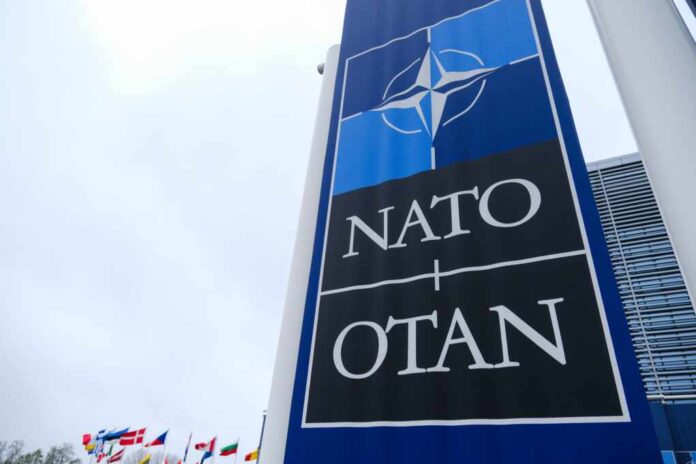
Donald Trump’s sweeping use of tariffs has driven European allies to accelerate economic and security independence, raising doubts about NATO’s cohesion and U.S. global leadership.
At a Glance
- European governments warn U.S. tariffs threaten alliance stability
- NATO members explore alternative defense procurement options
- Germany and France push for stronger EU-led security measures
- Trade disputes fuel rising skepticism about American reliability
Tariffs Strain Europe
The imposition of tariffs on European goods has sparked frustration across the continent, particularly in Germany and France, where leaders argue that U.S. actions undermine both economic stability and security cooperation. Trump’s unilateral approach has shifted perceptions of the alliance from partnership to pressure, driving Brussels to seek greater autonomy in decision-making.
European officials now warn that Washington’s tariff-first strategy weakens NATO solidarity at a critical time. Disagreements over defense spending, once secondary to shared security priorities, have become entangled with trade disputes, leaving the alliance fractured.
Read more: Allies, in jab at Trump, threaten not to buy F-35s
https://www.politico.com/news/2025/08/13/trump-tariffs-allies-f-35-00508201
Shifting Defense Priorities
Tariff tensions have pushed European governments to consider procurement alternatives outside the United States. Some NATO members are openly debating whether to scale back reliance on American defense technology, including the flagship F-35 fighter program.
Germany and France, leading advocates of European strategic autonomy, are pushing for stronger EU-centered security frameworks. This includes new investments in indigenous defense capabilities and broader cooperation with non-U.S. suppliers. Analysts warn such moves, while gradual, signal a deeper break from the postwar model of transatlantic dependence.
Declining Influence
Washington’s use of tariffs as leverage has diminished its ability to build consensus within NATO. Smaller member states, traditionally reliant on U.S. backing, are increasingly weighing the risks of dependence on a partner viewed as unpredictable. Eastern European countries, though still wary of Russian aggression, have expressed quiet concern that tariff-driven policies erode the collective defense guarantees central to NATO.
This erosion of trust is compounded by broader shifts in global alignment. European officials have expanded trade ties with Asia and Africa in an effort to reduce exposure to U.S. economic volatility, a move that further dilutes Washington’s influence within its closest alliance.
Long-Term Consequences
Analysts caution that the damage to transatlantic relations could prove lasting. Even if tariff policies are softened in the future, allies may continue to view Washington as a volatile partner, undermining U.S. efforts to rebuild credibility. NATO’s future cohesion, once considered a given, now faces uncertainty as economic disputes drive deeper divisions.
In this new environment, the United States risks losing its role as the unquestioned anchor of European security. Without trust, deterrence weakens, and the alliance may gradually shift toward a more multipolar balance—one less reliant on Washington’s leadership.
Sources