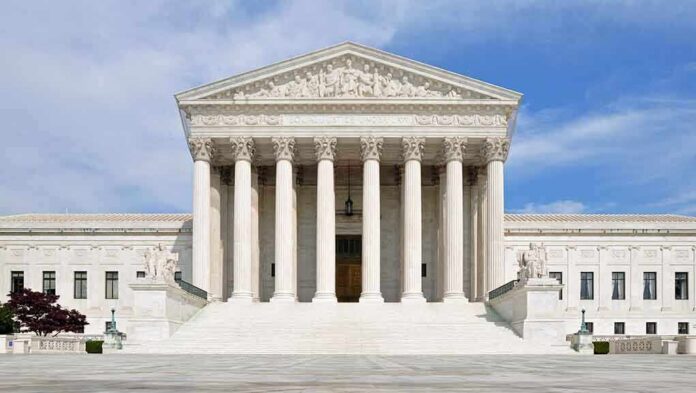
The Supreme Court’s first big case of its new term will decide whether local communities can use state law to hold global energy giants financially responsible for climate damage, or whether Washington and powerful interests will shut the courthouse doors instead.
Story Snapshot
- The Supreme Court will open its October sitting with a major climate and immigration docket, starting with a case over whether Boulder, Colorado can sue ExxonMobil and Suncor under state law for local climate harms.
- The Colorado Supreme Court said Boulder’s state-law claims for nuisance, trespass, unjust enrichment, and conspiracy are not blocked by federal law, but oil companies and the federal government argue only Washington can handle global emissions.
- President Trump’s administration has asked the Court to stop these climate damage suits, backing industry arguments that the Clean Air Act and the Constitution leave no room for local “lawfare” against fossil fuel companies.
- The justices added a special question about their own power to hear the case now, raising the risk that this first test of climate accountability gets tossed on procedure instead of answered on the merits.
Supreme Court Starts Term With Climate Fight Over Who Pays
When the Supreme Court returns for its October 2026 sitting, one of the first arguments will be Suncor Energy (U.S.A.) Inc. v. County Commissioners of Boulder County, a case that asks who should pay for the rising costs of fires, floods, and other climate-linked disasters. Local officials in Boulder, Colorado say ExxonMobil and Suncor made billions while hiding known climate risks and leaving communities with the bill for damaged roads, homes, and public services. The companies say federal law shields them from such state lawsuits.
The Supreme Court agreed in February 2026 to review a 5–2 ruling from the Colorado Supreme Court that let Boulder’s state-law claims move forward. Boulder sued in state court back in 2018, using familiar tort theories like public and private nuisance, trespass, unjust enrichment, and civil conspiracy to seek money damages for local climate harms. The Colorado court held that federal common law no longer controls this area because Congress passed the Clean Air Act, and that the Act itself does not wipe out every state remedy.
Oil Companies, Federal Government Push Back on State Climate Lawsuits
ExxonMobil and Suncor say Boulder’s case is really an attempt to use one state’s courts to control global greenhouse gas emissions and energy policy. In their petition, they argue that only federal law can govern interstate and international emissions, and that allowing dozens of local suits would create a patchwork of climate rules across the country. They rely on older Supreme Court cases about air pollution, claiming a “source-state” rule bars Colorado from reaching emissions or effects that cross state lines.
The federal government has stepped in on the side of the companies, a move that will get the attention of readers across the political spectrum who feel Washington protects the powerful. A Justice Department brief urges the Court to shut down state tort suits like Boulder’s, arguing that the Clean Air Act already replaced federal common-law claims and was never meant to be backfilled by creative state theories. This position fits a broader pattern where national leaders talk about climate but still defend the fossil fuel industry from large damage claims.
Jurisdiction, “Lawfare,” and What This Means Beyond Climate
The Supreme Court did something unusual when it granted review: it added its own question about whether the justices even have statutory and constitutional authority to hear the case at this stage. That jurisdiction issue could let the Court dismiss the case without ever saying if Boulder’s claims are valid, which many Americans will see as another example of the legal system bending to avoid hard accountability fights. Critics on the right call these suits “climate lawfare,” while critics on the left see the pushback as proof of a captured regulatory state.
The Supreme Court will start off its October sitting with Suncor Energy v. County Commissioners of Boulder County, a major climate case that tests what authority cities & states have to sue oil companies over climate change. https://t.co/IdwbOyRnKm
— Jordan Fischer (@JordanOnRecord) August 4, 2026
This climate case is landing at a time when many conservatives and liberals agree on one basic point: the federal government feels broken and too cozy with elites. On one side, long-time conservatives are tired of globalism, heavy spending, and energy rules that raise their power bills. On the other, older liberals see “America First” policies, immigration crackdowns, and fossil fuel expansion as deep threats to vulnerable communities. In this case, both groups can recognize a familiar pattern: regular citizens and local officials trying to address harm through their own laws, while distant lawyers in Washington argue over technical doctrines that may keep the matter from ever reaching a jury.
Immigration Disputes Also Crowd the Court’s New Term
Alongside Boulder’s climate lawsuit, the Court’s new term will also feature major immigration cases that highlight similar tensions between local impacts and federal control. States led by Republicans are pressing for broader power to enforce immigration rules and remove people they say crossed the border illegally, arguing Washington has failed to protect communities and workers. At the same time, civil rights groups challenge aggressive enforcement as harmful to families and basic freedoms, warning that some policies risk discrimination and deepen the divide between the “haves” and “have-nots.”
Together, the climate and immigration fights show why so many Americans now doubt that the system serves them. In both areas, the Court is being asked to decide how much power states and cities have to respond when they believe federal leaders are not doing their jobs. Whether the justices side with centralized control or local authority, their rulings will shape not only policy, but also public trust in a government many already see as more focused on protecting itself than on defending the American Dream.
Sources:
washingtontimes.com, scotusblog.com, bouldercounty.gov, spencerfane.com, nytimes.com, supremecourt.gov, bdlaw.com, lastmonthatthesupremecourt.com, business-humanrights.org