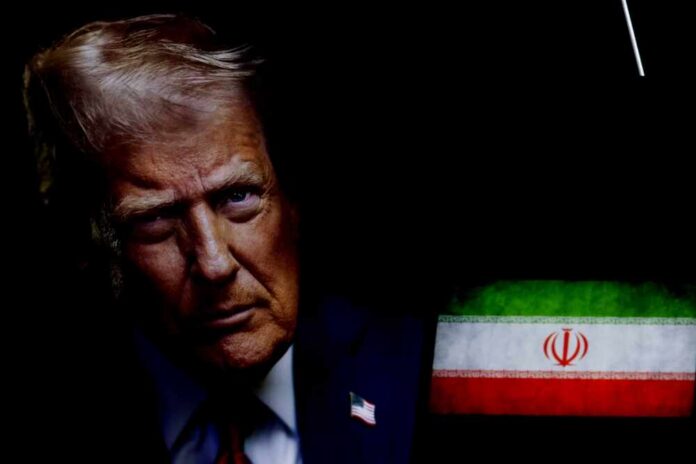
Trump is tying America’s exit from a fast-moving Iran war to reopening the Strait of Hormuz—an approach that could either end a global energy chokehold or drag the U.S. deeper into yet another Middle East fight.
At a Glance
- The U.S.-Iran conflict reached its 33rd day under “Operation Epic Fury,” with President Trump saying he will not accept a ceasefire until the Strait of Hormuz is reopened.
- Iran’s foreign minister publicly denied Trump’s claim that Tehran asked for a ceasefire, sharpening uncertainty about who is telling the truth and what diplomacy is real.
- U.S. officials say more than 11,000 targets have been struck, while Defense Secretary Pete Hegseth has indicated “all options” remain on the table, including ground forces.
- Trump has threatened additional strikes on major infrastructure such as power and desalination plants by April 6 if Hormuz is not reopened.
- Oil prices reportedly fell below $100 after Trump signaled a potential 2–3 week timeline to wind down operations, even as war aims and “regime change” claims remain contested.
Trump’s Hormuz Condition: A Deadline With Global Stakes
President Trump said any ceasefire deal is off the table until Iran reopens the Strait of Hormuz, a critical shipping lane whose disruption ripples into fuel costs and household budgets. Trump also set an April 6 pressure point, warning that Iranian infrastructure—specifically power and desalination—could be targeted if the strait remains blocked. The administration has framed Hormuz as the key lever to force compliance and to justify an exit timeline.
Trump’s posture lands hard with an American public that has little patience left for open-ended wars and the economic pain they can trigger. Conservatives who backed Trump for border enforcement, energy independence, and a calmer foreign policy are now split: some want a decisive finish, while others see “one more deadline” as the familiar gateway to mission creep. The Strait matters, but so does the constitutional expectation that war aims stay clear and limited.
Competing Narratives: Ceasefire Claims vs. Iran’s Denial
Trump claimed Iran sought a ceasefire through its “New Regime President,” but Iran’s foreign minister rejected that claim as false. The dispute matters because it changes the public’s understanding of whether Washington is negotiating from strength or improvising in public. The “New Regime” wording also created confusion about who is in charge in Tehran, with reporting pointing to Iran’s elected president while also noting unresolved claims about leadership changes.
On the U.S. side, the administration has presented the campaign as surpassing operational benchmarks, with emphasis on degrading Iran’s nuclear program, ballistic missiles, navy, and proxy networks.
Military Tempo and the “All Options” Signal
U.S. officials have described an intense air campaign that includes B-52 missions and strikes on more than 11,000 targets, alongside carrier deployments such as the George H.W. Bush. Defense Secretary Pete Hegseth has warned that the coming days could be decisive and that options remain open, including the possibility of ground forces. That language, even if meant as leverage, is exactly what triggers concern among voters who oppose sliding from strikes into occupation.
Trump has also indicated the U.S. could end operations within 2–3 weeks and later return for “spot hits,” suggesting a strategy aimed at avoiding a permanent footprint. The challenge is that Hormuz security cannot be wished away: shipping lanes require enforcement, and if the U.S. leaves without a durable arrangement, another crisis could immediately follow. The research notes an international diplomatic effort involving the UK and a broader coalition focused on reopening the strait.
Economic Pressure at Home, Humanitarian Pressure Abroad
Markets reacted to Trump’s signals of an end-state, with reporting that oil dipped below $100 and stocks rose. For American families, any stabilization is welcome after years of inflation and policy-driven energy volatility. But the same reporting also highlights the risk of escalation if infrastructure targets are hit, especially water and power systems, which can intensify civilian suffering and increase global backlash. Those second-order effects can quickly complicate U.S. objectives and exit plans.
The political pressure point is straightforward: voters who endured years of “forever war” fatigue want clarity on what victory means, what it costs, and how the administration prevents an endless cycle of strikes and retaliation. It also references threats aimed at U.S. tech companies, a reminder that modern conflict spills into domestic economic life without a single boot crossing a border. With competing narratives and incomplete verification, accountability hinges on transparent goals and a defined off-ramp.